

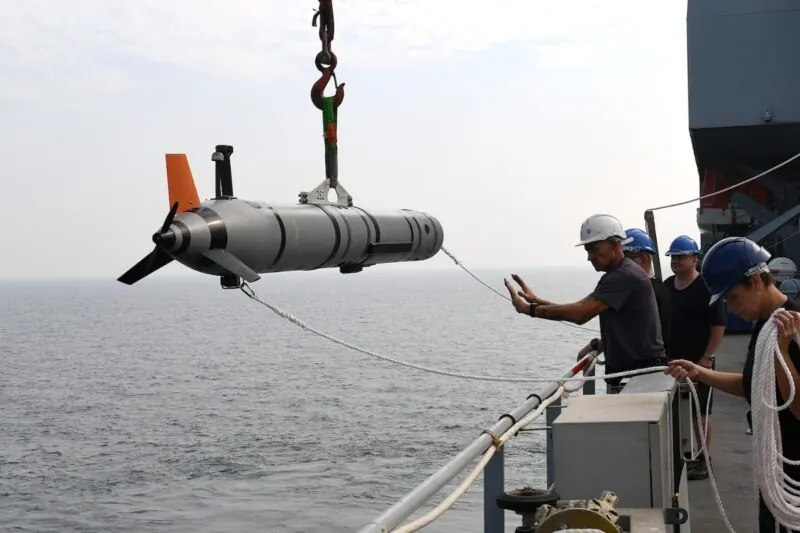
Defense Feeds, Washington — The US Navy is reinforcing its unmanned underwater warfare capability as the US Navy MK-18 drone program strengthens underwater mine warfare through a new contract awarded to Peraton. The agreement focuses on sustaining and maintaining the Navy’s MK-18 unmanned underwater vehicle fleet, ensuring the systems remain operationally ready for missions in complex maritime environments.
The MK-18 underwater drone plays a critical role in mine countermeasure operations, underwater reconnaissance and maritime security missions. As naval forces increasingly rely on autonomous systems, maintaining reliability and readiness has become a key priority. The latest contract reflects the growing importance of unmanned underwater platforms in modern naval operations.
The agreement also highlights how support and sustainment are becoming just as important as acquiring new systems. Advanced drones require continuous maintenance, software updates and technical support to remain effective. Ensuring these systems stay mission-ready is essential for long-term operational capability.
MK-18 Drones Support Underwater Mine Countermeasures
The MK-18 unmanned underwater vehicle is primarily designed for mine detection and underwater reconnaissance missions. Equipped with sonar and advanced sensors, the system can identify underwater threats while reducing the need to expose divers or crewed vessels to dangerous environments.
Mine warfare remains a major challenge for naval operations. Naval mines are relatively inexpensive yet capable of threatening major warships and disrupting maritime traffic. Detecting and clearing these threats quickly is critical for maintaining freedom of navigation.
The MK-18 allows the Navy to conduct these operations more safely and efficiently. Operating autonomously or semi-autonomously, the drone can survey large underwater areas and transmit detailed data back to operators. This significantly improves situational awareness during mine countermeasure missions.
In addition to mine detection, the system can support broader maritime surveillance tasks. Underwater drones are increasingly valuable for monitoring ports, coastal areas and critical infrastructure. Their flexibility makes them useful across a wide range of operational scenarios.

Peraton Contract Focuses on Readiness and Sustainment
The new contract awarded to Peraton centers on maintaining the operational readiness of the MK-18 fleet. Sustainment includes repairs, technical support, software maintenance and logistical assistance required to keep the systems functioning effectively. Without continuous support, even advanced unmanned systems can quickly lose operational reliability.
The focus on readiness reflects broader military concerns about maintaining capability over long-term operations. Unmanned platforms often operate in harsh environments that place heavy demands on equipment. Saltwater exposure, pressure conditions and extended deployments can affect performance over time.
Peraton’s role will help ensure that the Navy’s underwater drones remain available for deployment when needed. Reliable maintenance and technical support are especially important as unmanned systems take on more operational responsibilities. This reduces downtime and improves mission availability.
The contract also highlights the expanding role of private industry in supporting defense technology. Companies specializing in autonomous systems and sustainment services are becoming increasingly important partners in military modernization efforts.
Growing Importance of Unmanned Underwater Warfare
The MK-18 program reflects a larger shift toward unmanned and autonomous naval systems. Modern maritime operations increasingly rely on drones operating above, on and below the surface. Underwater systems, in particular, provide unique advantages in reconnaissance and mine warfare.
Autonomous underwater vehicles can operate in areas too dangerous or inaccessible for crewed platforms. They reduce risks to personnel while providing continuous monitoring and data collection. This capability is becoming more valuable as naval competition intensifies in strategic waterways.
The growing use of unmanned systems also aligns with broader naval modernization strategies. Future fleets are expected to integrate autonomous technologies into routine operations. This includes intelligence gathering, surveillance and defensive missions.
As underwater threats continue to evolve, maintaining readiness of platforms like the MK-18 will remain essential. Reliable mine countermeasure capability is critical for protecting sea lanes and supporting naval deployments. Ensuring these drones remain mission-ready directly supports broader maritime security objectives.
The US Navy’s decision to invest in sustainment for the MK-18 fleet demonstrates the increasing reliance on autonomous underwater systems. In an era where maritime operations are becoming more technologically complex, readiness and reliability are as important as innovation itself.
