

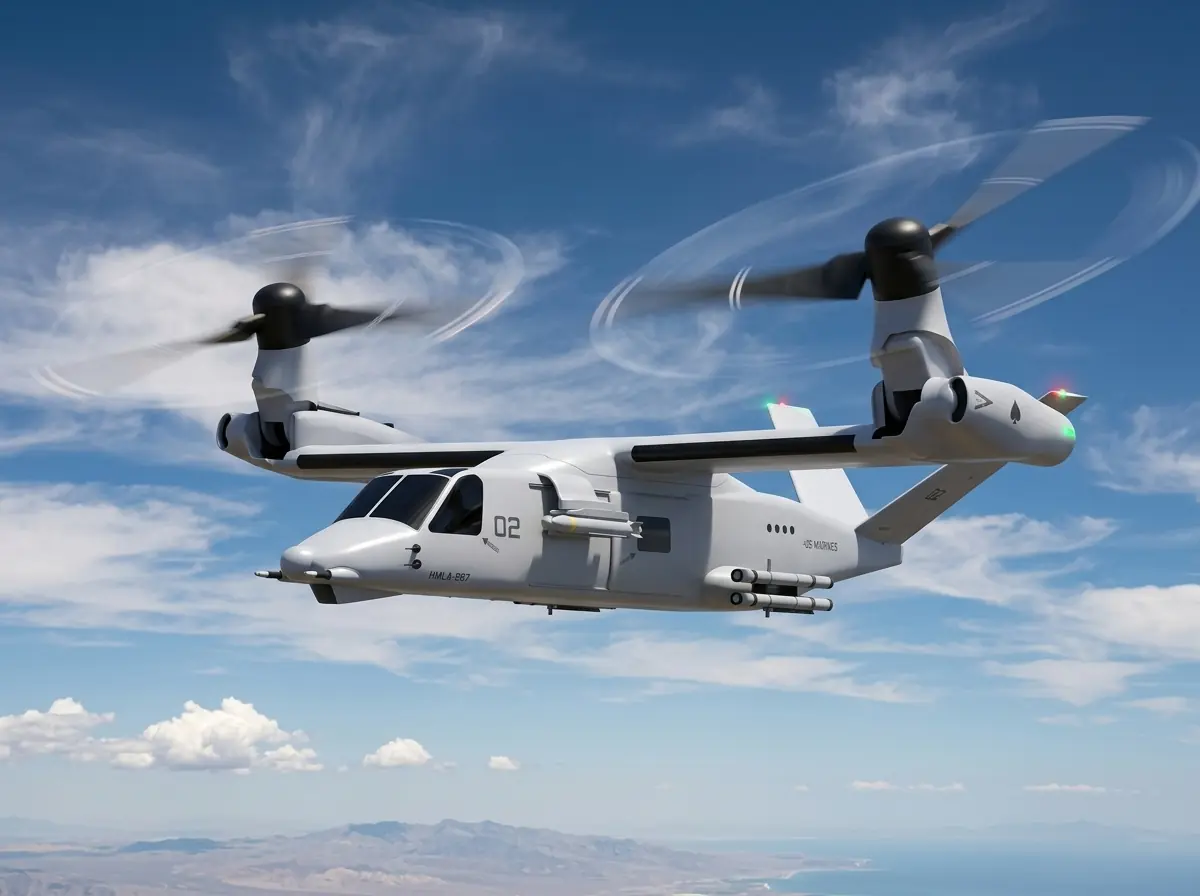
Defense Feeds, Washington — The US Marine Corps is exploring new operational concepts as the US Marines MV-75 tiltrotor concept adds cruise missile power to future aviation platforms.
The concept, recently revealed in visual materials, suggests a significant expansion of the tiltrotor’s role beyond transport and assault missions. By integrating cruise missiles, the platform could evolve into a flexible strike asset capable of operating across wide areas.
The MV-75 concept builds on the legacy of tiltrotor aircraft such as the MV-22 Osprey, which combine the vertical lift of helicopters with the speed and range of fixed-wing aircraft. This hybrid capability has already transformed how the Marines conduct expeditionary operations. The addition of strike capabilities would further extend its operational value.
The concept reflects broader changes in military strategy, particularly the need for distributed and rapidly deployable forces. As potential conflicts shift toward highly contested environments, platforms that can move quickly and strike effectively are becoming increasingly important. The MV-75 concept aims to address these requirements.
Combining Mobility With Long-Range Strike Capability
The defining feature of the MV-75 concept is its integration of cruise missiles. Traditionally, tiltrotor aircraft have been used primarily for transport, logistics and troop insertion. Adding a strike capability represents a major shift in how these platforms could be employed.
Cruise missiles provide the ability to engage targets at long range with high precision. Integrating them into a tiltrotor platform allows for rapid deployment and repositioning. This combination of mobility and firepower creates new operational possibilities.
Such a capability would enable Marines to conduct strikes without relying solely on traditional fixed-wing aircraft or naval platforms. It also allows for more flexible mission planning, as the same platform could perform multiple roles depending on requirements.
However, integrating missile systems into a tiltrotor design presents technical challenges. Issues related to weight, balance and aerodynamics must be carefully addressed. These factors will play a key role in determining the feasibility of the concept.

Supporting Distributed and Expeditionary Operations
The MV-75 concept aligns closely with the Marine Corps’ focus on distributed operations. This approach emphasizes smaller, more agile units operating across dispersed locations. In such scenarios, having platforms that can both transport forces and provide fire support is highly valuable.
A missile-armed tiltrotor could support these units by delivering precision strikes when needed. This reduces reliance on external support and enhances operational independence. It also allows forces to respond more quickly to emerging threats.
The concept is particularly relevant in regions such as the Indo-Pacific, where distances are vast and access may be limited. Platforms that can operate from austere locations and move quickly between positions are essential in such environments.
In addition, the ability to combine transport and strike roles could improve efficiency. Instead of deploying multiple platforms for different tasks, a single aircraft could handle several functions. This simplifies logistics and reduces operational complexity.
Implications for Future Marine Aviation
The development of the MV-75 concept highlights a broader trend in military aviation. Platforms are increasingly being designed to perform multiple roles, combining mobility, firepower and advanced technology. This reflects the need for more adaptable and resilient forces.
For the Marine Corps, such innovations are part of a long-term effort to modernize its aviation capabilities. The goal is to create platforms that can operate effectively in contested environments while supporting a wide range of missions. The MV-75 concept fits within this vision.
At the same time, the concept raises important questions about cost, integration and operational doctrine. Developing a new platform or significantly modifying an existing one requires substantial investment. Ensuring that it delivers meaningful advantages will be essential.
Looking ahead, further development and testing will determine whether the MV-75 concept moves beyond the conceptual stage. If realized, it could represent a significant evolution in how tiltrotor aircraft are used. The ability to combine speed, range and strike capability would provide a powerful tool for future operations.
The concept underscores the Marine Corps’ focus on innovation and adaptability. As the nature of warfare continues to change, platforms like the MV-75 may play a key role in shaping the future of military
