

Key Points
- The 13th Marine Expeditionary Unit ran two separate forward bases at once near Camp Pendleton, one for tracking ships and one combining command operations with aircraft refueling.
- The exercise builds on the Marine Corps’ Expeditionary Advanced Base Operations concept, introduced in 2019 to support distributed operations in contested waters.
U.S. Marines with the 13th Marine Expeditionary Unit ran two separate forward operating sites at once during a training exercise near Camp Pendleton, California, testing whether the unit can track ships at sea, direct combat operations, and keep aircraft armed and fueled from multiple locations simultaneously rather than a single base.
One site, called a sensing expeditionary advanced base, paired coastal surveillance radars and electronic sensors with small drones flown by Marines from Battalion Landing Team 2/4. When the radar picked up a surface vessel in nearby sea lanes, drone operators launched their aircraft to visually confirm and track it, then sent the imagery and coordinates back to the MEU commander in real time.
“We pull those grids, capture the imagery, and send that critical data directly back to the MEU commander,” said Sgt. Javier Guzman Granados, a drone operator with the battalion. Because ships move constantly, operators said the tracking data has to move fast before contacts drift out of range or the picture goes stale.
– ADVERTISEMENT – CONTINUE READING BELOW –
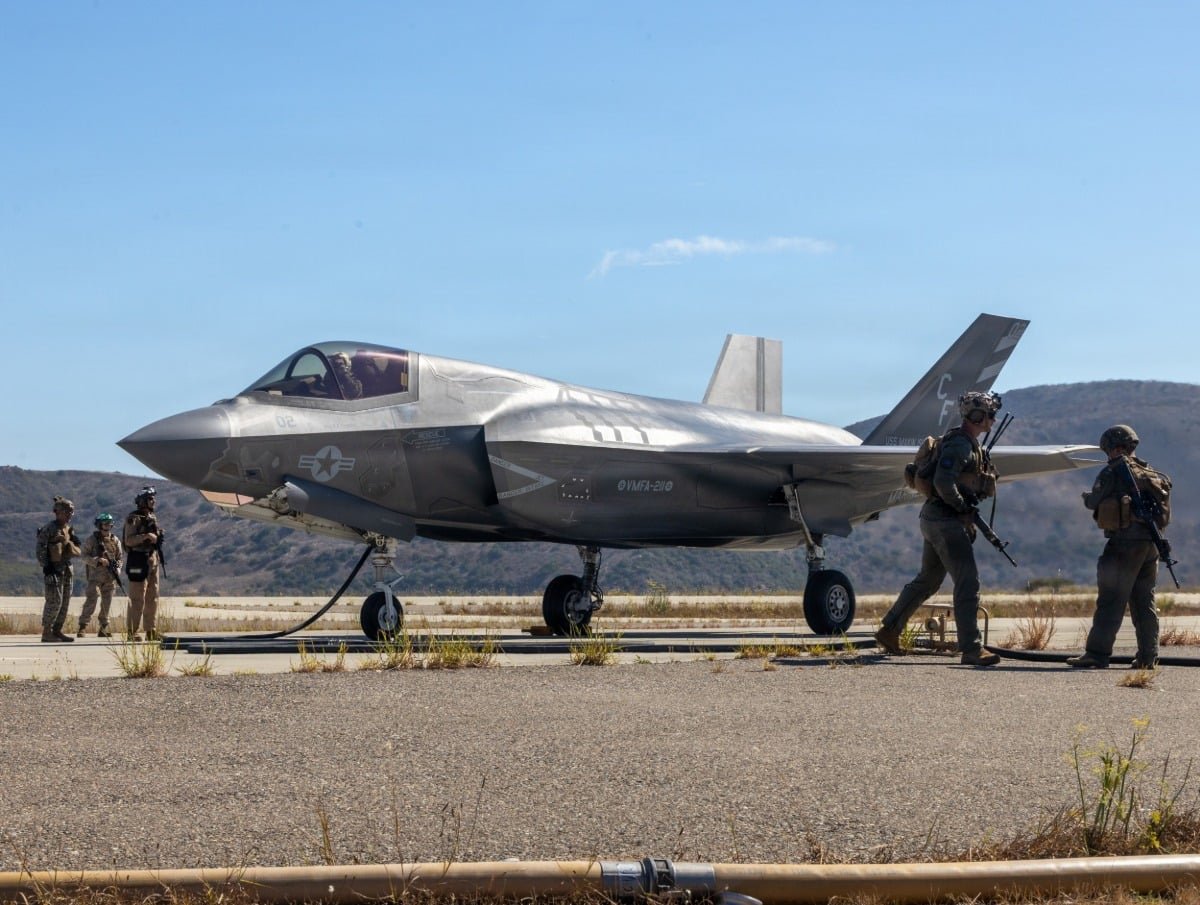
Miles away, Marines set up a second site combining a forward command element with a fuel and rearming point for aircraft. That command post linked the two forward bases, an operations center aboard Navy ships offshore, and aircraft flying overhead, while the adjacent fueling site let helicopters and other aircraft rearm and refuel without flying back to a ship or a main base.
“Forward arming and refueling points minimize the time aircraft spend out of the fight and maximize their time in the air,” said Sgt. Cody Quittner, a bulk fuel specialist with Marine Medium Tiltrotor Squadron 364. “Instead of flying all the way back to the ship or a main base for fuel and ordnance, aircraft come directly to us, rearm, refuel, and immediately return to supporting the infantrymen on the forward line.”
Running both sites at the same time meant splitting logistics, transportation and security personnel across two separate locations rather than concentrating them in one place, which Quittner said exposed how many people and moving parts it takes to stand up even a single site.
“One of the major takeaways from this training evolution is the sheer number of moving parts required to establish a site and deliver that capability,” Quittner said.
The exercise reflects a broader shift in how the Marine Corps trains its expeditionary units. The service introduced its Expeditionary Advanced Base Operations concept in 2019 as part of a larger overhaul called Force Design, built around the idea that small, mobile Marine units operating from austere, temporary locations ashore can extend the Navy’s sensor and strike coverage in contested waters, rather than relying solely on large amphibious landings. The concept was developed with a potential Indo-Pacific conflict in mind, and the Marine Corps has spent the years since testing it through unit exercises like this one. The 13th MEU ran an earlier version of this training in 2022 at San Clemente Island, California, using aircraft including the RQ-20B Puma and Shield AI’s V-BAT drone to build a picture of maritime activity for the MEU and its Navy counterparts.
“Connecting the land and sea is where the Marine Corps makes our money,” said 1st Lt. Joseph Nameth, a platoon commander with Battalion Landing Team 2/4.
