

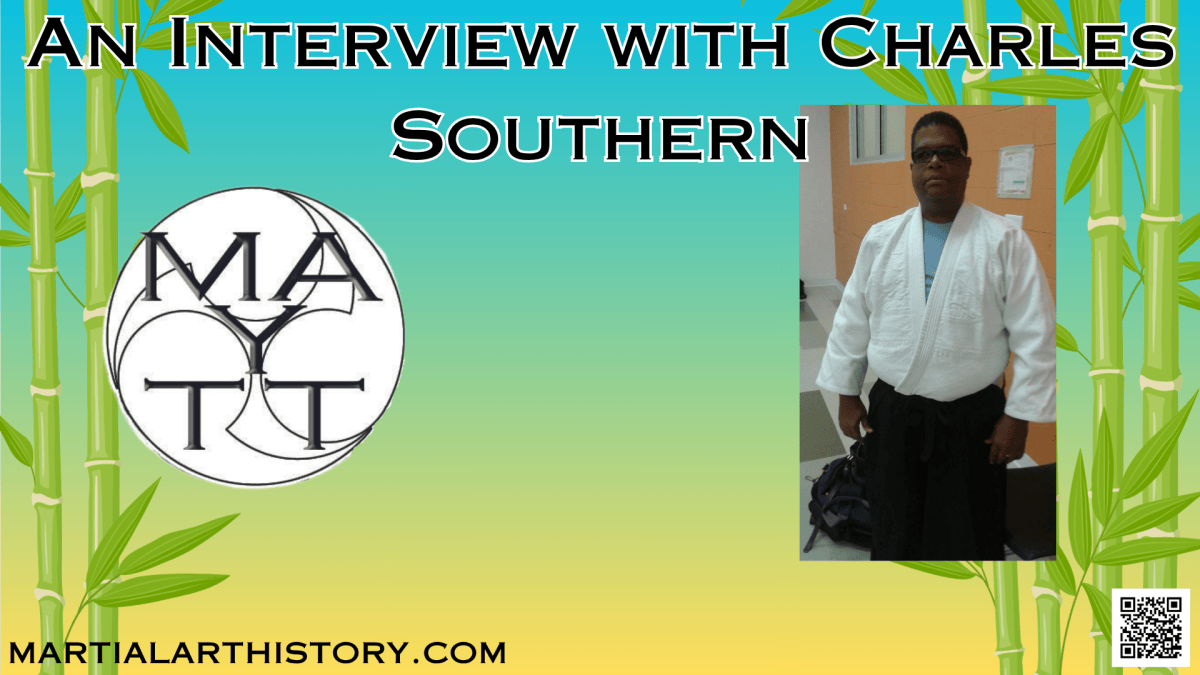
Charles Southern began studying Yoshinkan Aikido in 1982 while attending college after his sister told him about a class near her workplace. He began training under Robert Hackett and Gilbert James, two early Yoshinkan practitioners in Chicago, who had studied under Robert “Commander” Cramer and helped establish the Midwest Yoshinkan Aikido Association in the late 1950s. Today, Southern took some time to discuss training under Hackett and James, the uniqueness of Yoshinkan Aikido, and trying to maintain the tradition passed down from his instructors. All images provided by Charles Southern.
Martial Arts of Yesterday, Today, and Tomorrow: Hello, Southern Sensei! Thank you for joining us to talk about your experiences with Yoshinkan Aikido and the early history of Yoshinkan in Chicago.
Charles Southern: Thank you for having me.
MAYTT: You began studying aikido in 1982. How did you first find aikido?
CS: I began aikido in 1982. I was eighteen or nineteen and a college student. I had always been interested in martial arts, and I had taken judo when I was in eighth grade. I wanted to continue, but my mother said no. She told me that education was important and that I was getting ready to go to high school. I told her, lovingly, that one day, when I could afford my own lessons, I was going to go. That happened when I was about eighteen or nineteen. My sister was working at a daycare center next to a church, and she said, “There’s just this little old man throwing people across the room and everything, and he’s really nice.” She didn’t know what the art was called, but she said she would find out and get the information for me. I went over, and it was Yoshinkan Aikido. It was a senior citizen class, but they were doing breakfalls and everything. I was like, “Oh my God, what kind of art is this?” I met their instructor, and he was the nicest guy. His name was Robert Hackett. Robert Hackett and Gilbert James came up together under the Yoshinkan system.
MAYTT: What was it about Yoshinkan Aikido that kept your attention and commitment for so long?
CS: The thing was, it’s a lifelong art. It’s one word that all the masters in aikido say: Aikido is a journey. When you’re eighteen or nineteen, you’re thinking, “What journey?” You think about this long, long trip. But it’s an art that you grow with and learn how to do, and it’s not instant gratification. That alone drew me into the art. I just got immersed in it. I had really great teachers. They were mentors to me, and they were great men. They were just awesome, and I needed that at eighteen or nineteen. You know how you need that little direction when you get into your early adulthood? Your parents kind of wean you off a little bit, but I leaned on Robert Hackett. He was in his late sixties, but he was still teaching aikido up until he died. He told me that these were lifelong skills that I could use for the rest of my life. I’m only eighteen or nineteen, and it’s really funny because I was always the kid in the group. Now I’m the oldest one.
MAYTT: It sounds like Hackett had a particularly strong influence on you beyond aikido itself. What can you tell us about him?
CS: He was like a grandfather to me. He was really progressive, and he talked real hip and everything. He could relate at any point in time. He was a great talker. He spoke five languages, and he was a vaudeville tap dancer. He just had so many gifts and talents, and I said, “I want to be like that.” He spoke Spanish and could write and speak it fluently. He even taught aikido in Spanish. He also knew Portuguese, German, and French. I’m like, “Wow.” I don’t know where he picked all that up. I guess I would put him around World War II, but I don’t know if he picked up some of the languages over there or what. I can’t remember exactly how he came to know them. He wasn’t a very educated person. I think he may have only had a high school education. He worked for postal security for the post office. He was a dynamite man.
MAYTT: How would you describe the training you experienced under Hackett when you first began?
CS: When I first began, it was top-notch training. It was old school. It was, “Practice a hundred times a day. Learn these basic six movements.” Once you learn the basics, you can go on to do anything. He just drove that into my head. You don’t have to know a lot about anything, but if you know the basics – just the basics – you can do anything in your life. I grew up with that after I was eighteen or nineteen, and it has helped me all the way through adulthood, even today.
MAYTT: In what ways did you see the training change and evolve during your time in Yoshinkan Aikido?
CS: Let me go back. Aikido started in the Chicagoland area around the late 1950s. They learned from Robert “Commander” Cramer. He was in the Navy, and I believe he was stationed here. I believe he taught at the YMCA. Gilbert James had seen a demonstration. They already had black belts in karate and judo, as well as Hakko-ryu Jujutsu. He told Bob Hackett, “You’ve got to check this art out.” When they went to class, they liked it. They got their training from Gozo Shioda, the founder of Yoshinkan Aikido. They trained with Commander Cramer up to around brown belt, and they had to take their testing on 8mm film and send it to Japan. That’s how excited they were about it.
After learning from Sensei Hackett and Sensei James, the training was rigorous. Breakfalls were a big part of it. You learned all eight breakfalls from day one because when you went up for black belt, you had to do all eight four times. That’s thirty-two breakfalls before you even tested, so you had to have your endurance up. It was old-school training that had been handed down from generation to generation.
There was a period when Takashi Kushida Sensei came to the United States and ended up in the Ann Arbor, Michigan, area. He taught Aikido, and because he was the senior person, they had to report to him. During that period, things started changing. The techniques would change each year. You had to know the 1984 techniques, the 1985 techniques, and so on. Shioda and Kushida eventually had differences over the direction of the art. We had a meeting and asked, “What do we want to do? Do we want to go with Kushida, or do we want to stay with Shioda?” We took a vote. We said, essentially, that we already had our system before Kushida even came to America, so let’s stay with the Hombu Dojo in Japan. We stuck with the old system that Shioda had laid down through the years. Kushida eventually called his organization Yoshokai, which was a derivative of Yoshinkan Aikido. I teach aikido the way I was taught on day one in 1982. Mine is not watered down. If you leave my class, you can go to Japan and train at the Hombu Dojo in Yoshinkan Aikido.
MAYTT: You trained under both Hackett and James. How did they structure their classes?
CS: They taught independently of each other. When I started, we were next to a church that had a school, and we would use their gymnasium. Hackett Sensei taught there for years until eventually we were told we couldn’t use the space anymore and had to find another place to practice. Gilbert James was on the South Side of Chicago. I forget the name of the dojo, but it was around 35th and Halsted Street. They taught separately, and if you had the time and ability, you could train with each instructor. I did that because I was a college student. I think I only went to aikido maybe one day a week, but when I was between semesters, I would go over to Sensei James’s class as well.
MAYTT: What was it like training under James after having a background with Hackett?
CS: You know what? He was like thunder and lightning. His techniques were harsh. He would pound you into the mat. I was like, “Oh my God, this is a whole different ballgame.” Hackett Sensei would put it on you, too, but one thing I remember was going to Hackett and thinking, “When I’m here, it’s like I’m your number-one student.” Then I would go over to Sensei James, and he was always correcting me. I was doing this wrong and doing that wrong. I was confused because I thought I was doing it correctly. Hackett told me not to worry about it. He said James was a commercial artist, and everything had to line up exactly the way it needed to. If he wanted your hand at a certain height, you learned to put it there. It took me a while, but once I got it, it was the best journey in my life switching over to him.
MAYTT: Hackett passed away in 1992. What happened to your training and teaching after his death?

CS: His last words were, “You can keep my mat and continue to teach the art.” I was maybe a third-class brown belt or a purple belt at the time. I went to Sensei James and said, “Well, I guess I’ll be coming over here full-time.” At that time, we had gone to a Catholic school where they let us have access to the school on Saturdays. It was Little Flower Catholic School. There was a lady there who was a famous tap dancer, and she taught tap dancing. She wanted to do a program with the arts, so she said, “I want you guys to come over and teach the aikido class.” I did that up until Hackett’s death in 1992. After he died, I asked Sensei James if he was going to come over and continue studying with the students. He said, “No. That’s your class.” I’m like, “What?” I told him, “I don’t think I’m good enough to be teaching a class.” He said, “You’re going to come over to me for training, and you’re going to conduct a class on your own.”
I was teaching before I even knew how to teach. It turned out to be a great outlet for me to really learn the art and perfect it while teaching it at a level appropriate for a third-class brown belt. It was a tremendous experience to really get into the art and be able to teach it. Eventually, the schools shut down because they were starting to close a lot of Catholic schools if they didn’t have a large enough attendance. We had to let that program go, and then I came over full-time with Sensei James. He would come over and test the students for me and give them their belts and certificates. I didn’t have a teaching certificate. You had to have a teaching certificate in Yoshinkan Aikido, so I was under his tutelage, and he would come in and do the testing.
MAYTT: After Hackett death, you become a full-time student of James, correct?
CS: Correct. I signed on as a full-time student with him.
MAYTT: Do you remember when Kushida left the Yoshinkan organization?
CS: What year was that? I want to say it was sometime in the mid-to-late 1990s. Maybe around 1994 or 1995. We had a meeting, like I said, and asked whether we wanted to stay with Kushida or move on and remain with the Hombu Dojo. If we said we were Hombu Dojo, then a Hombu instructor could test you for black belt and send your information to Japan. I got my black belt through Gilbert James, and he sent my paperwork to Japan, to Shioda.
When we had that meeting, James didn’t even make the decision himself. He sat everybody down and asked, “What would you like to do?”
We decided to go with the original founder because if we had stuck with Kushida, we would have had to take those kenshukai classes from third kyu all the way up to first kyu. That meant driving from Chicago to Ann Arbor, Michigan, one weekend a month to take all those Kenshu classes. I was so glad. I said, “Yes, I can be under you, and you can send our paperwork to Japan and Shioda, and you can give me my certification.” At that time, we had our own autonomy. He had the autonomy to test you for a black belt and send your paperwork to Japan to get your certificate.
MAYTT: How much interaction did you have with Kushida before that split?
CS: We had the kenshukai classes coming up through the lower rankings. Every summer there was a seminar where we would have a weekend session with Kushida. People from all over the United States would come in. We also had aikido clinics taught by him. Each club would do an aikido demonstration during the weekend. It was basically a Friday-through-Sunday extravaganza of aikido. It was some rough training, too.
MAYTT: Was the training under Kushida different from what you had experienced with Hackett and James?
CS: No. Everything was similar. We did everything the way Kushida wanted us to do it at that time. But it kind of turned into a little profit thing because you had to know the 1988 techniques, the 1989 techniques, and so on. He sold you a VHS tape demonstrating everything the way he wanted it done. It was confusing because by the time you went up for black belt, you might have ten different years’ worth of techniques that you had to know. I had an old stack of tapes from each year. I went through a couple of them and thought, “Man, this guy was something else.”
He would modify something a little bit differently. We would do some duck-unders, and we didn’t do much ducking under your arm when you were doing Shioda-style Aikido. He had changed a lot of things. You would learn under him and think, “Okay, I’m going to take a pilgrimage to Japan,” and then you would be doing things totally differently from what the founder of the art was trying to teach. Shioda wanted everybody to do aikido the same way. He didn’t want somebody doing it one way and somebody else doing it another way. He wanted you to be able to recognize that it was Yoshinkan Aikido. I’ve been in places down through the years where nobody knew me, but they knew my instructor, Gilbert James. I would say, “I bet you’re from Chicago.” They’d say, “Yeah.” We moved a certain way, and that’s what I really liked about it.
MAYTT: How did Hackett and James interact with the larger Yoshinkan community in Chicago and throughout the United States?
CS: They were well known. Everywhere I would go with them, whether we were visiting other states or attending events, they were well regarded because they were the senior people who had started under that system going back to Commander Cramer. Everybody had picked up aikido around their college years, and Hackett and James were already getting up in age. They were revered as early pioneers of aikido.
MAYTT: Which states did they travel to teach seminars?
CS: I’ve been as far as Minnesota. We had instructors in Indianapolis, and they would go out to California. Wherever I could, I would travel with them. Wherever they wanted expert training that they didn’t have, they would ask them to come along. That included the Michigan area and the Detroit area.
MAYTT: Who would you consider some of the peers or contemporaries of Hackett and James among the early Yoshinkan practitioners?
CS: Eddie Moore was the instructor from Detroit and he had gone to Japan and somehow visited the Yoshinkan Hombu Dojo. He had written back and insisted that they send their top man to teach in the United States. That was the reason Kushida came over here and set up in the Ann Arbor area.
I also met one of the older black belts, Fred Haynes, who was from the Canada area. There was another African American practitioner who spent thirty-two years in Japan. His name was Amos Parker. He was the most senior and highest-ranking black belt in America for Yoshinkan Aikido. He was seventh dan. He passed away maybe about thirteen [2013] years ago. He spent over thirty-two years in Japan after getting out of the Navy. In the late 1990s or early 2000s, he came back to the United States to care for his mother. I believe he was from the Houston area.
MAYTT: Going back to Commander Cramer, you mentioned that he was stationed in Chicago and was in the Navy. Did he eventually get reassigned?
CS: I believe he was only there for a short time and had to leave because he was reassigned. He was still active-duty Navy.
MAYTT: Was the Navy his career?
CS: I don’t know. They always said he was here for a short time because he was stationed here. I guess he could have been a career Navy serviceman because I never heard them say anything more about it. That’s the little segment of history I know about how they got started. Then Gilbert James and Sensei Hackett started the Midwest Yoshinkan Aikido Association, which started around 1959.
MAYTT: Was the Midwest Yoshinkan Aikido Association still an active entity when you began training with Hackett and James?
CS: Yes, and I took over that, but I didn’t keep up with the yearly renewal, and that’s kind of on my part. Everything was given to me upon the death of Sensei James.
Part two coming soon!

