

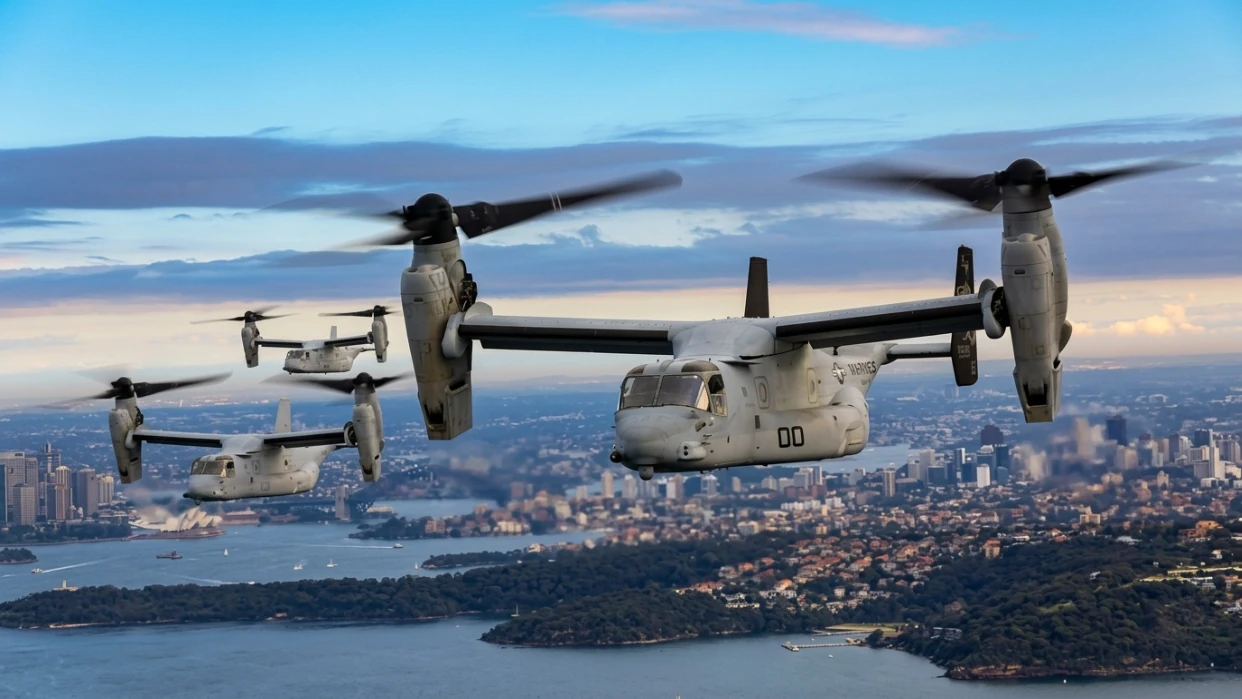
Defense Feeds, Washington, D.C. – The U.S. Marine Corps extends MV-22B Osprey service to 2055, reaffirming the tiltrotor aircraft’s central role in expeditionary warfare and long-range assault operations.
The decision ensures the MV-22B will continue supporting Marine Air-Ground Task Forces (MAGTFs) for decades while receiving modernization upgrades intended to maintain operational effectiveness in evolving threat environments.
The service-life extension reflects continued confidence in the aircraft’s unique combination of vertical takeoff capability, fixed-wing speed and long-range mobility, characteristics that remain difficult to replicate with conventional helicopters.
U.S. Marine Corps Extends MV-22B Osprey Service to 2055
The decision through which the U.S. Marine Corps extends MV-22B Osprey service to 2055 underscores the aircraft’s enduring importance in expeditionary operations.
Since entering service, the MV-22B has transformed Marine Corps aviation by combining helicopter-like vertical lift with the speed and range of a turboprop aircraft, enabling rapid movement of personnel and equipment across greater distances.
This capability allows Marines to launch operations from ships positioned farther offshore while maintaining the ability to insert forces into austere or contested locations. The extended operational reach also reduces dependence on forward operating bases, increasing flexibility during distributed military operations.
Maintaining the Osprey through 2055 ensures these capabilities remain available as the Marine Corps adapts to future operational concepts emphasizing mobility, survivability and rapid force projection.

Modernization Will Sustain Operational Effectiveness
Extending the aircraft’s service life involves more than keeping existing airframes in operation. The Marine Corps plans to continue investing in modernization programs that improve reliability, mission systems and long-term sustainment while addressing evolving operational requirements.
Upgrades are expected to focus on avionics, communications, defensive systems and maintenance improvements that enhance fleet readiness throughout the aircraft’s remaining service life. Continuous modernization enables the MV-22B to remain compatible with emerging command-and-control networks while supporting joint and coalition operations.
These improvements also help ensure the platform can integrate with future technologies introduced across the broader Marine aviation enterprise.
Tiltrotor Capability Remains Central to Expeditionary Warfare
The MV-22B occupies a unique position within military aviation because it combines vertical takeoff and landing with significantly higher cruising speeds and greater operational range than traditional helicopters. These characteristics make it particularly valuable for missions requiring rapid response over dispersed operational areas.
As the Marine Corps shifts toward expeditionary advanced base operations and distributed force employment, aircraft capable of connecting widely separated units become increasingly important. The Osprey’s ability to transport troops, equipment and supplies across extended distances supports these evolving operational concepts while improving logistical flexibility.
The aircraft also contributes to humanitarian assistance, disaster relief, medical evacuation and non-combatant evacuation operations, demonstrating its value beyond traditional assault missions.
Supporting the Future Marine Air-Ground Task Force
Retaining the MV-22B through 2055 reflects the Marine Corps’ broader modernization strategy, which balances the introduction of new technologies with continued investment in proven operational platforms. Rather than replacing the Osprey in the near term, the service intends to maximize its capabilities through incremental upgrades that improve performance, sustainability and interoperability.
The aircraft’s continued service also complements other modernization initiatives involving advanced sensors, unmanned systems and precision fires, creating a more integrated force capable of operating across multiple domains. By preserving the Osprey’s long-range mobility while enhancing digital connectivity, the Marine Corps aims to strengthen the effectiveness of future expeditionary operations.
The fact that the U.S. Marine Corps extends MV-22B Osprey service to 2055 highlights the enduring value of tiltrotor aviation in modern military operations.
As expeditionary missions continue to demand rapid deployment, operational flexibility and long-range mobility, the MV-22B is expected to remain a cornerstone of Marine Corps aviation, supporting global response capabilities well into the middle of the century.
