

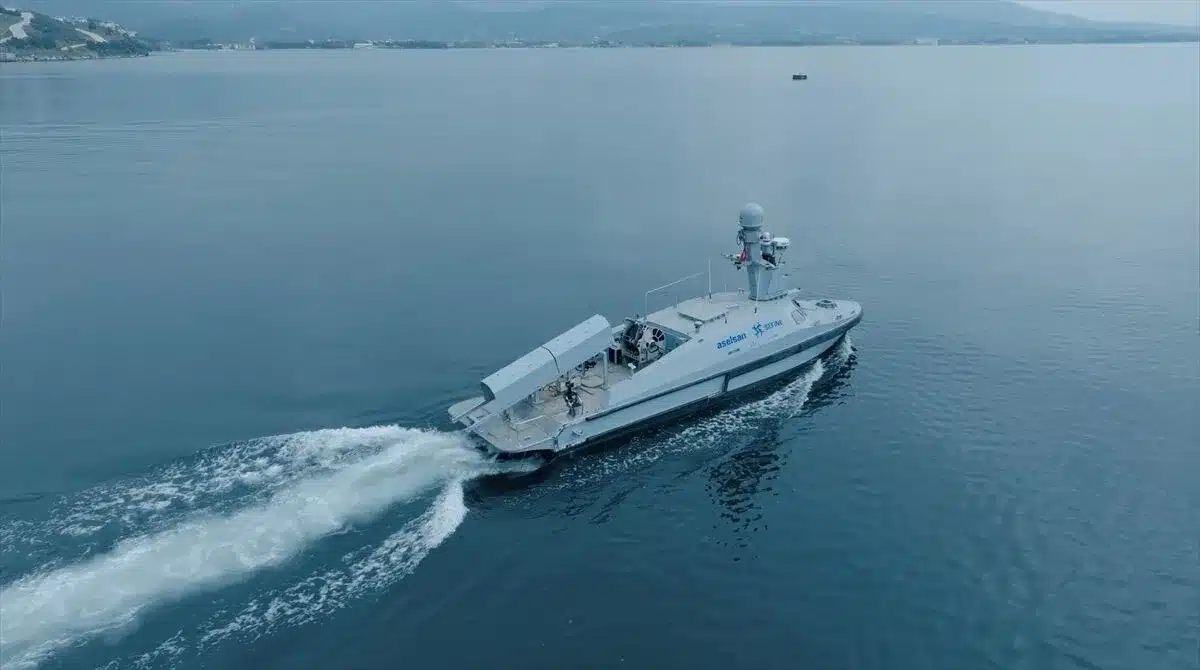
Türkiye’s MARLIN unmanned surface vessel (USV) has completed mine-laying trials using the MALAMAN smart bottom mine, adding a new mission set to the Turkish Navy’s first operational USV.
The demonstration included the release of MALAMAN mines in both remotely controlled and autonomous modes. According to information released by state-owned Anadolu Agency on August 17, the work covered the design and production of a mine carriage and release arrangement, as well as the integration of mission-planning interfaces and algorithms for autonomous mine-laying operations.
MARLIN was developed by Sefine Shipyard and ASELSAN under the coordination of Türkiye’s Presidency of Defence Industries (SSB). The platform entered Turkish Navy service as the country’s first USV in the naval inventory. It has since been used as a testbed for several mission configurations, including anti-surface warfare (ASuW), anti-submarine warfare (ASW), and electronic warfare (EW).
The addition of mine-laying is significant because it expands MARLIN’s role beyond surveillance, electronic warfare and kinetic missions. It provides a means to deploy naval mines without assigning a crewed platform to the task, whether in a remotely operated or autonomous mission profile.
The recent trials involved the MALAMAN smart sea bottom mine, a Turkish-developed system designed to be deployed from surface vessels, submarines, aircraft and unmanned platforms. Development of the mine has involved KoçSavunma, MKE and TÜBİTAK SAGE. Its electronic module and firing mechanism are designed to use pressure, magnetic and acoustic data for target detection and classification.
MALAMAN is a bottom mine intended for operation in waters between five and 100 meters deep. It features a composite casing and is designed to blend with the seabed. The mine’s stated dimensions also allow it to be deployed through 533 mm submarine torpedo tubes. Earlier tests have included fit checks aboard the Turkish Navy’s REIS-class submarines, while the system has also been associated with Turkish Navy landing ships for mine deployment.
The MARLIN integration creates another potential deployment method for MALAMAN. Unlike a submarine or a crewed surface vessel, a USV can be sent to conduct a mine-laying mission without exposing a crew. The remotely controlled and autonomous release tests indicate that the platform’s mine mission can be conducted under different levels of operator involvement.

MARLIN has been developed with a modular payload architecture, allowing equipment and weapons to be fitted according to the mission. In previous activities, the vessel has been displayed with different sensor, weapon and electronic-warfare configurations. It has also taken part in missile firing trials, demonstrating the use of a USV as a launch platform in addition to its other mission roles.
Naval News comments
Mine warfare has traditionally required dedicated minelayers, submarines, aircraft or adapted surface combatants. Especially after the Russo-Ukrainian war, the effectiveness of the sea mines was clearly observed by many countries. The MARLIN trial shows how unmanned surface platforms are now being considered for that task as well. The approach could be particularly relevant for shallow-water operations, where bottom mines are typically employed and where a small surface platform may operate close to shore. Deploying sea mines aboard unmanned systems will mitigate the risk of human loss in mine-laying operations, which is considered a risky mission type, especially in contested waters.
The Turkish Navy has continued to explore unmanned systems for multiple naval roles, including surface warfare, anti-submarine warfare, electronic warfare and mine-related missions. MARLIN’s latest demonstration adds mine-laying to that list, while also providing the first reported pairing of the platform with the MALAMAN smart bottom mine.
