

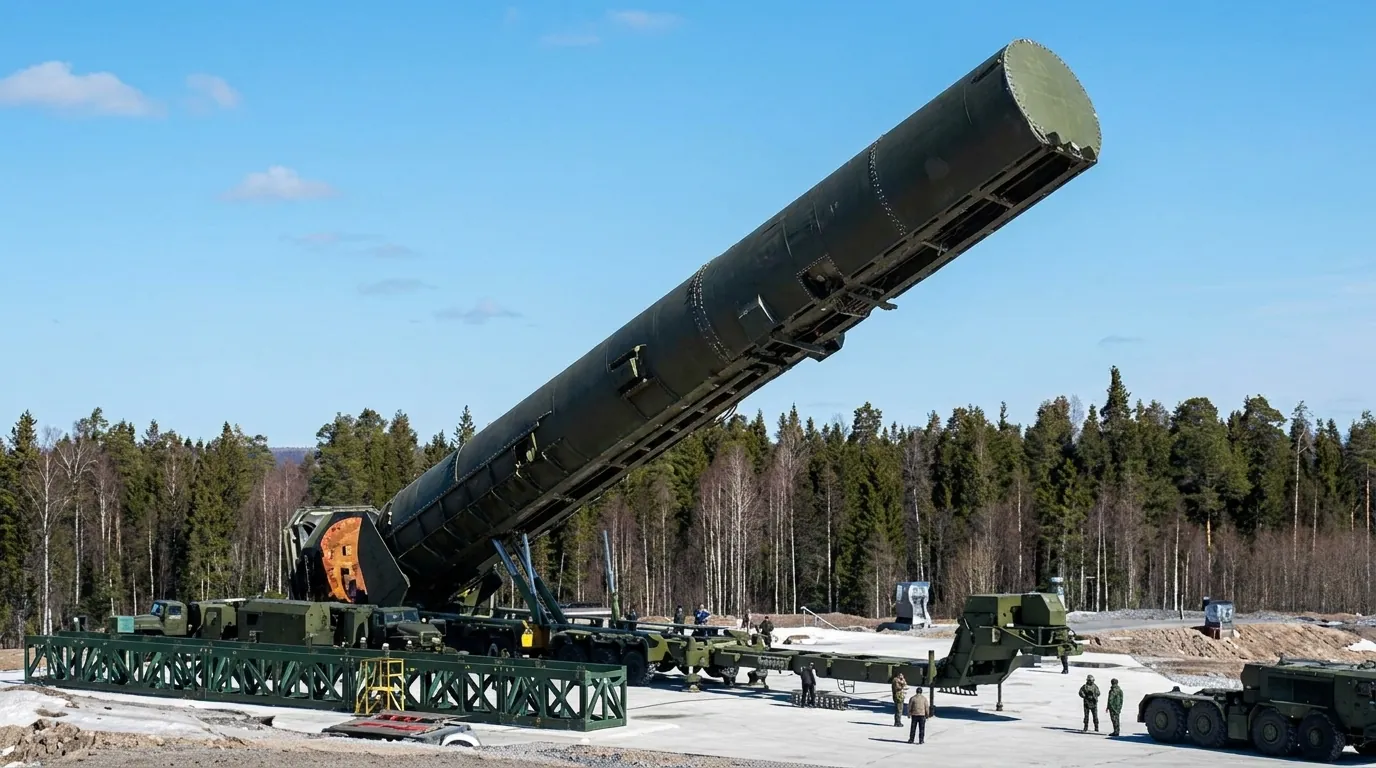
A missile does not need to be launched to change the strategic balance. Sometimes, simply knowing that it can travel thousands of kilometers is enough.
That is the peculiar power of long-range ballistic missiles. These weapons can cross continents, spend much of their flight outside the atmosphere, and deliver their payload over extraordinary distances. For nuclear-armed states, they are more than weapons, they are a central part of strategic deterrence.
But there is a catch: the longest-range missile is not automatically the most capable.
Range is only one piece of the puzzle. Payload, accuracy, launch method, mobility, survivability, and the ability to carry multiple independently targeted warheads can matter just as much. A missile hidden aboard a submarine, for example, may offer a different strategic advantage from one sitting inside a hardened underground silo, even if both can travel roughly the same distance.
This makes comparing the world’s longest-range ballistic missiles surprisingly complicated.
In this ranking, we’ll examine five of the most significant long-range ballistic missile systems in service or entering operational deployment, looking beyond headline range figures. We’ll compare their reported reach, propulsion, launch platforms, payload capabilities, and strategic roles.
The list includes systems from Russia, China, North Korea, and the United States, along with a U.S.-U.K. submarine-launched system.
Public specifications are used throughout, but keep in mind that missile performance is often partly classified. Some range figures are therefore estimates or official claims rather than independently verified numbers.
So, which missiles can reach the farthest, and which ones combine enormous range with the capabilities that make them strategically important? Let’s take a closer look.
How We Rank the Long-Range Ballistic Missiles
Ranking long-range ballistic missiles sounds straightforward: find the biggest range number and put it at the top. In practice, that approach can be misleading.
Missile specifications are rarely presented on perfectly equal terms. One country may publish a maximum theoretical range, while another provides an estimate based on intelligence assessments.
Some figures are widely accepted; others remain difficult to verify independently. Even the way a missile is deployed can change how useful its range actually is.
For this ranking, range is the starting point, not the finish line.
We consider the maximum publicly reported range, operational or deployment status, payload capacity, propulsion, launch platform, mobility, and survivability.
The missile’s broader strategic role also matters. A submarine-launched ballistic missile, for instance, brings a different advantage from a silo-based ICBM because its launch platform can remain hidden at sea.
| Ranking Factor | Why It Matters |
| Maximum reported range | Determines potential geographic reach |
| Payload capacity | Indicates how much destructive payload the missile can carry |
| MIRV capability | Allows multiple warheads to be carried on some systems |
| Launch platform | Affects survivability and flexibility |
| Mobility | Can make missiles harder to locate and target |
| Operational status | Separates deployed weapons from experimental systems |
| Strategic role | Shows how the missile fits into a country’s deterrent |
Another important distinction is reported versus verified performance. Open-source estimates can differ significantly, particularly for newer systems. North Korea’s Hwasong-18, China’s DF-41, and Russia’s newer strategic missiles are good examples of weapons for which public information does not reveal every detail.
So, don’t treat the ranking as a laboratory-style measurement contest. Think of it more like comparing long-distance aircraft when some of their flight data is classified. The published numbers provide a useful baseline, but the bigger picture tells you why each missile matters.
1. RS-28 Sarmat — Russia
When discussing the world’s long-range ballistic missiles, the Russian RS-28 Sarmat is hard to ignore. Often described as a heavy intercontinental ballistic missile (ICBM), Sarmat was designed to replace the aging R-36M2 Voevoda and preserve Russia’s ability to deliver a strategic nuclear payload across intercontinental distances.
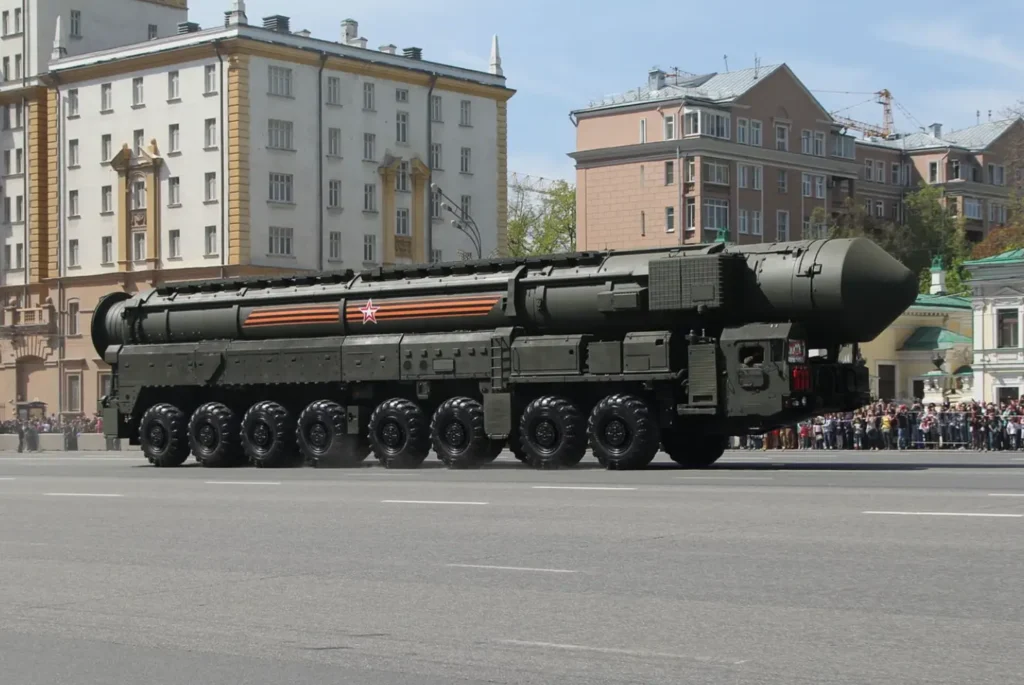
Its reported range is particularly striking. Russian sources have claimed a reach of roughly 18,000 kilometers, although open-source assessments caution that the figure is not independently verified. At that distance, the theoretical reach extends far beyond the distance separating most potential adversaries.
Sarmat is also notable for its size and payload philosophy. Unlike smaller, solid-fuel ICBMs designed around mobility and rapid deployment, this missile belongs to the heavy end of the strategic arsenal. Its large payload capacity is intended to accommodate multiple reentry vehicles and penetration aids, giving it considerably more flexibility than a missile carrying a single warhead.
| Specification | RS-28 Sarmat |
| Country | Russia |
| Type | Heavy ICBM |
| Propulsion | Liquid-fueled |
| Reported range | Up to ~18,000 km |
| Launch method | Silo-based |
| Payload | Multiple-warhead capable |
| Primary role | Strategic nuclear deterrence |
One interesting aspect of Sarmat is that range is not really its only selling point. Its heavy payload and ability to approach targets along different trajectories are intended to complicate missile-defense planning. In other words, Russia is not simply trying to build a missile that can travel farther; it is trying to build one that remains strategically relevant against evolving defenses.
That distinction matters. A missile can have extraordinary range on paper, but its real strategic value depends on what it can carry, how it survives, and whether it can reliably reach its intended target.
For Sarmat, those questions remain closely watched as Russia continues developing its next generation of strategic forces.
2. DF-41 — China
China’s DF-41 takes a very different approach from Russia’s massive Sarmat. Instead of relying primarily on sheer missile size, the DF-41 combines long range with solid-fuel propulsion and flexible basing options, three characteristics that make it one of China’s most important long-range ballistic missiles.
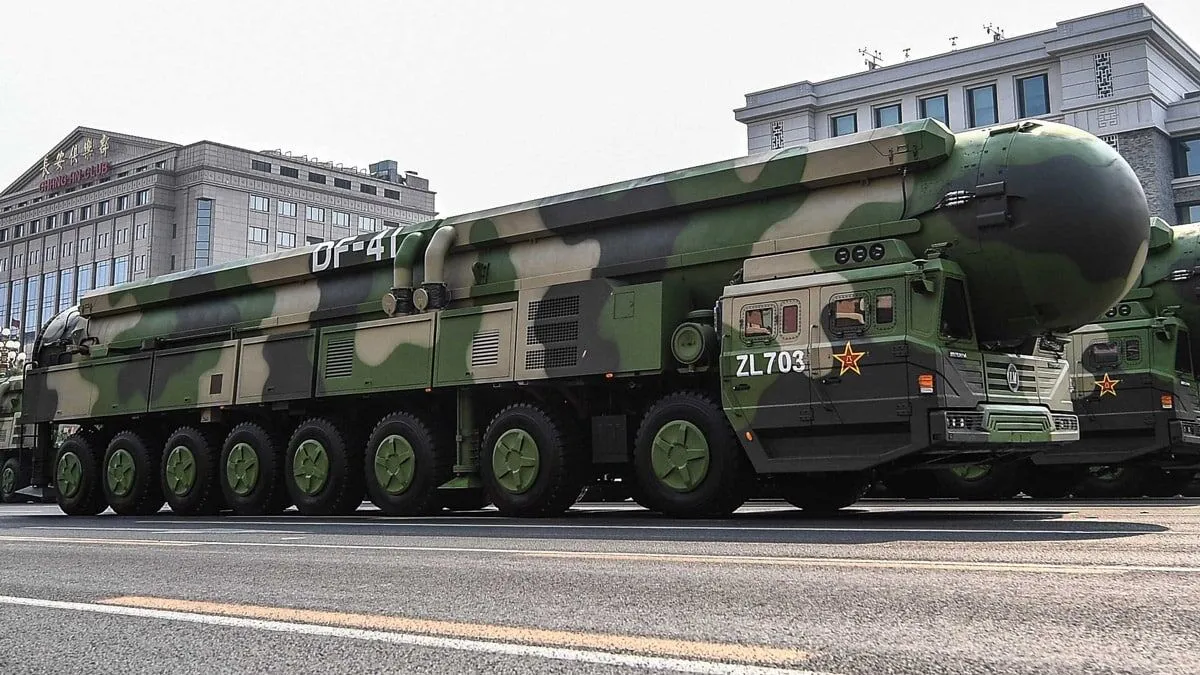
The missile is generally assessed to have a range of roughly 12,000–15,000 kilometers. That gives it intercontinental reach, allowing China to hold targets thousands of kilometers away at risk from mainland launch positions.
The DF-41 is also associated with multiple independently targetable reentry vehicle (MIRV) capability, although the exact configuration and deployed warhead load remain difficult to determine from public information.
Its propulsion system is another important detail. Solid-fuel missiles can generally be prepared for launch more quickly than older liquid-fueled designs because they do not require the same kind of lengthy fueling process immediately before launch.
| Specification | DF-41 |
| Country | China |
| Type | ICBM |
| Propulsion | Solid-fueled |
| Reported range | ~12,000–15,000 km |
| Launch platforms | Mobile launcher and silo |
| Warhead capability | MIRV-capable |
| Primary role | Strategic nuclear deterrence |
The DF-41’s potential road-mobile deployment is arguably just as significant as its range. A silo has obvious advantages in protection, but a mobile missile can be dispersed across a much larger area, creating a more complicated problem for an adversary trying to locate and target it.
That combination gives the DF-41 an interesting strategic profile: it can reach extremely distant targets while potentially being difficult to find before launch.
China’s growing ICBM force also puts the DF-41 into a broader story about the country’s changing nuclear posture. Rather than viewing the missile simply as a giant rocket with a huge range, it is better understood as one component of a larger effort to build a more survivable and flexible strategic deterrent.
And that is where the DF-41 becomes particularly interesting. Its headline range gets attention, but mobility and survivability may be the more consequential features.
3. Hwasong-18 — North Korea
North Korea’s Hwasong-18 marks an important shift in the country’s long-range ballistic missile program. Its significance is not simply that it can potentially travel thousands of kilometers; it is one of North Korea’s first demonstrated solid-fuel ICBMs, a change that could make its strategic missile force more flexible and difficult to monitor.

The Hwasong-18 was first publicly flight-tested in 2023. North Korean tests have demonstrated a missile capable of following a highly lofted trajectory, while outside analysts have used those tests to estimate a potential range of roughly 15,000 kilometers or more under a conventional trajectory. Because North Korea does not publish complete technical data, however, the exact maximum range remains an estimate.
| Specification | Hwasong-18 |
| Country | North Korea |
| Type | ICBM |
| Propulsion | Solid-fueled |
| Estimated range | ~15,000 km or more |
| Launch platform | Road-mobile transporter-erector-launcher |
| Development status | Tested/deployed |
| Primary role | Strategic nuclear deterrence |
Why does solid fuel matter so much? Think of it as the difference between a vehicle that needs substantial preparation before a journey and one that can remain ready to go. Solid propellant is stored inside the missile, reducing the need for time-consuming fueling operations immediately before launch.
The Hwasong-18’s road-mobile configuration adds another layer. A missile that can be moved between launch areas presents a more complicated surveillance problem than one permanently fixed in a silo.
Its development also illustrates how quickly missile technology can evolve. North Korea previously relied heavily on liquid-fueled ICBMs, but the Hwasong-18 points toward a force that could potentially achieve greater readiness and survivability.
Still, caution is important. Publicly available information cannot establish every aspect of the missile’s performance, reliability, warhead configuration, or operational readiness. Range estimates should therefore be treated as assessments rather than laboratory-confirmed specifications.
Even with those uncertainties, Hwasong-18 represents a major development: North Korea is pursuing an ICBM force that combines intercontinental reach with the operational advantages of solid-fuel, mobile technology.
4. LGM-30G Minuteman III — United States
The LGM-30G Minuteman III is not the newest missile on this list. In fact, its age is part of what makes it remarkable. First deployed in 1970, the Minuteman III has remained a central element of the U.S. land-based nuclear deterrent for decades, surviving repeated modernization programs while newer technologies came and went.

Its publicly reported maximum range is around 13,000 kilometers, putting it comfortably in the intercontinental category.
Unlike mobile systems such as the DF-41 and Hwasong-18, however, Minuteman III is deployed in hardened underground silos. That gives it a very different strategic character: its strength comes from readiness, hardened infrastructure, and integration into a highly established command-and-control network.
| Specification | LGM-30G Minuteman III |
| Country | United States |
| Type | ICBM |
| Propulsion | Three-stage solid fuel |
| Reported range | Up to ~13,000 km |
| Launch platform | Hardened underground silo |
| First deployed | 1970 |
| Primary role | Strategic nuclear deterrence |
One of the missile’s most important characteristics is its solid-fuel propulsion. Unlike older liquid-fueled designs that require substantial preparation, a solid-fuel ICBM can remain stored in a ready-to-launch condition for extended periods.
The Minuteman III has also undergone extensive modernization during its service life. Its electronics, guidance systems, propulsion components, and warhead arrangements have been upgraded over time. In that sense, calling it a “1970 missile” can be misleading, the basic architecture is old, but much of the technology supporting it has been repeatedly renewed.
There is another reason the Minuteman III deserves a place among the world’s longest-range ballistic missiles: reliability over time can be a strategic capability in itself. A missile that has been maintained, tested, and integrated into a mature operational system for decades presents a very different proposition from a newer weapon whose long-term reliability is still being established.
The Minuteman III is eventually expected to be replaced by the LGM-35 Sentinel, but until that transition occurs, it remains a key component of America’s land-based strategic forces.
Sometimes, the most consequential weapon isn’t the newest one in the room. It’s the one that has been quietly ready for decades.
5. Trident II D5 — United States and United Kingdom
The Trident II D5 deserves a place on this list for a reason that has little to do with being the absolute longest-range missile. Its real advantage is where it launches from.

Unlike the land-based ICBMs above, Trident II D5 is a submarine-launched ballistic missile (SLBM). It is carried aboard ballistic-missile submarines operated by the United States and United Kingdom, giving the weapon a launch platform that can remain hidden beneath the ocean for extended periods.
Public estimates put the missile’s maximum range at roughly 12,000 kilometers, although the exact performance depends on factors such as payload and flight profile. The missile uses solid-fuel propulsion and can carry multiple reentry vehicles.
| Specification | Trident II D5 |
| Operators | United States, United Kingdom |
| Type | SLBM |
| Propulsion | Three-stage solid fuel |
| Reported range | Up to ~12,000 km |
| Launch platform | Ballistic-missile submarine |
| Warhead capability | MIRV-capable |
| Primary role | Sea-based nuclear deterrence |
That submarine connection changes the strategic equation.
A silo can be hardened, and a mobile launcher can move, but a ballistic-missile submarine can disappear into a vast ocean. An opponent may know that submarines are deployed without knowing precisely where they are at a particular moment. This uncertainty is central to the concept of a survivable second-strike capability.
Trident II D5 is also notable for its long service life. The system entered operational service in the early 1990s and has been repeatedly upgraded rather than simply replaced. Its development illustrates an important point about long-range ballistic missiles: performance isn’t just measured in kilometers. Reliability, accuracy, readiness, and the ability to remain survivable are equally important.
The United States operates Trident II D5 aboard its Ohio-class ballistic-missile submarines, while the United Kingdom deploys the missile aboard its Vanguard-class submarines.
So while Trident II D5 may not claim the longest range in this ranking, its combination of intercontinental reach and a concealed launch platform makes it one of the most strategically significant ballistic missiles in service.
What Is the Longest-Range Ballistic Missile in the World?
If the question is purely about reported maximum range, the answer is generally the RS-28 Sarmat. Russian sources have associated the heavy ICBM with a range of up to approximately 18,000 kilometers, a figure that places it ahead of most publicly reported ranges for other operational strategic missiles.
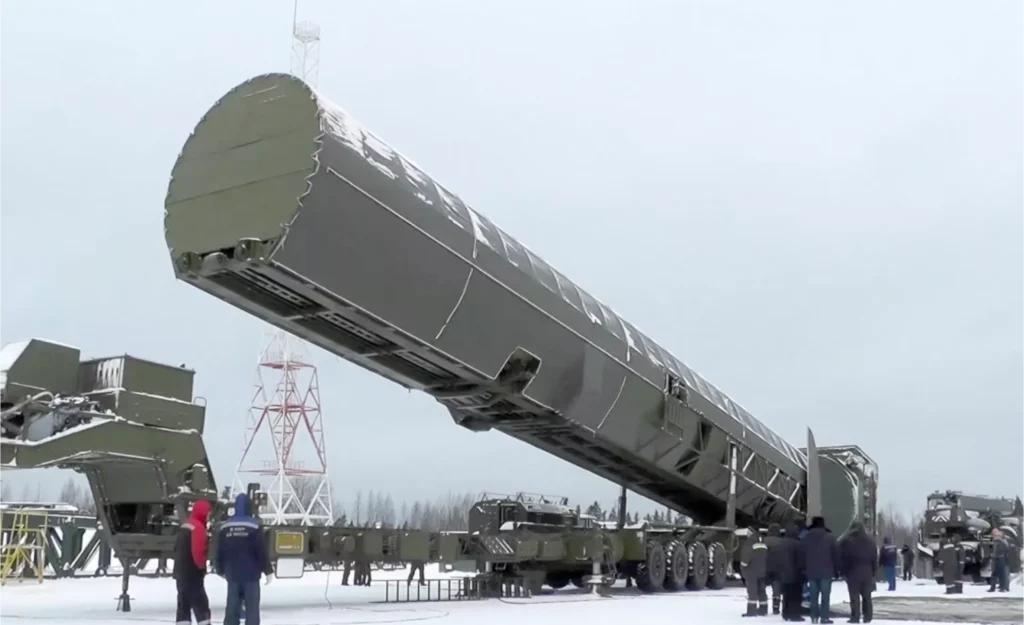
To put that distance into perspective, 18,000 kilometers is nearly half the circumference of Earth. It is far beyond what is needed to connect neighboring countries, or even most regional theaters. An intercontinental missile with that kind of theoretical reach can provide strategic coverage across enormous portions of the globe.
But there is an important asterisk.
Maximum missile range is not like the range printed on the side of a consumer product. It can depend on payload, trajectory, launch conditions, and the assumptions used by analysts.
For some advanced missile systems, especially those developed by countries that disclose limited technical information, outside observers cannot independently verify every published figure.
That is why the more useful question is not simply, “Which missile goes the farthest?” It is “Which missile combines long range with credible strategic capability?”
Sarmat was designed as a heavy, silo-based ICBM with substantial payload capacity and the ability to carry multiple reentry vehicles. Those characteristics are central to its strategic role and help explain why the missile attracts so much attention.
| Missile | Reported/Estimated Maximum Range |
| RS-28 Sarmat | ~18,000 km |
| Hwasong-18 | ~15,000 km or more* |
| DF-41 | ~12,000–15,000 km |
| Minuteman III | ~13,000 km |
| Trident II D5 | ~12,000 km |
So, if you’re looking for the longest reported range, Sarmat takes the top spot in this comparison. If you’re judging overall strategic effectiveness, however, the answer becomes much less straightforward, and that’s where range alone starts to lose some of its shine.
