

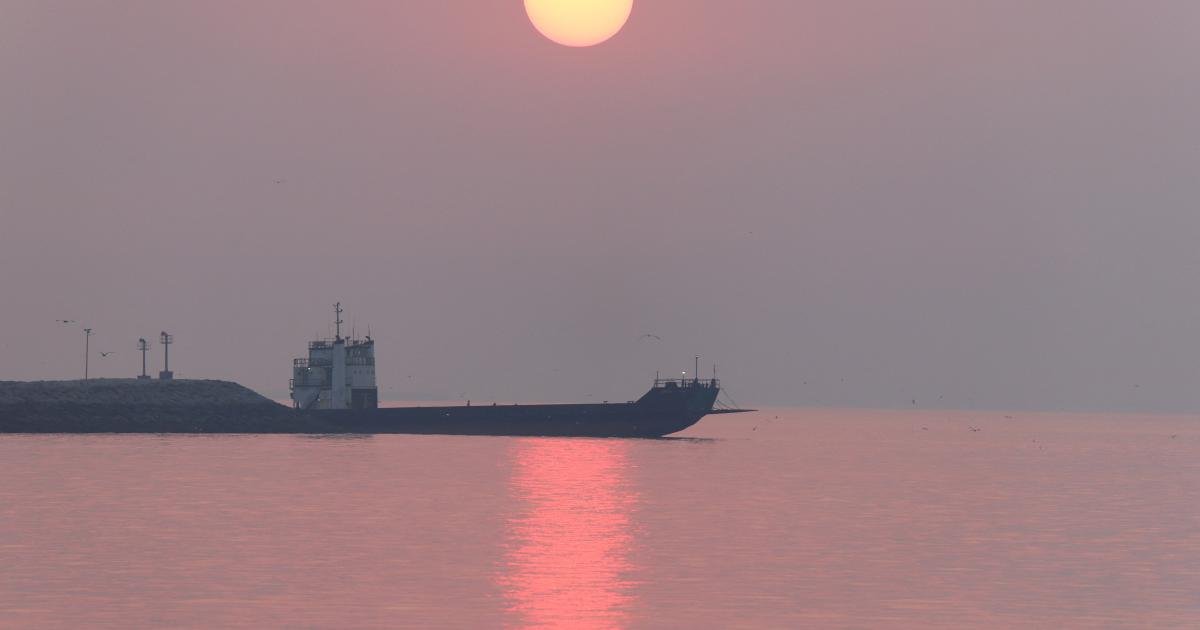
Over the last half millennium, societies around the globe competed to divide up the world’s land. Nearly every square inch of soil outside Antarctica is now owned and tucked within national borders. But the oceans have largely been spared that fate. There were times throughout history when countries tried to gate and regulate the seas, but they were too vast to be controlled for long periods. During the Cold War, as technology made it far easier to imagine partitioning the world’s waterways and seabeds, great powers avoided an unrestrained race to grab the oceans. Most governments agreed to deal with them through a patchwork of treaties and multilateral bodies that sought to guarantee freedom of navigation in international waters and assign coastal seabeds to adjacent littoral states.
That order is now collapsing. The Houthis are disrupting shipping in the Bab el Mandeb Strait, the gateway to the Red Sea. Iran and Oman are planning to charge ships fees for using the Strait of Hormuz, a chokepoint for global energy supplies and fertilizers. In July, U.S. President Donald Trump even floated the idea that the United States could impose its own toll on Hormuz, only to later drop the plan.
Other governments, too, are jockeying to claim international waters and marine resources for themselves. Russia is trying to assert control over vast swaths of Arctic waters and seabeds, China is building artificial islands in the South China Sea, the United States has expanded its claims to seabeds beyond its exclusive economic zone, and many countries are laying the groundwork to mine the ocean floor for critical minerals.
The institutions that have kept the oceans free and open are failing, and great powers have, in key areas, stopped abiding by the rules that have held for decades. States are already making moves to control the seas. If governments rush to claim the world’s waters, as they did its land, they will make global commerce more difficult and encourage a new era of seaborne conflict. A world in which the oceans are carved up will invariably be poorer and more dangerous.
FOR WHOM THE STRAIT TOLLS
Governments around the globe are taking note of the success of the maritime blockades in the Middle East. Just as Iran announced that it intended to introduce a toll in Hormuz, Indonesia’s finance minister suggested that Indonesia might follow suit in the Strait of Malacca, a critical shipping lane in Southeast Asia that carries roughly 29 percent of global maritime oil flows. (He eventually walked back the idea.)
The closures of the Strait of Hormuz and the Bab el Mandeb Strait are just the latest in a series of violations of the norms and rules governing oceans. China, for instance, has routinely flouted a binding 2016 ruling under the UN Convention on the Law of the Sea (UNCLOS) that rejected China’s expansive claims in the South China Sea. Beijing contravenes the decision by continuing to build artificial islands on disputed reefs, infringe on the Philippines’ exclusive economic zone, and encircle Taiwan. Russia, for its part, is suspected of breaking UNCLOS rules by using ships with concealed identities to cut undersea cables as part of a broader campaign to unsettle European countries.
This aggression is possible in large part because the institutions responsible for managing the oceans are ineffectual. The International Tribunal for the Law of the Sea, the body that is supposed to mediate maritime disputes, is slow and lacks an enforcement mechanism. The same is true of the Permanent Court of Arbitration, which makes binding rulings on treaty violations. The UN Security Council, which could levy economic penalties or even greenlight military action to protect shipping, is almost always paralyzed by a veto from China, Russia, or the United States. Punishing undersea saboteurs is further complicated by the rules of jurisdiction. Only the country in which the ship is registered has prosecutorial authority, so perpetrating states can protect troublemaking crews by not pursuing cases.
MIGHT MAKES RIGHT
Climate change will spur new disputes over the oceans. Over the next two decades, as Arctic ice melts, the Northern Sea Route that connects Europe and Asia along Russia’s Arctic coast will see dramatic growth in commercial shipping. It is difficult to imagine Moscow allowing free access to that route. Russia already forces foreign vessels to submit to a complicated and suffocating system of permissions and permits to operate within its exclusive economic zone. It also treats corridors, such as the Vilkitsky Strait off the Siberian coast, as domestic waterways subject to Russian jurisdiction rather than international straits that grant the right of passage.
Fights over the oceans are not limited to controlling transit. As China has come to dominate and weaponize the existing global supply of land-based critical minerals, other countries are exploring the possibility of mining deep ocean seabeds. Areas such as the Clarion-Clipperton Zone in the North Pacific between Hawaii and Mexico, the central Indian Ocean basin, and the Penrhyn basin in the South Pacific are studded with trillions of stones containing critical minerals. The International Seabed Authority, an UNCLOS body that regulates such activities, has issued dozens of exploration contracts that allow governments to survey and map the ocean floor, gather environmental data, and test extraction technologies. But the body currently forbids commercial mining because its members cannot agree on environmental standards or enforcement and compliance rules.
Nevertheless, the race for underwater critical minerals may soon heat up. The United States is the only great coastal power that has never ratified UNCLOS. Unbound by the seabed authority’s rules and seeking to diminish dependence on China and meet the insatiable demand for minerals to fuel artificial intelligence and other advanced technologies, the Trump administration is fast-tracking permits for deep-sea mining in parts of the Clarion-Clipperton Zone over which the United States already has de facto control. (Although the United States has never ratified UNCLOS, previous U.S. administrations adhered to many of its standards.) U.S. regulators are expected to rule within the next year on a growing number of commercial deep-sea mining applications, potentially clearing the way for extraction to begin soon. The Bureau of Ocean Energy Management, which regulates energy and minerals on the U.S. outer continental shelf, is also holding a lease auction in November for two large tracts of seabed off American Samoa that will be opened for exploration and, potentially, mining.
The future could see states duking it out to secure their share of the seas.
If the United States moves ahead with mining in open ocean areas, countries that have signed on to international laws restricting extraction, including China, India, and Russia, will likely cry foul. Although Beijing and Moscow already disregard other laws of the sea, they will point to the United States’ mining to justify their own.
As with other forms of rules-based order, ocean governance won’t collapse all at once. Great powers still benefit from certain guidelines, such as the regulation of fisheries, even if they stand to gain from disorder in other areas. Rather, the system will likely die a death of a thousand cuts.
Each broken precedent will make the next easier to ignore or justify. Coastal powers will come to believe that the oceans are there for the taking. That lesson will not stay confined to tolling ships or claiming seabeds. States will assert ownership of fishing grounds, tamper with undersea cables, and, potentially, conquer or besiege islands. The erosion of ocean governance could pave the way for China to blockade Taiwan, Russia to strangle Norway’s Svalbard archipelago, or the United States to seize maritime control around Greenland.
The breakdown of the international maritime order could also spur a scramble for Antarctica. During the Cold War, the great powers signed a treaty that froze territorial claims to the continent and designated it a site of scientific exploration and cooperation. But that treaty now looks fragile. China is rapidly expanding its icebreaker fleet and building research stations on Antarctica that U.S. and European observers worry could have dual-use capabilities, which is banned under the treaty. China and Russia have teamed up to delay the establishment of protected marine areas in Antarctic waters so they can expand krill fishing operations. Melting ice and advances in technology could also open up the continent to mining. If a contest for the South Pole breaks out, a host of countries could reassert old territorial claims and race to build satellite tracking stations in Antarctica for intelligence gathering, surveillance, and other military purposes.
LINES IN THE SAND
In a world with contested oceans, trade and commerce would slow as ships would have to zigzag across the seas and pay mounting fees at points of passage. Goods would become more expensive and supply chains more volatile and prone to disruption. Rogue actors and governments could hold up critical resources or food supplies for their own immediate gain. The oceans would be divvied up as national territories. And in the wrong hands, marine resources and ecosystems, including fisheries, could face grave and lasting damage.
The conquest of the oceans could ultimately unfold like the conquest of land, with the most powerful countries—or those that arrive first—gaining ownership over resources. The number of geopolitical flash points would multiply as governments rushed to grab their share of the oceans and protect their claims through force.
It took centuries of conflict and state building for land borders to become mostly stable. Replaying that in the oceans would be dangerous and unpredictable. Tracts of the oceans would change hands repeatedly as powers rose and fell and as technologies evolved. New winners and losers would arise in the scramble. The countries of the world once chose to govern the oceans together. But the future could see states duking it out to secure their share of the seas. It would be a tragedy of the planet’s biggest commons.
Loading…
