

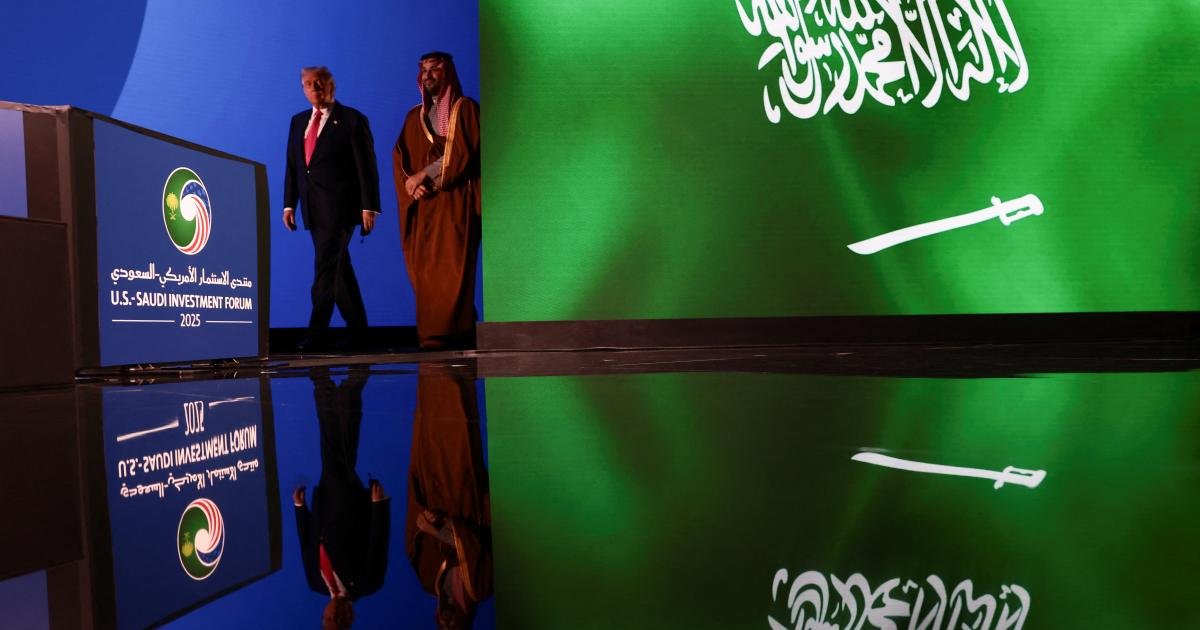
Since its announcement on July 22, the U.S.-Saudi nuclear agreement has alarmed nonproliferation experts. The 30-year deal would open the way for U.S. companies to develop the kingdom’s nuclear infrastructure, but it could also allow Saudi Arabia to pursue nuclear enrichment on its own soil. Although the agreement is still under congressional review, it has already created fears that it will weaken the U.S. “gold standard”—the strict requirements Washington holds nuclear partners to—and thus encourage other Middle Eastern states to demand similar capabilities.
Adding to the uncertainties, U.S. President Donald Trump declared a day after the announcement that the terms of the deal were “totally subject” to Saudi Arabia normalizing relations with Israel by joining the Abraham Accords and insisted that “there will be no enrichment.” Neither of these conditions was apparently in the original announcement. Meanwhile, reports of confidential side letters to the deal have raised additional questions. Without knowing their contents, it is impossible to assess the agreement’s true implications.
Regardless of what conditions are present, however, the deal makes one thing absolutely clear: the central question is no longer whether Saudi Arabia will advance along the nuclear path but how its pursuit of nuclear power can be managed without igniting a nuclear arms race. Saudi Arabia is already in the final stages of completing an Argentine-designed low-power research reactor, and it has reportedly received bids from China’s National Nuclear Corporation, France’s EDF, Russia’s Rosatom, and South Korea’s Korea Electric Power Corporation to build two nuclear power plants. Although the kingdom has deliberately delayed making a final decision on those bids while negotiating with the United States, Saudi officials are determined to go ahead with their nuclear program as soon as possible.
This need not end in crisis. Rather than helping Riyadh make enrichment a national project and allowing it to go it alone on nuclear power, the Trump administration has another, better option: the United States should build a regional uranium enrichment framework through the establishment of a regional nuclear fuel bank on Saudi soil. Not only would such a mechanism reduce the risk of proliferation; it would also offer significant geopolitical and economic advantages, both to the United States and to the region. If Washington fails to explore this alternative, it could find itself facilitating the emergence of multiple national enrichment programs across the Middle East, driving a regional nuclear competition that will be far more difficult to contain than it is to prevent.
RELAXING ON RIYADH
Nuclear nonproliferation experts have reason to take Saudi intentions seriously. In 2018, Saudi Crown Prince Mohammed bin Salman warned that if Iran went nuclear, Saudi Arabia would follow suit. Then, in September 2025, Saudi Arabia entered a mutual defense agreement with nuclear-armed Pakistan. Although that agreement did not mention nuclear weapons, it has reinforced the strategic ambiguity surrounding the Pakistani-Saudi relationship and serves as a reminder that Riyadh has alternative security options should it lose confidence in the U.S. nuclear umbrella.
Moreover, the United States has appeared to soften its position on Saudi nuclearization over time. In earlier years, Washington insisted that Saudi Arabia permanently forgo enrichment. Under the Biden administration, however, the United States considered building a U.S.-owned and -operated enrichment plant on Saudi soil as part of a broader Saudi normalization deal with Israel. Although the negotiations were interrupted by the October 7, 2023, Hamas attacks and never produced a final agreement, the Trump administration now seems to have gone further.
Along with opening the way to Saudi enrichment, the July agreement does not require Saudi Arabia to adopt the International Atomic Energy Agency’s Additional Protocol, which grants the IAEA expanded inspection and verification powers to ensure that nuclear materials and activities remain exclusively peaceful. Given the lack of Saudi transparency on nuclear issues, the construction of an enrichment facility in the kingdom thus carries the risk that the facility could be nationalized or diverted for military use during a crisis.
As of now, the Trump agreement is better understood as a framework than a final settlement. It leaves unresolved the central question of Saudi enrichment and nonproliferation requirements, and it has already triggered a new political battle in Washington over the future of U.S. nonproliferation policy. As a result, the deal is unlikely to be implemented in its current form without further negotiations or congressional scrutiny.
SOVEREIGNTY, WITH SAFEGUARDS
To understand why the United States needs to consider a different arrangement with Saudi Arabia, it is crucial to recognize that the question of enrichment remains central to the negotiations. The evolution of the Trump administration’s public messaging illustrates this. Following Prince Mohammed’s November 2025 visit to Washington, Energy Secretary Chris Wright insisted that the agreement “is not about enrichment.” Yet the July 2026 framework appears to leave open the possibility of a future Saudi enrichment capability. Whether this reflects a substantive policy change or simply contradictory signals, it underscores the lack of clarity surrounding one of the agreement’s most consequential provisions.
For Riyadh, civilian nuclear power is not merely a response to future energy demands or a component of climate policy. It is part of what it sees as a broader argument about sovereignty, status, and strategic balance. These issues directly shape how Saudi Arabia defines its willingness to commit to the Nuclear Nonproliferation Treaty (NPT) regime. The central distinguishing feature of the Saudi model is its refusal to relinquish sensitive components of the nuclear fuel cycle—above all, uranium enrichment—to multinational ownership or control. The kingdom is insisting that enrichment remain a sovereign national capability rather than part of a multilateral, IAEA-supervised fuel-cycle arrangement. Saudi logic is thus rooted in keeping its nuclear options open and securing its future freedom of action.
At the same time, Riyadh’s parallel dialogues with other potential nuclear partners, including China, has resulted in years of inconclusive negotiations, regulatory ambiguity, and continued uncertainty over whether Saudi Arabia ultimately seeks a conventional civilian nuclear program or one that preserves sovereign control over the full nuclear fuel cycle. The Saudi demand for a U.S. agreement that recognizes its right to enrichment is therefore not merely a technical issue but also an expression of deeper tensions in its relationship with Washington—tensions between its U.S. security dependence and its aspirations for strategic autonomy as a hedge against Iran.
The United States thus faces a dilemma. On the one hand, granting tacit approval to Saudi enrichment capabilities could set off a wave of regional proliferation should other states demand the same “right.” The United Arab Emirates, for example, might consider itself no longer bound by its own previous commitments to the United States. If Saudi Arabia were to eventually decide to pursue a military nuclear capability, the civilian nuclear project under development today could provide a shortened pathway. On the other hand, Washington has a strong interest in preventing China from getting access to the Saudi nuclear domain.
Equally important, however, is comprehensive international supervision of all Saudi nuclear-related activities. The kingdom must be persuaded to accept the full scope of IAEA safeguards, including the intrusive inspections required by the Additional Protocol. None of this is guaranteed in the current framework of the U.S.-Saudi deal.
POWER WITHOUT PROLIFERATION
One way to satisfy Riyadh’s quest for nuclear power that avoids most of these risks is to establish a regional nuclear fuel bank on Saudi soil. Such a project could be led by the United States and would be owned and managed by the IAEA. It would be designed to serve all Middle Eastern states that are parties to the NPT, including Iran. There is already a successful example of such a facility; in Kazakhstan, a fuel bank controlled by the IAEA supplies low-enriched uranium for civilian use.
A regional fuel bank offers many advantages. For Saudi Arabia, hosting the bank on its own soil could bring it the international prestige it craves but in a multilateral framework. It would also curb the appetite of states such as Egypt, Turkey, and the United Arab Emirates for independent nuclear development, thereby lowering the danger of a nuclear arms race in the Middle East. As the exclusive supplier of enriched uranium, the regional fuel bank would impose de facto limitations on their nuclear programs, yet by its existence, it would also lower their potential opposition to Saudi Arabia’s nuclear program.
At the same time, such a framework would deepen U.S. oversight of Saudi nuclear activities and help block potential Chinese penetration into the sector. IAEA ownership and supervision would also build international confidence in the peaceful nature of the program. And significant U.S. involvement in the construction and operation of the facility would provide Washington with sustained insight into Saudi nuclear activities, making deception more difficult.
Establishing a regional fuel bank would not reduce the threat from Iran itself, nor would it eliminate Saudi incentives to hedge if Iran eventually acquired nuclear weapons. But it would make it easier for Saudi Arabia to meet its civilian nuclear needs without developing a domestic enrichment capability, thereby making any future regional nuclear competition less likely. At the same time, guaranteed access to nuclear fuel under IAEA oversight would reduce the rationale for Saudi Arabia—and other regional states—to pursue domestic enrichment capabilities in response to Iran’s advancing nuclear program. In the long term, this framework could eventually provide a diplomatic model for addressing Iran’s own nuclear program, offering guaranteed access to reactor fuel under international auspices.
Such a project is not without risks. It could encourage states that might otherwise abstain from nuclear development to reconsider. Nevertheless, the drawbacks are relatively limited compared with the dangers posed by Saudi Arabia operating a fully autonomous nuclear fuel cycle, including a nationally controlled enrichment facility. Moreover, the volatile regional context underscores the need for innovative risk management. The Middle East is already experiencing a low-intensity nuclear competition, at least in its civilian dimension, and the challenge facing policymakers is how to slow and manage this trend. The real choice is not between enrichment and no enrichment but between a proliferation-prone national enrichment program and a multilateral, IAEA-supervised fuel-cycle arrangement that minimizes regional incentives for a nuclear arms race.
THE NUCLEAR THREAT IS GREATER
Today, the question is no longer whether Saudi Arabia will eventually be permitted to enrich uranium but under what conditions, under whose control, and with what implications for the global nonproliferation regime. As of now, the July framework seems unlikely to survive in its current form. Congress, for example, could insist on stronger nonproliferation conditions, such as an explicit prohibition on enrichment; the adoption of the IAEA Additional Protocol; or tighter safeguards. Saudi Arabia might well reject those additional conditions, particularly if they limit its sovereign control over the fuel cycle.
Trump’s declared requirement that Saudi Arabia also normalize relations with Israel could itself derail the agreement. In both Israel and the United States, there is little appetite to give Saudi Arabia sensitive nuclear capabilities without a major strategic payoff. But Riyadh may continue to insist that meaningful progress must be made on the Palestinian issue before any normalization can happen. Whatever the outcome, any relaxation of the traditional U.S. standard should be accompanied by equally strong nonproliferation safeguards.
A better way out of the current situation is to reframe enrichment not as a national right but as a regional, internationally controlled service. Such an approach would transform nuclear enrichment from a concession into a conditional reward. It would align American nonproliferation interests with Israeli security concerns and give Saudi Arabia a clear strategic choice: nuclear legitimacy and international status in exchange for transparency, restraint, and regional integration. If Saudi Arabia were to accept a regional fuel bank in lieu of a sovereign enrichment capability, that arrangement need not be conditioned on immediate normalization with Israel. Instead, it could become part of a broader, phased regional process in which progress on civilian nuclear cooperation, regional security, and normalization reinforce one another over time. In the larger strategic picture, nonproliferation is more important than normalization.
Loading…
