

By Dr. John P. Cordle, Captain, U.S. Navy (Retired)
Introduction
There is an episode of Star Trek (S1:E2) that has always chilled me to the bone, called “Armageddon”. The premise is that wars are too costly, so they are gamed out using a computer simulation. Predicted deaths are calculated, then assigned to the general population by lottery. If your number comes up, you report to a central location and are executed. Everyone accepts it as the cost of doing business.
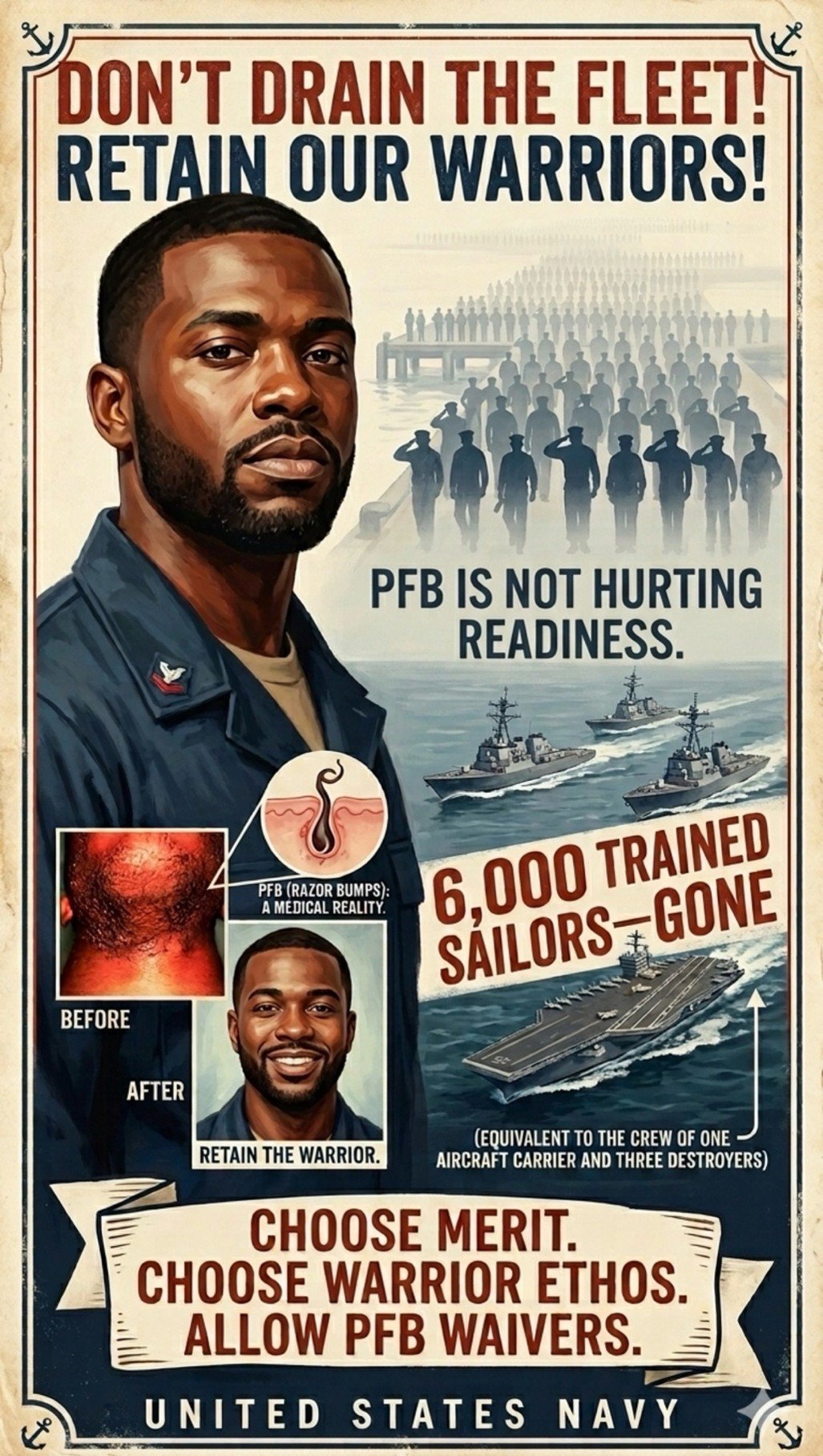
In the military today, a quiet Armageddon is about to occur as we watch the potential separation of up to 5% of the force for a condition known as Pseudofolliculitis Barbae (PFB).
If you are in the military and can’t pronounce it, you need to learn it, because PFB is about to change your life whether you are directly affected or not. At the direction of Secretary of War Pete Hegseth, this condition, which has been waiverable for four decades, is now a disqualifying condition for continued service in the armed forces. Depending on the military service, separations will begin as early as now (Air Force), nine months (USMC) or 11 months (Army and Navy). (1)
As a veteran with 30 years service, and a Human Factors Engineer who has researched this topic extensively in collaboration with military dermatologists, I would like to ask Mr. Hegseth to reverse his position against facial hair in the military, specifically for religious and medical reasons. It would be a win-win situation for him and the military.
The Secretary’s often-articulated core values of merit and warrior ethos would seem to lend support rather than opposition to beards, at least for those with religious or medical waivers. In June he stated, as justification for rescinding the requirement for flu vaccinations, that, “We will not force you [to get a flu shot) because your body, your faith and your convictions are not negotiable.” (2) That is exactly the argument that he could use to support beards; the reasons for beard waivers are also related to individual body characteristics (the medical condition PFB) or religious convictions. If he truly believes in these values, he is missing a huge opportunity when it comes to facial hair.
Despite the sudden prevalence of this issue, many military members and national security members lack familiarity with PFB. A quick primer follows:
PFB is a chronic skin condition primarily associated with the curved shape of the hair follicle and tightly curled hair structure but can be associated with a genetic predisposition. It is triggered by shaving.(3)
There is no “treatment plan” that allows a person with PFB to “return to normal shaving.” Shaving itself, combined with genetics, is the cause of PFB.
Discussions regarding the separation of service members who cannot shave revolve around force protection and risk-to-mission in contaminated or smoke-filled environments where protective masks must be worn. However, considerable research demonstrates that there is minimal impact on forced air mask effectiveness for individuals with 1/8” to 1/4” facial hair; they achieved a satisfactory seal to OSHA standards in the vast majority of cases. (3)
While the effect of facial hair is more pronounced for gas masks in a CBRD environment, the setting of MOPP levels can easily incorporate shaving as additional step when gas masks are issued in the event of a real world threat, as I did in command. Effectiveness can be validated by a periodic fit test. Yes, there is risk, but it can be mitigated.
This shows an exceedingly small risk, and one that we have accepted for decades with no recorded injuries due to mask leakage during fires. I spoke with several military members affected by this policy. They, and their families, are under immense stress – especially those deployed and unable to access medical care. Here are a few of their stories:
Vignette 1
“I am a black Naval officer with PFB. I am fairly senior and have dealt with it for my entire career. Up until last week I felt like I was upwardly mobile in my community, but it appears that those days are over – a selection board will take one look at my photo and vote “Zero” regardless of my accomplishments. I’m still trying to wrap my head around the fact that I was able to serve honorably in a multitude of operational assignments for over 29 years with a beard, and suddenly it appears to be disqualifying. I have made peace with this, and I’m ready to move on. But the impact doesn’t stop there. I have two teenage sons. One of them had decided long ago the Navy was not for him based on watching my career and the things that I had to work through. The second was on the fence, but the new policy essentially shuts the door on him since he has PFB. For me this policy is generational in its impact.”
Vignette 2
“I’m a junior enlisted person who has been in the Navy for six years. I joined the Navy to build a better life. Since joining I have become a naturalized citizen, earned a Bachelor’s and a Master’s degree while working full time on Active Duty. I have PFB and have tried everything but the only thing that works is not shaving. I have applied for a Commissioning program and felt I have a good chance, but the new policy seems to remove that opportunity. I am getting used to the idea that I may have to give up my career because of my PFB, despite having no impact on my performance or ability to do my job. I find the entire process confusing and frustrating. All I want is to do my job and serve my country.”
Vignette 3
“I recently graduated from the United States Naval Academy. Before that I attended NAPS (Naval academy prep school) and that’s when I was originally diagnosed with PFB. They were better with it there, I also wasn’t growing the same amount of facial hair so that could have played a part. They were a lot more understanding at NAPS than what I later experienced at USNA.
“My preparation actually came before plebe summer because I was led to believe that the only reason I had PFB was because I was shaving wrong. (No one ever taught me how to shave) So I tried everything: single and multi-bladed razors, magic shave, heated towels and steam. Using the techniques I figured a way to make my shaving better, but it still didn’t get rid of the PFB or the discomfort that came with shaving.
“So, when Plebe summer came around with completing time hacks, I was unable to properly shave not to mention being told to dry shave in front of everyone on the bulkhead if there was any stubble. I tried to toughen it out for a while because I didn’t want to seem different from my peers it wasn’t until an upperclassman from another company saw my neck and face that I was instructed to go to the doctor and get a chit. At this time when you received a chit you couldn’t line your beard up at all. I thought my facial hair was getting out of control and I didn’t think I was presentable or professional so I decided to line my beard up.
“This was a mistake. When my supervisors saw this, they made me shave immediately and then once again there was stubble so I had to dry shave in the hallway. The discomfort with all the training evolutions or just being outside having the sun and my own sweat run across my razor scrapped neck and face was horrible. I was very self-conscious about my face and neck while at the academy the way people stared at it makes you feel unhuman. Then the irritation and pain cause you to focus on your neck when you could be focusing on much more important things like school.
“When you look at PFB it’s usually minorities that have it. I understand that racism is not the intention of the current rules and policies but when usually only one race has PFB and we are told to be in the back while marching or are hidden at certain events it starts to get your mind racing. It just sucks to be singled out because of a medical condition that for some reason has a negative stigma. After a while you understand “it is what it is” and you may not be able to get certain jobs as a flag aide or things of that nature I realized this at the Academy that because of me not being able to shave I will probably miss out on a lot of opportunities in the Navy. Now it appears I may be separated before my career has really begun.”
Vignette 4
“I’m scheduled to promote to Lieutenant Commander (LCDR) on September 1. I’ve served for 19 years, enlisting in 2007. Throughout my career I’ve had intermittent medical shaving waivers for pseudofolliculitis barbae (PFB). At no point has this condition affected my ability to perform my duties, deploy, qualify, or lead Sailors.
“Early in my career, having a shaving waiver as a white Sailor came with a lot of ridicule. I was routinely told by senior leaders, “You’re not Black. Shave your f****** face.” Wanting to fit in and avoid the attention, I often shaved anyway despite the medical consequences. As I gained experience and advanced in rank, I became more confident advocating for my own health and refused to accept that kind of toxic leadership.
“I made Chief Petty Officer in 2015 and was commissioned as a Limited Duty Officer in 2017. Across my career I’ve completed 13 operational submarine deployments. During every deployment, once we were underway, no-shave morale chits were standard practice. Neither I nor my teammates were required to shave, and it was never treated as an operational safety concern. Throughout all of those deployments, our ability to accomplish the mission was never questioned because of PFB or facial hair. I have earned numerous personal, campaign and unit awards. I also completed a Bachelor of Science while enlisted and a Master of Arts after commissioning, accomplishing both while serving on active duty and between deployments.
“I share that background because I want to make one point: PFB has never prevented me from deploying, qualifying, leading Sailors, or successfully completing any operational assignment I have been given. My record demonstrates that. When the new policy was announced, I immediately went to Navy Medical to understand my options. Based on the guidance I received, if I continue requesting recurring 90-day shaving waivers, after one year I could be processed for administrative separation. If I accept my promotion to LCDR on September 1, I will incur a three-year service obligation. Yet, based on the guidance I received, I could still face administrative separation before reaching retirement eligibility, despite nearly two decades of honorable service. That leaves me with an incredibly difficult decision. I can accept promotion and resume shaving, knowing it will aggravate a documented medical condition, or I can decline promotion and retire instead.
“For me, this isn’t about wanting to wear a beard. It’s about facing the possibility that a medically documented condition—not my performance, conduct, leadership, or ability to serve—could force me to choose between my health and the career I’ve spent nearly 20 years building.
“I understand the Navy has the authority to establish grooming standards, and I have lived under those standards for my entire career. I am not asking for special treatment. I am simply asking that decades of demonstrated readiness, operational performance, and documented medical evidence be given appropriate weight when determining whether a Sailor remains fit to serve. My concern is that this policy appears to place successful, deployable Sailors with documented medical conditions in an impossible position. I hope my story helps illustrate the very real impact these changes may have on experienced Sailors, their families, and ultimately the retention of proven leaders the Navy has spent years developing.”
These are real people, with real families. There are over 6000 of them in the Navy alone, and potentially quadruple that across the entire military. They feel betrayed, abandoned, and forgotten by the Navy they have loved and served. How do I know? They told me.
Contradictions
Finally, beards are historically aligned with the warrior ethos that the Secretary of War wants for the military. Navy SEALS are routinely authorized to have beards, and they are truly amazing warriors. He also once said, “If you want to grow a beard, join the special forces.” He has already associated beards with an elite fighting unit, and expressed willingness to abandon grooming standards if the service-member is of a certain military skillset. This reveals either a lack of consistency or a contradiction in this new policy.
Beards are aligned with warrior ethos, independent of merit, and a historical symbol of strength and religious conviction, which puts them in perfect alignment with his values. Remember, this is not a case where a policy change was recommended by the services and approved by the Secretary; it came from him. But his actions contradict his words; what this policy is saying is, “We will force you (to shave) because your body, your faith and your convictions are negotiable.” This stance is contrary to Secretary of War’s previously stated values regarding bodily autonomy and religious conviction.
Further, many of our NATO Allies,such as Great Britain and Germany, allow beards with no operational or safety impact. Compared to navies around the world, our clean-shaven force is an outlier.
The Cost to the Service
Most importantly, if the services follow through with the Secretary’s plan to separate those service members with PFB, we will be ruining lives and careers, as well as creating gaps in critical skill areas – many more than those separated during the pandemic for refusing the COVID vaccine. Let’s look at the numbers. I’ll focus on the Navy, and the readers can extrapolate the numbers for each service.
Since the majority of those with PFB are Black, this policy has a disproportionate, if coincidental, racial outcome. This may not be the intent, but it is clearly the impact. Just within the Navy, the new policy will discharge between 6,000 and 12,000 Sailors in the next two years. Demographically that represents between 3-5% of all Sailors, but could exceed 20-25% of Black Sailors, who represent 65-85% of those with waivers. (4) That is the equivalent of an entire Carrier Strike Group, at a time when our warships are engaged in combat operations and extended deployments with over 10,000 gaps at sea.
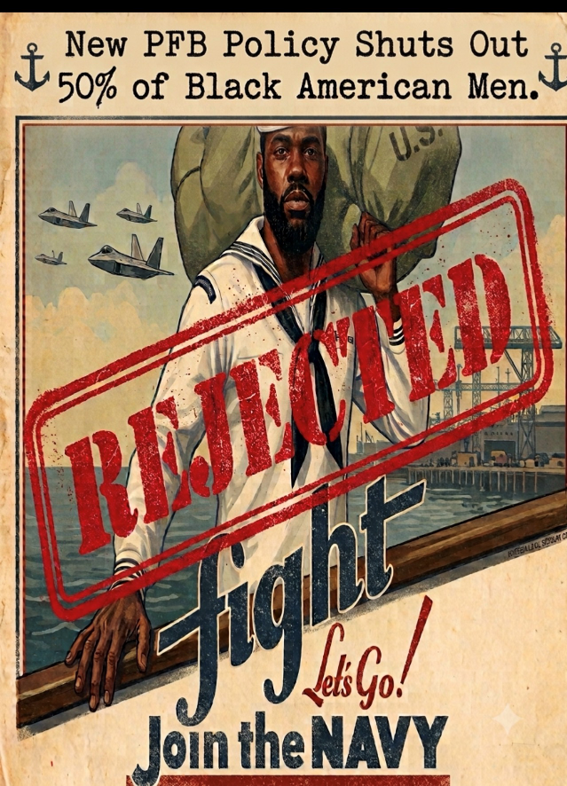
The new Navy policy goes a step further, buried in a small sub paragraph in the policy, applying the PFB restriction to new recruits as well. This will effectively shut the door to Navy service for 50% of Black Americans and ultimately change the face of the Navy. It will certainly turn back the clock by undoing the progressive policies of CNO Elmo Zumwalt in the removal of barriers for minorities. But the Secretary can change that by allowing those with PFB to continue to serve on a waiver.
Talk to Your Experts and Your Sailors
I encourage the Secretary of War to meet with a Dermatologist to discuss the true nature of PFB; then meet with a group of “bearded warriors”, those with approved waivers – over a cup of coffee. Listen to their stories. Look past the beard at the person behind it; they are proud professionals who just want to serve their country, and exactly the type of people we want leading in tomorrow’s wars.
Dr. John Cordle is a retired Navy surface warfare officer (nuclear). He commanded the destroyer USS Oscar Austin and the cruiser USS San Jacinto during his 30-year military career and was recognized with the U.S. Navy League John Paul Jones Award for Inspirational Leadership.
References
1. NAVADMIN 162/26, “Navy Grooming Standards, “(https://www.mynavyhr.navy.mil/
Portals/55/Messages/NAVADMIN/FACT_SHEETS/Fact_Sheet_NAV_162_26.pdf).
2. “US military service members will no longer be required to get annual flu shot,” The Guardian, 21 April 2026 (https://www.theguardian.com/us-news/2026/apr/21/military-flu-shot-
requirement-pete-hegseth).
3. “Review of Treatments for Pseudofolliculitis Barbae,” National Institute of Health, (https://
pubmed.ncbi.nlm.nih.gov/36840647/).
4. Influence of Facial Hair Length, Coarseness, and Areal Density on Seal Leakage of a Tight-
Fitting half-face Respirator, Floyd et al, University of Oklahoma College of Public Health.
5. Transcript of SECDEF Speech to Flag and General Officers, 30 September 2025, (https://www.war.gov/News/Transcripts/Transcript/article/4318689/secretary-of-war-pete-hegseth-
addresses-general-and-flag-officers-at-quantico-v/).
6. New Navy Policy Limits Medical Shaving Waivers to One Year, USNI, July 9, 2026.
Featured image: Fleet Master Chief Petty Officer Raymond D. Kemp, fleet master chief for U.S. Naval Forces Europe-Africa, waits to receive the American flag during the reading of “Old Glory” at his retirement ceremony on Naval Support Activity Naples, Italy, June 4, 2019. (U.S. Navy photo by Mass Communication Specialist 3rd Class Damon Grosvenor/Released)
Discover more from Center for International Maritime Security
Subscribe to get the latest posts sent to your email.
