

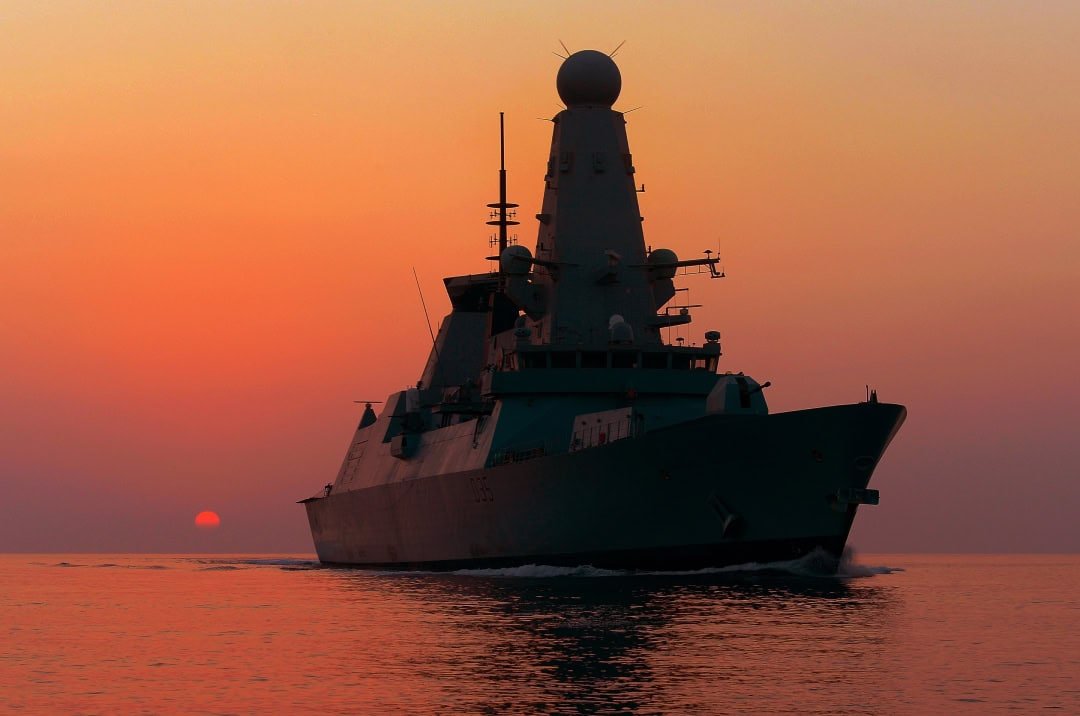

The UK government has announced that the Royal Navy’s (RN) Type 45 Daring-class destroyer HMS Dragon will be deployed to Cyprus in the Mediterranean Sea. Dragon will provide air-defence capabilities to counter the air threat emanating from Iran across the Gulf region and beyond, following the US-Israel strikes on Iranian nuclear, military, and government targets that began in late February.
According to reports, Iran’s response so far has targeted US bases in the Gulf region, other Gulf states, and interests of US allies further afield. Its response has primarily involved launching ballistic and cruise missiles, as well as one-way attack uncrewed aerial vehicles (OWA UAVs).
An OWA UAV struck the UK Royal Air Force (RAF) base at Akrotiri, Cyprus, during the early days of the conflict. The BBC, citing Western officials, reported that the drone had not been launched from Iran itself.
In turn, the UK announced a Type 45 deployment to the region to provide a defensive presence and air defence coverage for Akrotiri, Cyprus, and, more broadly, across the area.
Conversations centred initially on HMS Duncan. However, Duncan had already been committed to deploy on North Atlantic tasking across 2026, including in Standing NATO Maritime Group 1 (SNMG1).
Ultimately, Dragon was chosen for the Mediterranean deployment. Dragon recently completed a maintenance period and was already preparing to return to operational tasks on another mission. Now being prepared for this new deployment, the process includes loading Sea Viper air-defence missiles, which are installed in the Type 45s’ 48-cell Sylver A50 vertical launching system.
Reports confirm that the UK Ministry of Defence verified such work was ongoing, being conducted at HM Naval Base Portsmouth, home to the Type 45s.
The Type 45s’ anti-air warfare capability means Dragon’s presence will also bolster NATO’s ballistic missile defence posture, which NATO Allied Command Operations announced on 5 March following alliance capabilities successfully intercepting a ballistic missile fired from Iran towards Türkiye the day before.
The decision to keep Duncan assigned to NATO duties in the North Atlantic—even though the ship recently completed the UK’s QinetiQ-hosted Exercise ‘Sharpshooter’, which includes countering drone attacks—is significant. Duncan had worked with SNMG1 on North Atlantic tasks in late 2025. Therefore, in light of NATO’s early 2026 decision to strengthen maritime presence around the Greenland-Iceland-UK (GIUK) Gap and the UK’s support for this commitment, Duncan was a sensible choice.
The enduring NATO commitment is also significant, particularly in sending a deterrence and defence message in the North Atlantic during a time of crisis and conflict elsewhere. The Russo-Ukraine war persists unabated, and Russia’s Northern Fleet – largely unaffected by the war’s attrition – continues to expand its presence and influence on and below the surface.
The RN has six Type 45s. Based on a rough naval ‘rule of thumb’, six ships can support two sustained deployments, with three ships in a ‘roulement’ cycle providing one ship on station during each of the two taskings. Sometimes, more than two missions can be supported from six ships if sufficient platforms are operationally available. However, HMS Dauntless and HMS Diamond are currently in refit after recent extensive operational periods. HMS Defender and HMS Daring are already alongside undergoing work. The entire class has also been undergoing a power improvement programme (PIP) to boost each ship’s power and propulsion outputs. This has affected operational rhythm, but with Daring, Dragon, and Dauntless having completed PIP, the class is now beginning to recover its rhythm.
The UK’s initial plan was to acquire 12 Type 45s, but in the late 2010s, the decision was made to reduce that number to six.
by Dr. Lee Willett
