

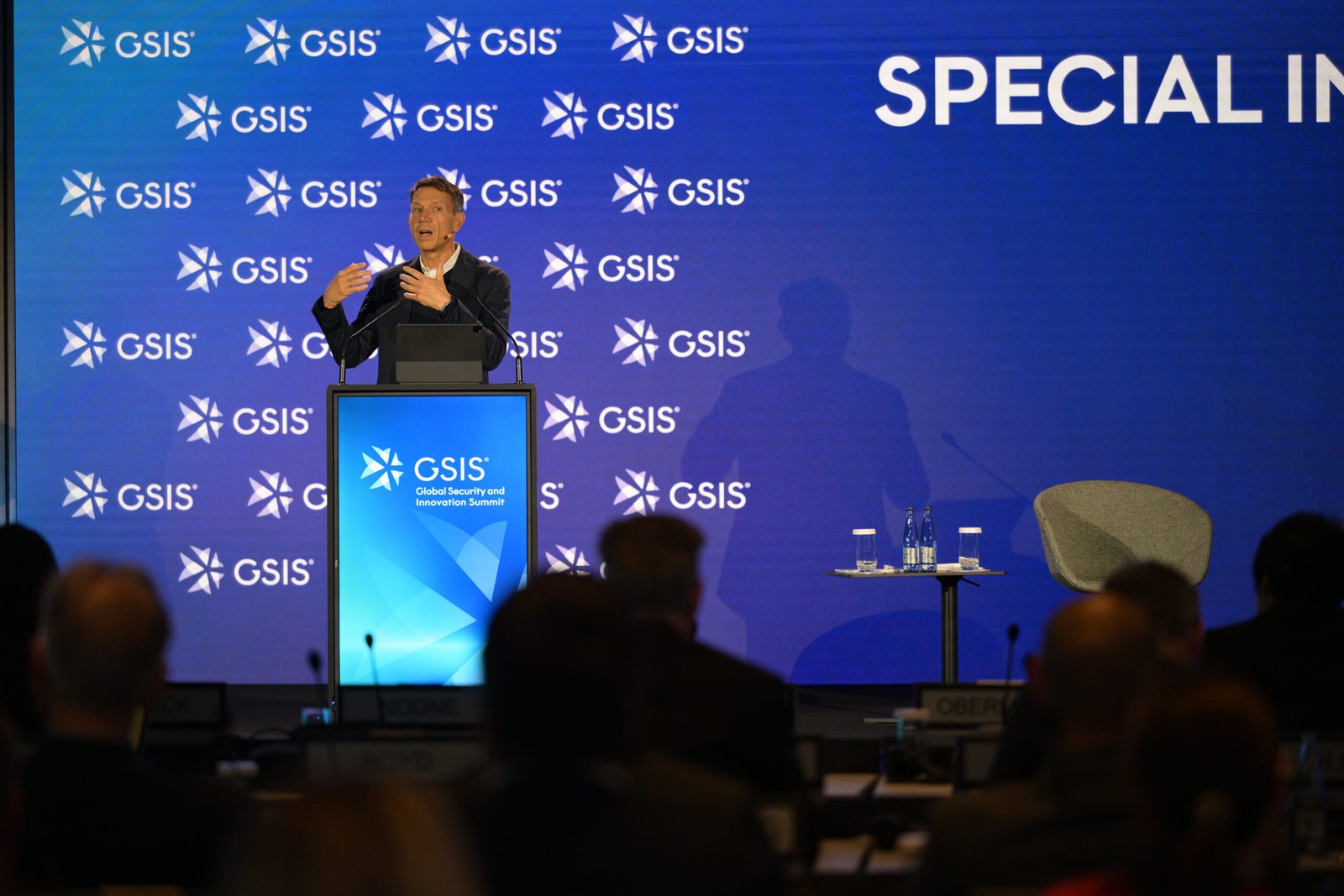
ESD: Since we last spoke the international security situation continues to be complex, the situation of the US in the Middle East appears to have reached resolution, while the conflict in Ukraine continues and numerous conflicts continue in Africa. How will GSIS tackle this complex global security environment at its conference?
Argirakos: GSIS will not try to treat every crisis as a separate universe. Ukraine, the Middle East, Africa, the Indo-Pacific, cyber conflict and economic coercion are different expressions of a broader strategic reality. The central question is whether open societies can still organise the capabilities they need to defend their own order. That means technology, industrial capacity, infrastructure, finance, supply chains and political will. This is where GSIS wants to make a contribution. We are not interested in another elegant description of instability.
The conference is designed to connect strategic analysis with the practical conditions of action. So the focus in Hamburg will be on capability: what Europe and its partners need to build, finance, protect and sustain in a more contested world. Security is no longer the responsibility of one sector alone. It has become a test of how seriously societies organise themselves.
ESD: Access to raw materials, from exotics such as rare earths to widely used metals such as copper continue to be a concern in the US and Europe. Will the question of access to strategic raw materials and their economic consequences be a factor at GSIS 2026?
Argirakos: Yes. Strategic raw materials will be a factor at GSIS 2026 because they are now part of the security equation. Rare earths, copper, lithium, semiconductors and other critical inputs determine whether defence systems, energy infrastructure, digital networks and advanced technologies can be built at scale. If these foundations are fragile, strategic autonomy remains a slogan. At GSIS, we will address this through the lens of supply chain resilience. The question is not only where materials come from, but whether Europe and its partners can identify dependencies early, diversify sources, mobilise investment, strengthen industrial capacity and build trusted partnerships.
The economic consequences are direct. Procurement, competitiveness, infrastructure, defence production and innovation all depend on access to critical materials. Dependency is vulnerability before it becomes leverage. That is why this issue belongs at the centre of a serious security discussion.
ESD: You have a partnership with the Special Competitive Studies Project (SCSP) in Washington DC, could you tell us more about this and how important are transatlantic connections to GSIS?
Agirakos: The partnership with the Special Competitive Studies Project is important because SCSP works at the intersection that matters for GSIS: technology, national security, innovation and long-term strategic competition. The transatlantic relationship remains indispensable. But it must become more practical. Shared values matter, but they do not replace capability. Europe and the United States need to work together on AI, defence innovation, cyber resilience, secure supply chains, critical infrastructure and industrial scale. At the same time, GSIS should not simply reproduce an American debate in Europe.
Europe has its own strengths. It has industrial depth, engineering quality, regulatory influence, financial centres and strategic geography. The task is to organise these strengths more effectively and connect them intelligently with our partners. For GSIS, transatlantic cooperation is therefore not ceremony. It is capability-building among democratic societies. The West will not be defined by what it says about itself, but by what it is still able to build together.
ESD: You recently announced the Hamburg Dual Use Forum working with the Hamburg Chamber of Commerce. What will this arrangement achieve?
Argirakos: The Hamburg Dual Use Forum is meant to create a practical bridge between business, technology, capital and public institutions. Many of the technologies that matter for security today come from the civilian economy: AI, cyber, robotics, sensors, logistics, maritime systems, space, autonomy and advanced manufacturing. But many companies still face uncertainty when their technologies move closer to defence and security. They need clarity on regulation, procurement, financing, reputation and access to the right public-sector counterparts. Together with the Hamburg Chamber of Commerce, we want to reduce that friction. The Forum should help companies understand the security relevance of their capabilities and connect them with the institutions and partners that can turn potential into application. Hamburg is the right place for this. It is a port city, an industrial city and a logistics hub. It understands both openness and exposure. This is not about militarising the economy. It is about making openness resilient.
ESD: Finally, with less than six months to go until GSIS 2026 in Hamburg, what can you say about how the event will be structured?
Argirakos: GSIS 2026 will be structured around three main pillars: advanced technology, the finance of innovation and supply chain resilience. These are not decorative themes. They describe the conditions under which security will be organised in the coming decade. Advanced technology determines speed and advantage. Finance determines whether innovation can scale. Supply chain resilience determines whether capability can be sustained under pressure. The programme will include plenary sessions, focused tracks, closed-door discussions, partner formats and innovation elements. But the main point is not format for its own sake. The main point is strategic density with fewer ceremonial moments and more consequential conversations. The ambition is to develop GSIS into a serious European platform for the new security economy

GSIS – Global Security and Innovation Summit
