

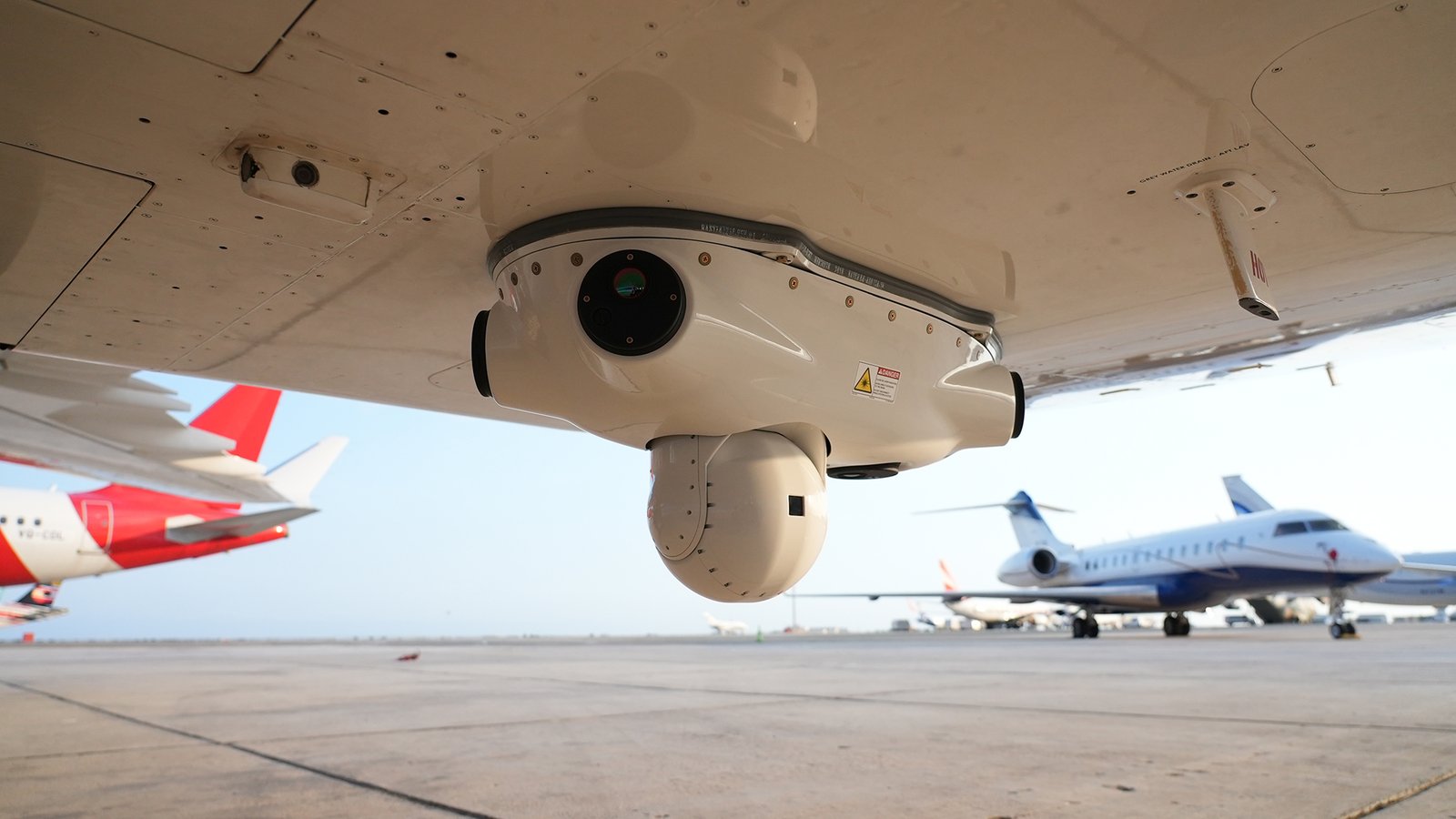
Israeli company BIRD Aerosystems has completed the installation and European Aviation Safety Agency (EASA) certification of its Airborne Missile Protection System (AMPS) with Directional Infrared Countermeasures (DIRCM) on a Bombardier Global 7500 business jet. The certification enables the aircraft to operate with the integrated missile protection system as part of its approved configuration, addressing growing concerns over the proliferation of man-portable air defence systems (MANPADS) and the vulnerability of high-value civilian aircraft.
The installation marks another step in the expansion of BIRD Aerosystems’ missile protection technology into the business aviation and VVIP transport markets. While airborne missile protection systems have traditionally been associated primarily with military aircraft and government transports, operators of civilian business jets are increasingly considering such capabilities when flying into regions where shoulder-launched missiles may pose a threat.
According to the Israeli manufacturer, the successful certification confirms that the integration of AMPS on the Global 7500 meets applicable European airworthiness requirements. This is particularly significant for business aircraft, where modifications to avionics, electrical systems and the aircraft structure must satisfy stringent certification standards.
Detecting and Defeating Infrared-Guided Missiles
BIRD Aerosystems’ AMPS is designed to protect aircraft against MANPADS and other infrared-guided missile threats. The system combines missile warning sensors, threat detection and confirmation, tracking and directional infrared countermeasures. When an incoming missile is detected and identified as a threat, the DIRCM subsystem directs infrared countermeasure energy towards the missile’s seeker in order to disrupt its guidance.
Unlike conventional expendable countermeasures such as flares, DIRCM systems are intended to interfere directly with the missile’s infrared seeker without relying on the release of pyrotechnic decoys.
According to BIRD Aerosystems, the integrated architecture is designed to provide rapid and accurate responses while reducing false alarms to virtually zero. The manufacturer has not disclosed the specific sensor configuration or performance parameters of the installation on the Global 7500. The system is also designed to be adaptable to different aircraft types and operational requirements. BIRD Aerosystems provides services covering the entire programme lifecycle, including system design, integration, certification, installation and operational support.
EASA Certification for the Global 7500
The Bombardier Global 7500 is a long-range business aircraft used for executive and VIP transport. Its combination of range, cabin capacity and operating flexibility makes it suitable for missions requiring long-distance travel without intermediate stops.
The integration of an airborne missile protection system on such an aircraft involves more than mounting sensors and countermeasure equipment. The installation must also be compatible with the aircraft’s existing systems and comply with applicable airworthiness and safety requirements. The EASA certification therefore represents an important element of the programme, allowing the protection equipment to form part of the aircraft’s certified configuration.
BIRD Aerosystems did not identify the aircraft operator or disclose the number of Global 7500 aircraft expected to receive the system. “The Global 7500 is another aircraft now protected by BIRD Aerosystems, joining a growing number of high-value platforms equipped with our airborne missile protection suite,” said Ronen Factor, Co-CEO and Founder of BIRD Aerosystems. He added that the programme reflected the company’s expanding presence in the market and increasing demand for protection against MANPADS and other missile threats.
Growing Demand from Business Jet Operators
According to Israeli industry sources, interest in airborne missile protection systems has increased in recent months, particularly among operators of business jets flying to destinations where MANPADS are believed to be accessible to terrorist organisations or other non-state armed groups.

Israeli manufacturers of aircraft protection systems have reportedly received enquiries from operators concerned about the vulnerability of their aircraft during take-off and landing, when aircraft are generally operating at lower altitudes and may be exposed to shoulder-launched missile threats.
Israeli sources told ESD that part of the growing demand may be connected to humanitarian flights associated with the war in Ukraine. Some of these missions reportedly involve business jets operating in or near regions where the security situation presents additional risks. However, the sources did not provide figures establishing how much of the recent demand is directly attributable to humanitarian operations.
MANPADS Proliferation Remains a Security Concern
The interest in aircraft protection systems comes against the background of the continued proliferation of portable surface-to-air missiles. Although MANPADS are primarily held in government arsenals, some have reached terrorist organisations, insurgent groups and other non-state actors through illicit transfers, theft or diversion from military stockpiles.
Research by the Small Arms Survey, cited by the Arms Control Association, has identified reports of illicit MANPADS possession or transfers in more than 32 countries and territories since 2011. The reported cases include advanced systems obtained by non-state armed groups, including Russian-backed forces operating in Ukraine before the full-scale Russian invasion in 2022 and ethnic armed organisations in Myanmar. These findings illustrate the difficulties of controlling the circulation of portable air defence weapons, even where international efforts seek to prevent their illicit transfer.
For civilian aircraft, the potential threat is particularly relevant during operations at airports in unstable regions. MANPADS are designed to engage aircraft at relatively low altitudes, making the departure and approach phases of flight a particular concern.
Missile Protection Beyond Military Aviation
The Global 7500 installation highlights a broader development in the airborne protection market. Technologies originally developed primarily for military and government aircraft are increasingly being considered for civilian platforms operating in elevated-threat environments. For business jet operators, however, the adoption of such systems depends not only on the availability of suitable technology but also on aircraft compatibility, certification requirements, installation complexity and long-term support.
By completing the EASA certification of its AMPS installation on the Global 7500, BIRD Aerosystems has demonstrated an additional integration option for operators seeking protection against infrared-guided missiles. Whether the growing interest reported by Israeli sources will translate into larger-scale installations across the business aviation sector remains to be seen.
Author: Arie Egozi, Israel Correspondent
Click here to read the latest issue of ESD.
