

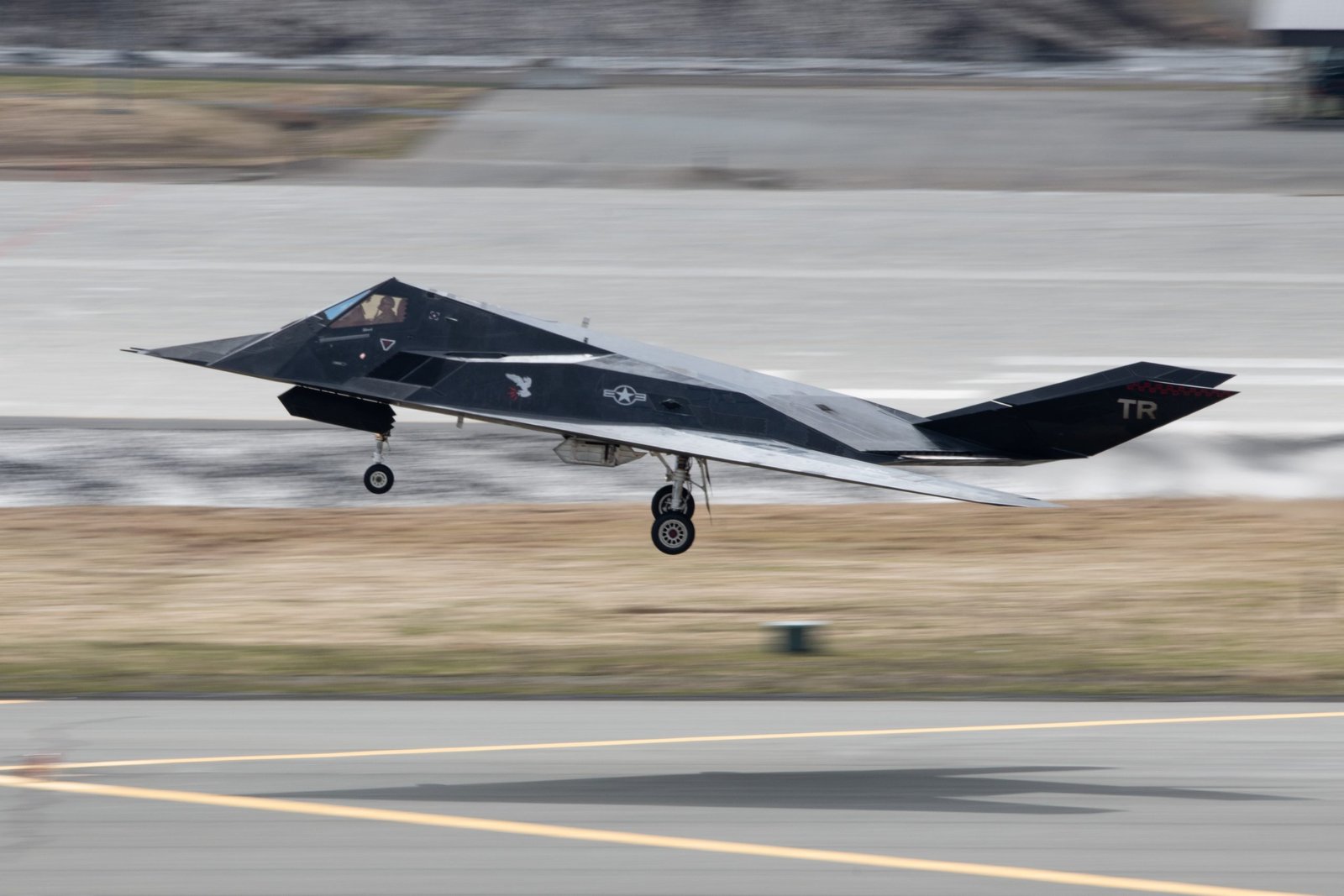
The Smithsonian’s announcement that an F-117A Nighthawk, tail number 85-0818, is headed to the Smithsonian Institution’s National Air and Space Museum, or NASM, is welcome news. Historically, 90 percent of all visitors to Washington D.C. go to the Smithsonian. Of those, 90 percent visit the NASM, either downtown or at its Dulles annex; some visit both. 85-0818 will be seen by millions.
The acquisition of this Nighthawk fills a long-standing historical gap—indeed, need—in the collections of what is generally considered the world’s premier air and space museum.
There are F-117As on exhibit at a few other military and aviation museums across the country (including at the National Museum of the U.S. Air Force at Dayton, Ohio), but visitors to the NASM have not been able to see this truly transformational Air Force airplane.
Exposing the public to this history and sharing its story will help American taxpayers better understand what their hard-earned dollars do for our Air Force and, perhaps, inspire future generations who want to fly or design future generations of aircraft.
By doing so, the Air Force is sharing an important and little-known piece of its history with a broader audience.
Created by a small team working for Lockheed Skunk Works Chief Ben Rich, the F-117A is not just one more aging warbird cleaned up for exhibit. In practical terms, the F-117A began the “stealth” revolution that today includes aircraft, missiles, drones, and spacecraft, as well as treatments for ships at sea.
Some notable air weapons—Firebee reconnaissance drones in Vietnam, the Lockheed Blackbird strategic reconnaissance aircraft, and selected Cold War missiles—had stealthy features. But the F-117A was the world’s first aircraft designed from the outset with an unprecedentedly small radar cross section, a reduced infrared signature, and reduced noise and visual signatures. These attributes were made possible by its shape, radar-absorbent materials, radar-absorbent structures, and radar-absorbent edge-treatments and coatings.
Members of the design team recognized it was likely impossible to develop a truly invisible airplane—at least with the faceted technology of “first generation” stealth—but that if they could come up with a design that could frustrate search, tracking, and fire-control radars, they could design an airplane that would be only fleetingly and tantalizingly visible. Such a plane could not be tracked and would be virtually impossible to target except at very close range. Thus, its reflective signature characteristics took precedent over all other design criteria, a first in the history of aircraft design.
The F-117 was a product of the computer age, made possible by the galloping advances in computer prediction and command execution by Moore’s Law. Inherently unstable, its unique radar-defeating shape demanded computerized “fly-by-wire” flight control, as well. It incorporated a forward-looking infrared sensor and laser targeting attack system.
Though a product of the computer age, the roots of the F-117 went back to the Great War, when German and Allied designers tried to reduce the visual signature of early deep-penetration reconnaissance and bomber airplanes by incorporating see-through translucent coverings over their wooden structures, or complex camouflage schemes. Neither worked well.
Striking strategic targets behind enemy lines was likewise an early objective of airpower advocates all the way back to World War I. Later, deep strikes into Germany, Occupied Europe, and Japan helped the allies win World War II. But the achievements of early strategic bombing had to be weighed against heavy losses, which led to tens of thousands of dead, missing, and wounded aviators across multiple wars.
During the Cold War, advances in air defenses raised the price and risk of air combat. Sophisticated air defense fighters, new radar guided surface-to-air-missiles, and improved antiaircraft artillery—increasingly netted into ever-more-sophisticated command, control, communications and intelligence networks—began to gain the upper hand.
American aircraft losses in Vietnam from 1965-1973 (and Israeli losses in the October 1973 Arab-Israeli War) profoundly demonstrated that the ever-more-dangerous linkage of radar-cued SAMs and flak, coupled with infrared MANPADS and mobile antiaircraft systems, such as the notorious Soviet ZSU-23-4 Shilka, created a new and highly lethal air defense nexus.
By 1972-1973, these weapons were endangering third-generation aircraft, such as the then-new F-4E, and even threatening new fourth-generation combat aircraft, such as the F-14A, F-15A, F-16A, and F/A-18A, which were then in development.
In the final two weeks of Operation Linebacker II, in December 1972, the U.S. lost 27 planes over North Vietnam—including 15 B-52 bombers, the iconic backbone of America’s bomber force. The following year, in the 1973 Yom Kippur War, Israel lost over a 100 aircraft in a single month—35 percent of its prewar aircraft.
Applying those loss rates to a potential Soviet assault through the Fulda Gap against NATO, American military leaders realized the U.S. Air Force would run out of planes in only about two weeks.
Something had to change. DARPA, the Air Force, and industry attacked the problem, inventing an aircraft unlike any previously seen. Ironically, DARPA’s choice of possible contenders for a low radar cross section signature design did not include Lockheed. But Ben Rich’s strenuous advocacy finally led to the inclusion of the Skunk Works, which ultimately won a “pole off” radar test range competition against Northrop. By 1977, Lockheed test pilots were secretly flying the experimental “Have Blue” against a variety of radar types, confirming it was nearly invisible to conventional radars. Though both “HB” demonstrators eventually crashed (one from a hard landing, and the other from an inflight fire—both pilots survived), these had nothing to do with stealth, and they provided vital lessons for the future.
Just four years later, Lockheed delivered the first F-117 Nighthawk. What Americans would come to know as “the Stealth Fighter” was roughly the size of an F-15A, with a flyaway cost of $42.6 million in then-year dollars. Nine years after that, in the summer of 1990, the USAF had a fleet of 59—just in time for Operation Desert Storm.
Operating in total secrecy from a specially constructed base at Tonopah in the Nevada desert, the F-117A and its mysterious parent unit, the 4450th Test Group, was among the nation’s biggest secrets. In 1983 it achieved initial operational capability, though further refinement and development of its signature GBU-27 hardened 2,000-lb laser-guided bomb took still more time. In 1988, in a move both to deter the Soviet Union and to address what were increasingly widespread calls for some information release, officials finally shared a grainy image of the aircraft with the public.
The Nighthawk’s first operational use over Panama against a military facility at Rio Hato during Operation Just Cause was a disappointment. Confusion over targeting from higher command and technical problems with the target designation system led to one airplane significantly missing its aim point. Perhaps predictably, after that, critics attempted to use the results to argue against the viability of stealth.
Yet in Desert Strom, the Airmen of the 37th Tactical Fighter Wing fully demonstrated the power of stealth. On Jan. 17, 1991, the opening night of Operation Desert Storm, 36 F-117s generated 42 attack sorties and struck roughly 31 percent of the coalition’s targets across the breadth and depth of Iraq—despite constituting just 2.5 percent of the strike force. They all returned safely home.
The attacks constituted a revolution in air warfare, evident by comparing what the F-117s did with a nonstealthy strike package launched that same night. To get to a single target, that strike package employed 41 planes—only eight of which dropped bombs. Without stealth, the eight bomb-carrying planes needed multiple escorts to jam air defense radars, suppress surface-to-air missile threats, and counter enemy fighters. In contrast, operating by themselves, every stealth fighter launched was a striker, capable of hitting two targets on a single sortie.
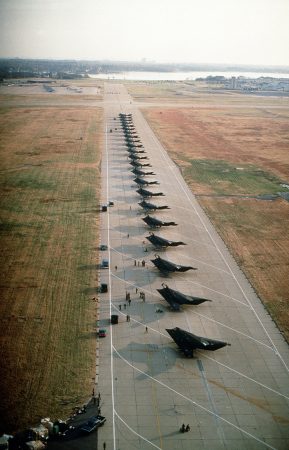
That night, stealth demonstrated unparalleled operational value. From a cost perspective, even though each individual F-117 was more expensive than conventional equivalents, stealth proved more efficient than conventional attack. The stealth strike package required no escort or supporting aircraft aside from refueling tankers and thus placed fewer aircrew in danger. Considering the cost of more planes, more aircrew, sustainment costs, logistical support, and basing requirements, the U.S. Air Force had permanently altered the rules of air combat.
Commanders prized the F-117s, which continued in heavy use in nearly every U.S. combat operation through Operation Iraqi Freedom. The Air Force retired the planes in 2008, putting them in protected storage at the secret base first constructed for their use in Tonopah, Nev.
By then, however, stealth aircraft had multiplied across the force. The F-117 paved the way for the stealthy B-2, F-22, F-35, RQ-170, and the next-generation B-21 and F-47. Today, newly designed semi-autonomous aircraft, known as Collaborative Combat Aircraft, and some high-end munitions also harness stealth characteristics.
The F-117 was the unique product of American innovation, an extraordinarily successful quick-turn acquisition program, with the first aircraft delivered in 1981 and IOC achieved in 1983. Many people from various organizations came together to make it a success, and it teaches what’s possible when government and industry innovators partner and collaborate on a well-defined challenge, using streamlined management, minimal bureaucracy, and a special access program approach.
Creating a flying stealth airplane was one thing; turning it into a devastating operational weapon system was quite another. Here the senior leaders, executives, planners, designers, builders, and others delivered when the chips were down. The F-117A at the Smithsonian will stand as a reminder and tribute to them and, in particular, to all those Air Force military and civilian senior leaders, engineers, test pilots, flight test engineers, test directors, planners, operational combat airmen, and maintainers working nationwide from the Pentagon to bases and remote test sites in the deserts of the great Southwest.
Among the most crucial lessons of the Stealth Fighter are ones we learned in its first real operational test: that just as airpower pioneers predicted, deep strike attack is both the sine qua non and the secret to victory. And in the modern era, only stealth makes that possible.
