

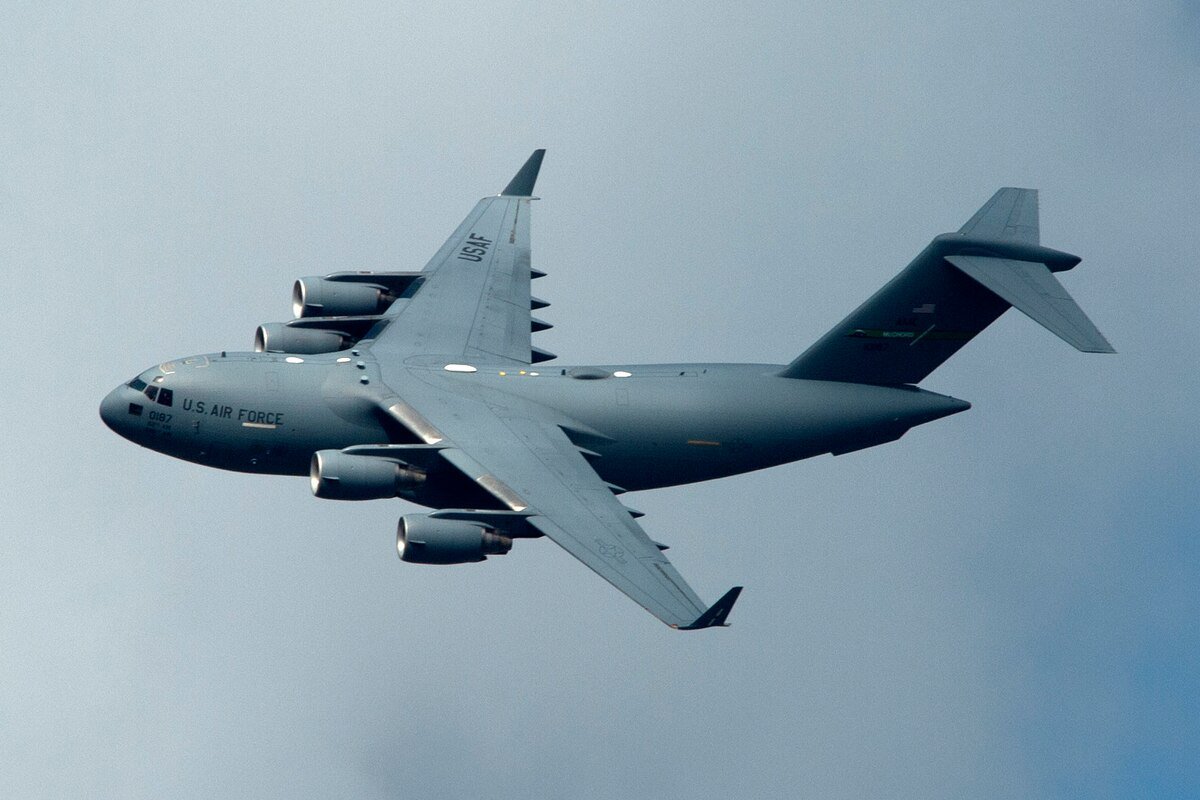
KISSIMMEE, Fla.—After years of experiments and tests, senior Air Force leaders say they’re on the verge of using C-17s and other cargo aircraft to launch cruise missiles via airdrop, touting the development as a way to bolster the combat fleet and a major shift in the service’s mindset.
The Air Force is investing heavily in its Family of Affordable Mass Missiles, or FAMM, program, to expand its munitions stockpile with affordable, less exquisite, air-to-ground missiles. In July, the Pentagon announced framework agreements for multiyear deals with three companies to produce and develop two versions of FAMM weapons—FAMM-Lugged, for fighter aircraft, and FAMM-Palletized, for airlifters.
Air Force Chief of Staff Gen. Kenneth S. Wilsbach said Nov. 6 he was “excited” about arming the mobility fleet with the FAMM-P weapon but stressed the that “concept is more complex than just rolling dumb munitions off the back of an airplane.”
The palletized munitions concept involves putting a specialized container loaded with cruise missiles on a standard airdrop platform. The container is released like any other airdrop and deploys its parachute, then the weapons are deployed, ignite their engines, pull up, and proceed toward their target.
“This system is modular and smart; the weapons are networked and affordable,” Wilsbach told Airmen at the Airlift/Tanker Association’s 2026 Symposium.
“As you might gather, capabilities like FAMM-P blur the distinction between our [combat air forces and [mobility air forces] mission sets. That’s a cultural shift we need to be prepared for, and I need every mobility Airman in the room to embrace that change.”
Air Mobility Command Boss Lt. Gen. Dan Tulley also spoke at the conference about C-130s and C-17s could deliver “mass fires on the adversary” through FAMM-P.
The current FAMM program evolved out of an Air Force effort to find affordable cruise missiles to drop via pallets from cargo planes in Air Force Research Laboratory experiments known as “Rapid Dragon,” which debuted in 2019. It was previously known as “Franklin,” which sought to build cruise missiles for $100,000 per round as compared to more exquisite weapons like the Joint Air-to-Surface Standoff Missile, which can cost between $1.5 million and $2.6 million each.
In April, the Air Force Life Cycle Management Center renamed the effort “Dragon Cart” and made it an official program of record. In its 2027 budget request, the service is asking for $355 million for procurement of 1,000 FAMM weapons, according to budget documents. Budget projections show plans to acquire 28,000 FAMM missiles over the next five years, with a price tag of $12.6 billion.
Wilsbach said each FAMM-P “costs about a tenth” of one JASSM, and the lead time is “months, not years.”
“Solutions like FAMM-P augment fighter rails and bomber bays to creatively scale our combat power at a fraction of the time and cost of more exquisite options,” Wilsbach said.
U.S. strike aircraft used roughly 1,100 JASSMs during Operation Epic Fury out an of an estimated 4,400 in the inventory before the conflict, according to an April report by the Center for Strategic and International Studies. The report also noted that the JASSMs take two years to go from order to delivery.
