

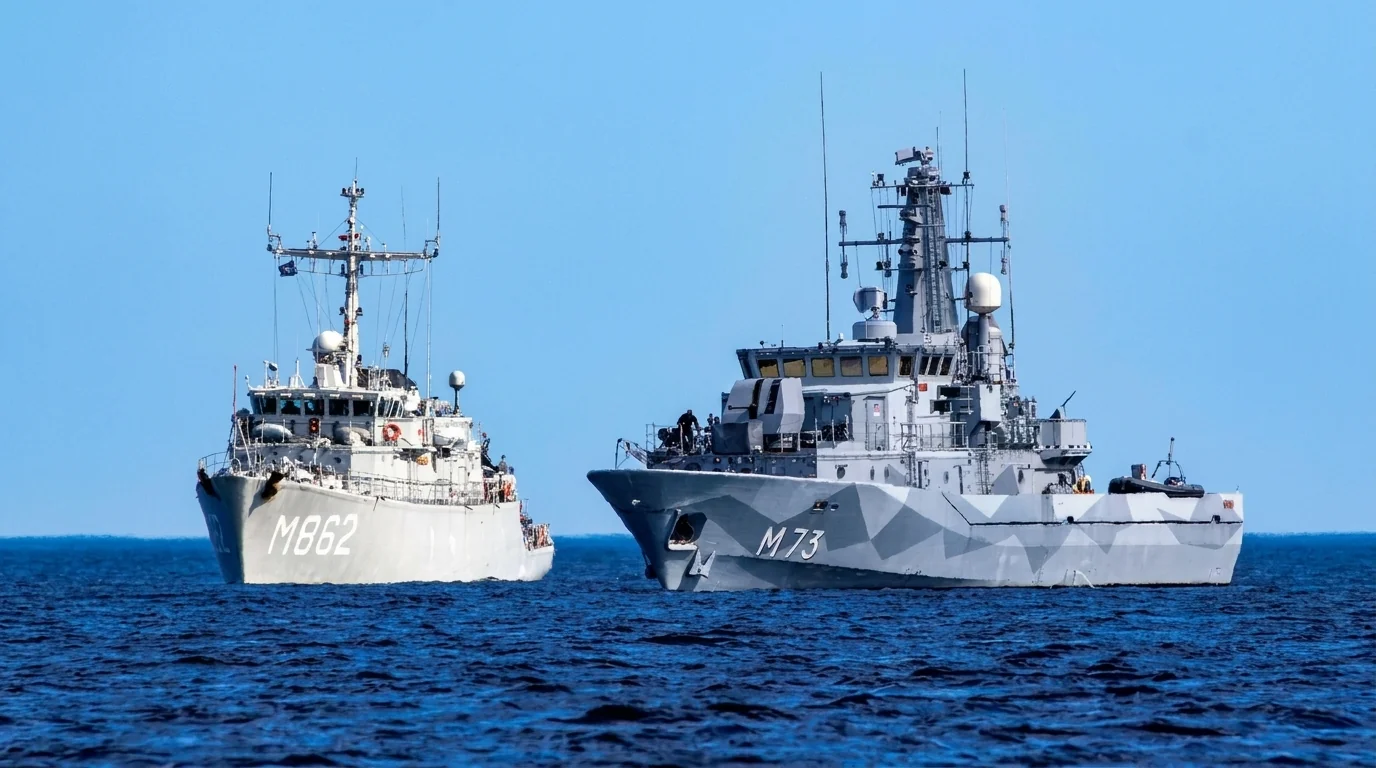
A naval mine can turn an ordinary shipping route into a deadly obstacle course. Hidden beneath the water, these weapons can threaten warships, disrupt commercial shipping, and block access to strategically important ports. Yet finding and removing them is far from simple. That’s where minehunter and minesweeper come into play.
Although both vessels perform mine countermeasure (MCM) missions, they approach the threat in remarkably different ways. A minehunter searches for individual naval mines, identifies their locations, and helps neutralize them, while a minesweeper clears an area by triggering or removing mines using specialized sweeping equipment.
Think of it this way: a minehunter works like a detective examining suspicious objects one by one. A minesweeper, meanwhile, operates more like a specialized cleaning crew, clearing a designated path without necessarily identifying every mine beforehand.
The distinction matters, especially as modern naval mines become increasingly sophisticated. Some respond to magnetic signatures, underwater sounds, or changes in water pressure rather than direct physical contact. Consequently, detecting and clearing these weapons requires different equipment, techniques, and operational planning.
Modern navies also combine both approaches to protect ports, coastal waters, and vital maritime trade routes. Advances in sonar, remotely operated vehicles (ROVs), and autonomous underwater systems have made these missions more precise while reducing risks to naval personnel.
Interestingly, minehunting and minesweeping are not always performed by entirely separate classes of warships. Some modern mine countermeasure vessels can conduct both missions, depending on their equipment and operational requirements.
So, what exactly separates a minehunter from a minesweeper? How do their technologies work, and which approach is more effective against modern naval mines?
Let’s examine their roles, capabilities, equipment, and limitations to understand why both remain important to modern naval warfare.
What Are Minehunters and Minesweepers?
Minehunters and minesweepers serve the same broad purpose: keeping waterways safe from naval mines. However, their methods differ considerably. One searches for individual threats, while the other clears a designated area using specialized equipment.
Understanding this distinction makes it easier to appreciate their importance in modern naval warfare.
What Is a Minehunter?
A minehunter is a specialized naval vessel designed to detect, identify, classify, and help neutralize individual underwater mines. Rather than sweeping an entire area, it searches for suspicious objects using advanced underwater detection systems.
Its most important equipment is usually high-resolution sonar. This technology sends acoustic signals through the water and analyzes returning echoes to identify objects resting on the seabed or suspended underwater.
Once the sonar detects a suspicious object, the crew investigates it further. They may deploy remotely operated vehicles (ROVs), underwater cameras, or clearance divers to determine whether the object is actually a mine.
If confirmed, the mine can be neutralized using an appropriate explosive disposal method.
Precision is the defining characteristic. Minehunters are particularly useful when dealing with sophisticated seabed mines that cannot easily be triggered by conventional sweeping equipment.
What Is a Minesweeper?
A minesweeper is a naval vessel designed to clear naval mines from waterways using mechanical or influence-based sweeping equipment.
Instead of locating every mine individually, it deploys specialized equipment to trigger or physically remove mines across a designated area.
Mechanical sweeping systems use cutting devices or other equipment to sever the mooring cables of certain contact mines. Once separated, the mines may float to the surface, where they can be dealt with safely.
Influence sweeping works differently. It generates magnetic or acoustic signatures that imitate those produced by passing ships, potentially triggering mines designed to respond to such influences.
This approach can clear an area without requiring the crew to identify every individual mine.
Why Both Methods Matter
Neither vessel makes the other obsolete. Minehunters offer precision, while minesweepers provide an area-clearing capability that can be valuable when dealing with minefields.
Modern navies therefore use both techniques as complementary parts of mine countermeasure operations.
How Does a Minehunter Work?
A minehunter operates more like an underwater detective than a conventional warship. Its mission is to locate suspicious objects, determine whether they are naval mines, and help eliminate confirmed threats.
Unlike minesweepers, which can clear an area using sweeping equipment, minehunters focus on individual targets. This makes them particularly valuable against modern mines designed to rest quietly on the seabed.

1. Searching for Mines Using Sonar
The search usually begins with sonar. Minehunters use high-resolution sonar systems to examine the underwater environment and identify objects that could represent mine threats.
Side-scan sonar is especially useful because it produces detailed images of the seabed. Operators can examine these images to distinguish suspicious objects from rocks, debris, and other underwater features.
Some vessels also use variable-depth sonar systems to improve detection under challenging conditions.
2. Identifying Suspicious Objects
Finding an underwater object doesn’t automatically mean discovering a mine. The seabed can contain discarded equipment, shipwreck fragments, rocks, and countless other objects.
Minehunter crews must therefore classify potential threats before taking further action.
This process may involve examining sonar images from different angles and deploying underwater cameras. The objective is to determine whether an object represents a genuine explosive threat.
3. Deploying Remotely Operated Vehicles
Once an object requires closer inspection, the crew can deploy a remotely operated vehicle (ROV).
These underwater robots carry cameras, lighting equipment, and specialized sensors. They allow operators aboard the ship to examine suspicious objects without sending divers directly into dangerous areas.
Some systems also support explosive ordnance disposal operations.
4. Neutralizing Confirmed Mines
When a mine is positively identified, specialized disposal teams determine the appropriate response. This may involve using an expendable mine disposal vehicle or another approved neutralization method.
The process requires careful coordination between sonar operators, ROV controllers, and explosive ordnance disposal specialists.
Why does this approach matter? Modern seabed mines can remain difficult to detect, particularly when surrounded by natural underwater clutter. Minehunters provide the precision needed to investigate individual threats rather than relying entirely on broad-area sweeping.
How Does a Minesweeper Work?
A minesweeper approaches naval mine clearance from a different direction. Instead of searching for every underwater mine individually, it uses specialized equipment to trigger or remove mines across a designated area.
Think of it as clearing a dangerous path rather than investigating every suspicious object. This approach can be particularly useful when naval forces need to reopen shipping lanes or secure access to important ports.
Traditional minesweepers rely on two main techniques: mechanical sweeping and influence sweeping. Each targets different characteristics of naval mines.

1. Mechanical Minesweeping
Mechanical sweeping uses physical equipment to deal with certain types of contact mines, particularly moored mines.
These mines are typically anchored underwater and held in position by cables. When a vessel strikes the mine’s contact sensors, the explosive charge detonates.
A minesweeper deploys specialized mechanical sweeping gear to cut or sever the cables holding these mines in place. Once released, the mines may rise toward the surface, where they can be identified and dealt with by trained personnel.
This technique is especially useful against traditional moored contact mines. However, it is less effective against mines resting directly on the seabed.
2. Influence Minesweeping
Influence sweeping targets mines that respond to specific signatures produced by passing ships.
Modern naval mines may use magnetic, acoustic, or pressure sensors to recognize potential targets. Influence minesweeping equipment attempts to reproduce selected characteristics of these signatures.
For example, magnetic sweeping equipment generates an artificial magnetic field that can imitate aspects of a ship’s magnetic signature. Acoustic sweeping equipment produces underwater sound signals to simulate vessel noise.
Some systems can also reproduce pressure-related influences.
The objective is to trigger compatible mines without exposing an actual warship to the danger.
3. Clearing an Area Without Finding Every Mine
One major advantage of minesweeping is its area-based approach. A minesweeper can conduct sweeping operations across a designated waterway without individually identifying every mine beforehand.
However, success depends on the mine’s design and the sweeping equipment’s ability to reproduce the required triggering conditions.
The important distinction: Minesweeping does not guarantee that every mine has been removed. Untriggered, buried, or incompatible mines may remain, requiring additional detection and clearance measures.
Minehunter vs. Minesweeper: Key Differences
At first glance, minehunters and minesweepers might appear to perform identical naval missions. Both protect warships, commercial vessels, and important maritime routes from underwater explosives.
Look closer, though, and their operational approaches are quite different. A minehunter searches for individual mines, while a minesweeper uses specialized equipment to clear an area by triggering or removing compatible mines.
This distinction affects everything from onboard technology to mission planning.
Minehunter vs. Minesweeper Comparison Table
The following table highlights their most important differences:
| Feature | Minehunter | Minesweeper |
| Primary mission | Detect and identify individual mines | Clear designated areas of mines |
| Main technology | High-resolution sonar | Mechanical and influence sweeping equipment |
| Detection approach | Searches for individual underwater objects | Sweeps areas using specialized equipment |
| Mine identification | Examines suspicious objects individually | Does not necessarily identify individual mines |
| Neutralization | Specialized disposal systems and EOD teams | Triggers or physically removes compatible mines |
| Typical targets | Seabed, buried, and moored mines | Primarily mines compatible with sweeping methods |
| Main advantage | Precise threat identification | Area-based clearance |
| Main limitation | Investigating individual targets takes time | Effectiveness depends on mine characteristics |
Differences in Detection Technology
The biggest difference lies in how these vessels find underwater threats.
Minehunters depend heavily on sonar systems to locate and classify suspicious objects. Their crews examine sonar images and may deploy underwater vehicles for closer inspection.
Minesweepers, meanwhile, focus on equipment that generates mechanical or simulated environmental influences. Their objective is to activate compatible mines or physically remove them.
Consequently, minehunters are better suited to investigating individual seabed objects, while minesweepers can be useful when clearing larger areas.
Differences in Operational Speed
Neither method is automatically faster in every situation.
Minehunting can become time-consuming when an area contains numerous suspicious objects. Each potential threat may require investigation before clearance.
Minesweeping can cover designated areas without examining every object individually. However, repeated sweeping may be necessary, depending on the minefield and equipment involved.
Which Is More Effective?
There is no universal winner.
Minehunters offer greater precision when dealing with individual threats, particularly sophisticated seabed mines. Minesweepers provide another approach for clearing compatible mine threats across larger areas.
Modern naval forces often combine both methods. Using them together provides greater flexibility than relying on either technique alone.
What Types of Naval Mines Can They Counter?
Not all naval mines work the same way. Some explode when a ship physically touches them, while others remain hidden underwater until they detect a vessel’s magnetic field, acoustic signature, or pressure changes.
These differences matter. A minehunter or minesweeper must use equipment suited to the particular mine threat.
Understanding the main types of naval mines also explains why modern navies rarely depend on a single mine countermeasure technique.

1. Contact Mines
Contact mines are among the oldest types of naval mines. They typically contain protruding contact sensors that trigger an explosion when a vessel strikes them.
Many traditional contact mines are moored beneath the water’s surface. Their explosive bodies remain suspended at a particular depth using an anchor and cable.
Minesweepers can counter compatible moored contact mines using mechanical sweeping equipment. Minehunters can also locate individual examples through sonar and support their subsequent disposal.
2. Magnetic Mines
Magnetic mines detect changes in the surrounding magnetic field. A passing steel-hulled vessel can produce a magnetic signature that triggers the mine’s firing mechanism.
These weapons present a significant challenge because physical contact is unnecessary.
Minesweepers can use magnetic influence sweeping systems to reproduce selected magnetic signatures. Minehunters can search for individual magnetic mines using sonar and other detection equipment.
3. Acoustic Mines
Acoustic mines respond to underwater sounds, particularly noise associated with passing ships.
Their sensors can detect acoustic signatures produced by vessel machinery, propellers, and other underwater sources.
Influence minesweepers can use specialized acoustic equipment to simulate relevant sounds. Minehunters can locate these mines through sonar-based searches and support individual disposal operations.
4. Pressure Mines
Pressure mines detect changes in water pressure caused by a vessel moving nearby.
Unlike traditional contact weapons, they do not require direct physical interaction. Their detection systems respond to pressure disturbances associated with passing ships.
Countering these mines can be challenging because their triggering characteristics vary. Minehunters can search for individual seabed objects, while specialized influence sweeping systems may address compatible pressure-sensitive threats.
5. Bottom and Buried Mines
Bottom mines rest directly on the seabed, while buried mines can become partially or completely covered by sediment.
These weapons are particularly challenging because they may blend into the surrounding underwater environment.
Minehunters are especially valuable here. High-resolution sonar and specialized underwater inspection systems help locate suspicious objects that conventional sweeping methods might miss.
The key takeaway: Minehunters and minesweepers address different aspects of the naval mine threat. Their effectiveness depends on mine design, environmental conditions, and the equipment available.
Why Do Modern Navies Need Both Minehunters and Minesweepers?
Naval mines remain a serious threat to maritime security, even as warships become faster, more heavily armed, and technologically advanced. A relatively inexpensive underwater weapon can disrupt commercial shipping, restrict naval movements, or make an important port inaccessible.
That’s precisely why modern navies need both minehunters and minesweepers.
Neither platform provides a complete solution. Their different capabilities allow naval forces to respond to various mine threats without depending on a single clearance method.
Protecting Important Shipping Routes
International trade depends heavily on safe maritime transportation. Major shipping lanes, narrow straits, and commercial ports are particularly important because disruptions can affect entire supply chains.
Minehunters help identify individual underwater threats along these routes. Minesweepers provide an additional capability for clearing compatible mines from designated areas.
Together, they help restore safe maritime access and support naval operations.
Supporting Naval Operations During Wartime
Naval mines can restrict access to strategic waterways and prevent warships from entering important maritime areas.
For example, a mined harbor could complicate the deployment of naval reinforcements or disrupt the movement of military supplies.
Minehunters and minesweepers help address these threats, allowing naval forces to maintain freedom of movement.
Their missions also support amphibious operations, coastal defense, and the protection of naval installations.
Reducing Risks to Naval Personnel
One of the biggest developments in modern mine countermeasures is the growing use of unmanned technology.
Autonomous underwater vehicles (AUVs), remotely operated vehicles, and unmanned surface vessels can perform dangerous tasks without placing sailors directly inside minefields.
These systems can carry sonar equipment, inspect suspicious objects, and support mine clearance operations.
The US Navy’s modular mine countermeasure approach illustrates this transition toward distributed, unmanned capabilities.
The Future of Mine Countermeasures
Future mine warfare will likely involve greater automation, improved sonar processing, and more capable underwater robots.
Artificial intelligence may also help operators classify sonar contacts and distinguish potential mines from natural seabed objects.
However, technology alone cannot eliminate every challenge. Environmental conditions, buried mines, and increasingly sophisticated sensors will continue testing naval mine countermeasure capabilities.
For modern navies, the most effective approach is combining minehunting, minesweeping, and unmanned systems into one coordinated capability.
Both methods remain essential. One provides precision, the other offers area-based clearance, and together they give naval forces greater flexibility against underwater threats.
