

Testing of Taiwan’s Hsiung Feng III (HF-III) air-launched supersonic anti-ship missile progressed with a test-fire on 1 July.
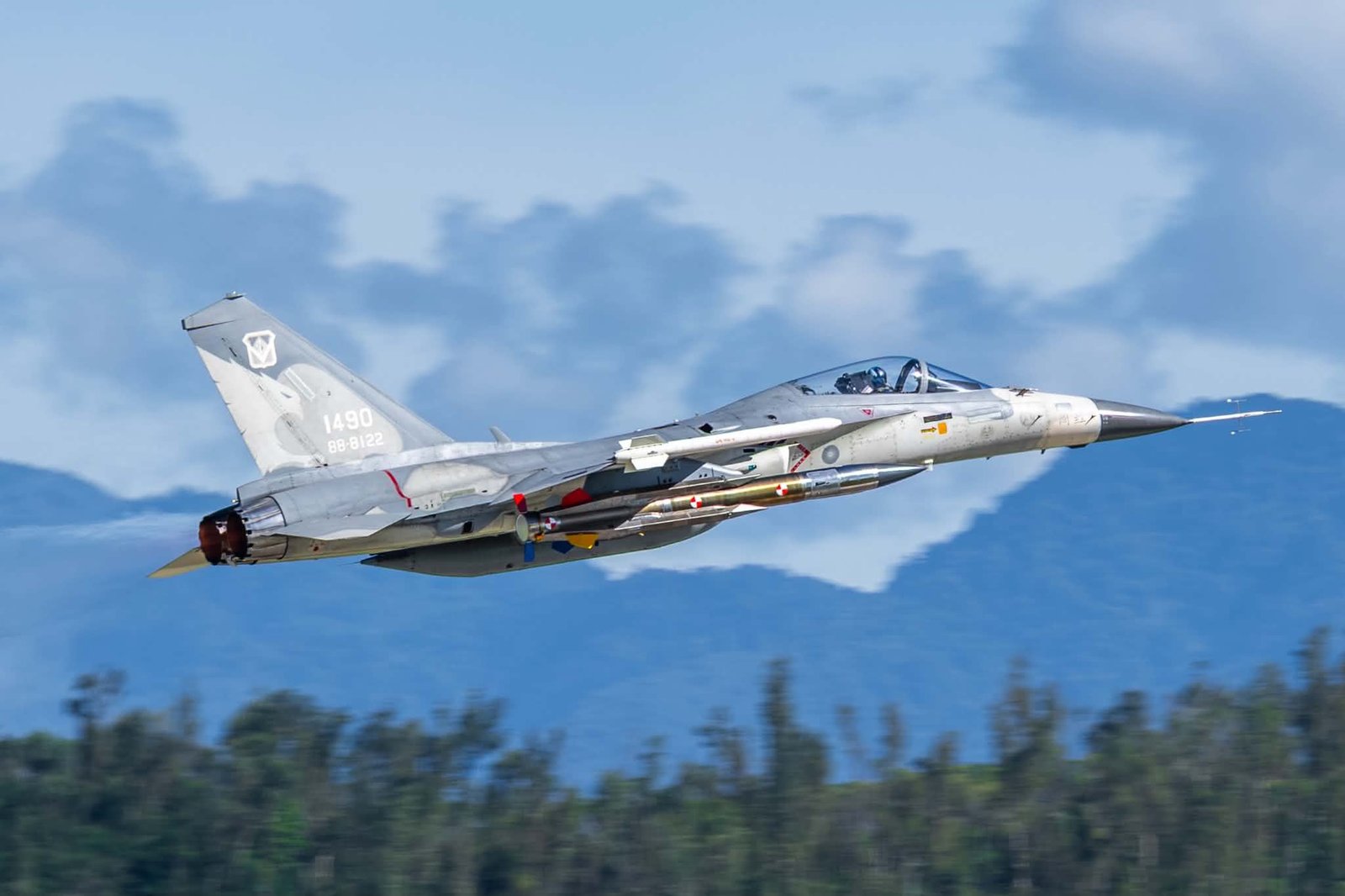
The missile developed by the National Chung-Shan Institute of Science and Technology (NCSIST) was launched by a Republic of China Air Force (ROCAF) F-CK-1C, tail number ‘1490’. The fighter departed Chihhang Air Base in Taitung County in southeast Taiwan that morning.
The AIDC-manufactured aircraft was configured with a single missile on its starboard wing and a drop tank on the port wing, and it returned 40 minutes later without the missile.
The test-firing marked the second such event, following the first on 18 December 2025. The missile appeared externally identical in both launch events. Unlike the first test, however, the latest event is understood to have included testing of the warhead’s explosive charge, with the missile carrying a live warhead.
Development of the air-launched HF-III under Project Hsiung Chih has progressed at a relatively fast pace. The missile first appeared in test article form during ground taxi trials on an F-CK-1 in February 2025, followed by captive-carry flight trials the following month.
The F-CK-1C ‘1490’ was also used in those trials, indicating that the aircraft is dedicated to the test and evaluation effort.
Developed from its land- and sea-launched variants, the air-launched HF-III differs notably in the removal of its two solid-rocket boosters – commonly used on larger, surface-launched missiles to achieve the required launch velocity – as well as in its more streamlined and reduced form factor.
State-owned NCSIST is reported to have worked to scale down the missile from its original weight of around 1,500kg for carriage on the F-CK-1, with the air-launched variant understood to target a weight of less than 1,000kg.
In its air-launched form, the ramjet-powered missile is still expected to sustain supersonic speeds of up to Mach 3.5, although its range is likely to be reduced due to its smaller size.
For comparison, the sea- and land-launched variants are believed to have a range of more than 100km in sea-skimming mode, increasing to 300-400km when flown at higher-altitude flight profiles. The more recently developed land-launched HF-IIIER extends this range even farther.

This air-launched HF-III would allow Taiwan to expand its anti-ship range rings farther out than those provided by land- and sea-launched variants, while also enabling attacks from multiple vectors.
This would complicate any attempt by China to conduct an amphibious and/or heliborne assault using its Type 071 landing platform docks and Type 075 and 076 landing helicopter docks, potentially forcing those ships to operate farther from Taiwan and thus reducing their ability to achieve tactical surprise.
Should the development effort prove successful and Taiwan proceed with integration of the missile on its F-CK-1 fighter fleet, the island’s anti-ship missile capacity could also see significant enhancement.
This would further complement the wide array of anti-ship missiles Taiwan already deploys across land, sea and air platforms.
Incidentally, the Republic of China Navy is in the process of taking delivery of 100 land-based Harpoon missile systems. F-16s flown by the ROCAF also conduct anti-shipping missions with air-launched AGM-84 Harpoon missiles.
by Roy Choo
