

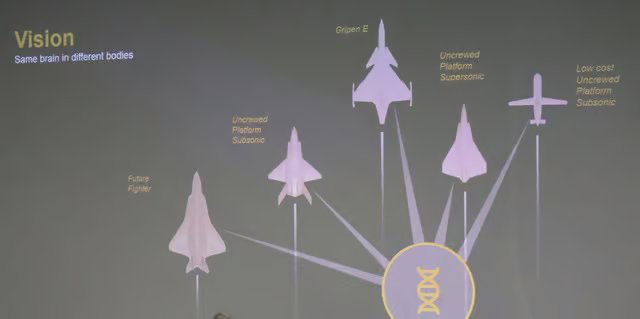

Saab has revealed that concept studies for a Future Combat Aircraft System have been funded by the Swedish government since 2024. A total of EUROS 400 million has already been spent. The programme will continue until 2029, and include payment to Saab for an unmanned demonstrator, which is due to fly next year.
The studies have been organized into two parts, with a Phase 1 of concept exploration having already ended. They include operational analysis, system concepts, and technology development. All three activities will continue into a Phase 2, which is labelled “concept technology demo development.”
The areas of technology development are autonomy; artificial intelligence; nano technologies; additive manufacturing; and rapid prototyping.
Saab was reluctant to provide further details on its demonstrator, or on an “unmanned component” named Ruby which is due to fly this year and which is entirely Saab-funded. The company is investigating both subsonic and supersonic platforms, both with low observability and the latter being low cost and attritable. Saab says it is leveraging Gripen know-how, characteristics and philosophy, and that the software and hardware is being developed with agile engineering methods at a high pace.

The company also revealed Project Beyond, the addition of Artificial Intelligence to the Gripen E.
The “Future Combat Aircraft System” (FCAS) terminology has also been used in the UK to describe the sixth-generation combat aircraft that was later named Tempest, and its associated collaborative combat aircraft (CCA). That aircraft was later named Tempest, and the effort is now known as the Global Combat Aircraft programme (GCAP), after Italy and Japan joined it. Sweden was briefly part of this FCAS, but pulled out in 2021 citing the need to concentrate funding and resources on the Gripen E fighter, which was still being developed then.
Confusingly, the Franco-German-Spanish programme with similar aims is also known in English as FCAS. It has foundered on disputes about workshare, and has an uncertain future.
Ultimately, Saab says, Sweden will have to decide whether to launch its own programme for a future combat aircraft and for CCAs; whether to seek international collaboration; or even buy “a ready-made system”.
by Chris Pocock
