

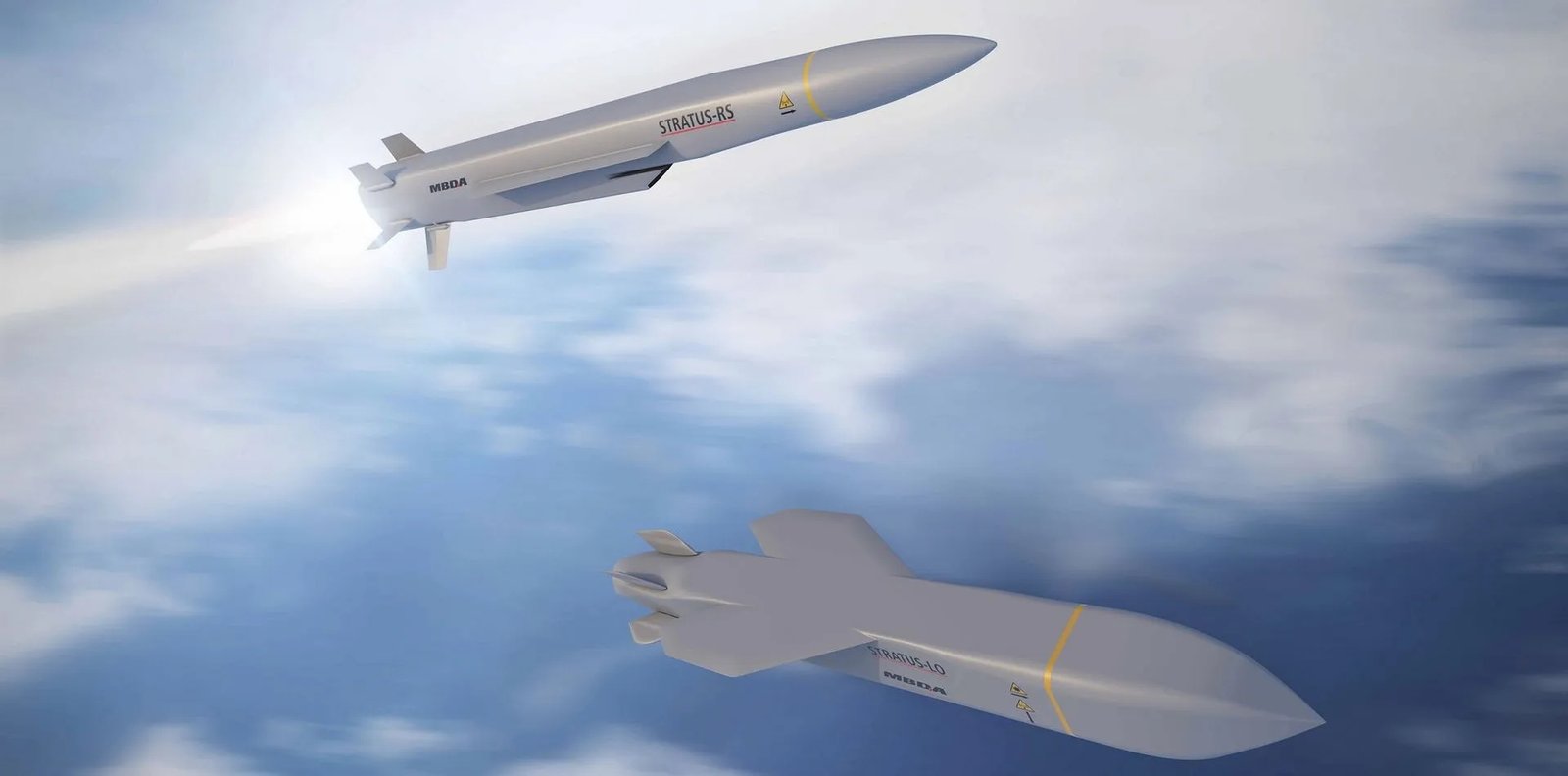

The European Stratus-RS anti-radar missile could move into the development stage by the end of the year.
MBDA officials have told Armada that the company is continuing negotiations with France’s Direction Générale de l’Armement (DGA/General Armaments Directorate) concerning the future development of the company’s Stratus Rapid Strike (Stratus-RS) Anti-Radiation Missile (ARM). It is understood that the company has finished the weapon’s assessment phase and is negotiating with the DGA concerning the launch of the missile’s formal development. Company officials added that an announcement to this effect could be made during the 2026 Euronaval exhibition to be held in Paris between 3rd and 6th November. Despite the ongoing negotiations, the original proposed date of 2030 for the missile’s initial operational capability remains in place.
Armada understands that discussions are continuing regarding the procurement of Stratus-RS by the Royal Air Force. The Aeronautica Militare (Italian Air Force) had been mooted as another potential customer, although it does not appear that an Italian procurement will now occur. Italy has already purchased the Northrop Grumman AGM-88E Advanced Anti-Radiation Guided Missile and is likely to continue relying on this as its mainstay Suppression/Destruction of Enemy Air Defence (S/DEAD) weapon. Development of the Stratus-RS is mainly being driven by France and the United Kingdom.
Pending the outcome of the development negotiations and a subsequent procurement decision by the French Ministry of Defence, Stratus-RS is expected to be deployed by Armée de l’Air (French Air Force) and Aeronavale (French Naval Aviation) Dassault Rafale series combat aircraft. Other mooted platforms include Eurofighter Typhoon series jets and forthcoming sixth-generation combat aircraft. Additional launch options for the Stratus-RS include warship vertical launch systems.
Clues have emerged concerning the missile’s performance: MBDA officials stated that the weapon is likely to achieve velocities exceeding those of standard surface-to-surface/air-to-surface cruise missiles but below those of a ballistic missile. To this end, the company disclosed that the missile would be capable of achieving supersonic velocities using a ramjet engine although would not be drawn on Stratus-RS range.
Guidance
Curiously, the Stratus-RS will not contain a passive radio frequency seeker to detect, locate and identify, henceforth known as process, ground-based air surveillance and fire control/ground-controlled interception radars supporting Ground-Based Air Defences (GBAD) and Integrated Air Defence Systems (IADS). Instead, the missile will be equipped with a Synthetic Aperture Radar (SAR) to process these targets. It is possible that the SAR will match the Radar Cross Section (RCS) of potential targets with a pre-loaded RCS radar library. For example, the missile maybe launched in the vicinity of a known threat like an 96L6 (North Atlantic Treaty Organisation codename Cheese Board) C-band (5.25 gigahertz/GHz to 5.925GHz) ground-based air surveillance radar. The 96L6 routinely equips Russian S-400 Triumf (SA-21 Growler) long-range/high-altitude surface-to-air missile batteries. The SAR could match that radar’s RCS with its internal library and then engage the system.
Alternatively, the missile could be launched in a suppression role without pre-briefed targets but programmed to engage any targets the SAR processes after a pre-emptive launch within a defined area. Alongside the SAR the missile will be outfitted with a Global Navigation Satellite System Position, Navigation and timing (PNT) receiver. The latter adornment will allow the missile to engage radars based on their coordinates which are either known prior to the mission or are determined during the sortie.
Both the SAR and GNSS PNT receiver will allow Stratus-RS to avoid the so-called ‘switch off’ tactic. ARMs have historically been vulnerable to a tactic in which radar operators stop their systems transmitting once an incoming anti-radiation missile is detected. This tactic is intended to cause the missile to break its target lock as it would rely on the radar signal to guide towards the antenna where it would detonate. MBDA officials hinted that the missile may also be outfitted with a datalink to allow networking between other weapons, platforms and sensors. The datalink would allow several Stratus-RSs to work together, or with dissimilar weapons, to provide a highly dynamic S/DEAD strike mission against numerous GBAD and IADS radar targets.
Assessment
The evolution of the Stratus-RS programme is occurring at a moment when NATO European nations face the threat of highly contested airspace in the event of war with Russia. Similar conditions may also be seen beyond the European theatre in the Middle East and Asia-Pacific. In some ways, the missile parts with anti-radiation missile orthodoxy, with a passive RF seeker forsaken in favour of a SAR and GNSS PNT receiver combination. This choice of guidance reduces the effectiveness of the switch-off technique. Nonetheless, there is the attendant risk that the synthetic aperture radar is foxed by physical decoy radars. Real radar coordinates could be determined by cross referencing imagery intelligence and Electronic Intelligence (ELINT). The latter could ascertain the radar’s location through standard signals intelligence techniques like time difference and angle of arrival determination.
MBDA and the DGA still must conclude negotiations to allow the missile’s development to occur before a formal procurement decision is taken. Assuming both these stages are concluded successfully France, the UK and potentially other customers, look set to receive a highly capable S/DEAD weapon. Stratus-RS could emerge as a robust riposte to the anti-access/area denial postures of potential adversaries in Europe and beyond.
by Dr. Thomas Withington
