

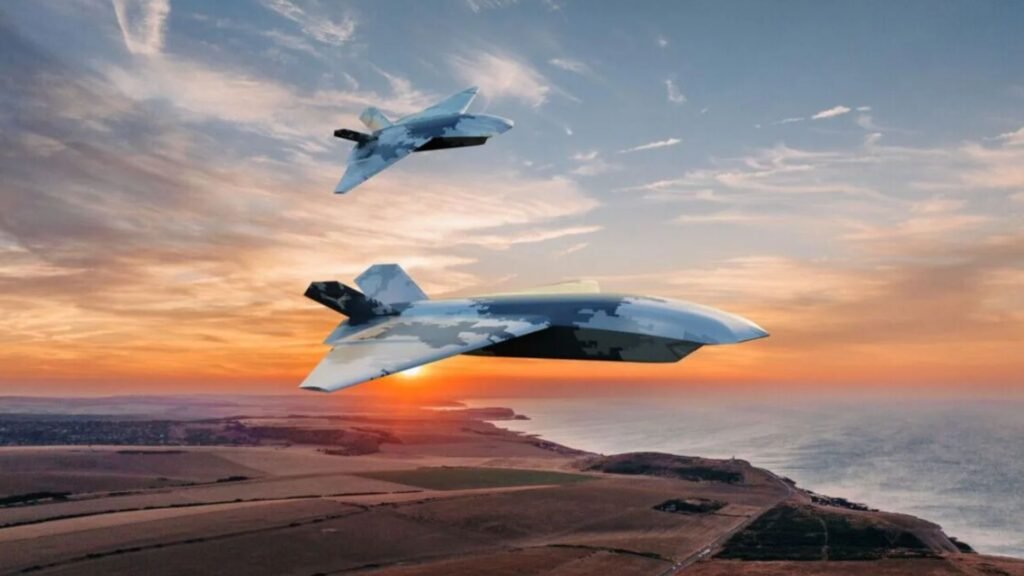

Royal Air Force electronic warfare capabilities are expected to receive added enhancement in the coming years via the Storm Chrome initiative.
In July the United Kingdom’s Ministry of Defence (MOD) announced it had designated the Collaborative Combat Aircraft (CCA) destined to equip the Royal Air Force (RAF) as the Storm Fighter. CCAs are uncrewed platforms that can assume several missions and tasks traditionally associated with crewed platforms. The rationale behind CCAs is to ease pilot workload by transferring some tasks to an uncrewed platform, to reduce the number of service personnel in harm’s way, provide attritable platforms that are relatively easy to replace and relatively inexpensive to build.
The Storm Fighter concept will include two subvariants; one of which is called Storm Fire; a one-way attack platform capable of hitting targets at ranges of circa 860 nautical miles (1,000 kilometres). The other variant is called Storm Chrome and will be a dedicated Electronic Warfare (EW) platform. Reports noted that the MOD will initially invest $405 million to launch the CCA programme with plans to fly a technology demonstrator by 2030. Nonetheless Air Marshal Harv Smyth, the chief of the air staff, has said he would like a demonstrator to fly with an RAF Eurofighter Typhoon FGR4 combat aircraft as soon as 2027.
From a Concept-of-Operations (CONOPs) perspective, it is likely that the Storm Chrome CCA will accompany either individual, or strike packages of, RAF and allied combat aircraft. As an EW platform Storm Chrome may be tasked with detecting, locating and identifying, henceforth known as process, hostile electromagnetic targets within range. Such targets could include ground-based air surveillance and Fire Control/Ground-Controlled Interception (FC/GCI) radars equipping Ground-Based Air Defences (GBAD) and Integrated Air Defence Systems (IADS).
Other targets may include radio communications which IADS and deployed GBAD rely on to share command and control, and intelligence, surveillance and reconnaissance voice and data traffic. Storm Chrome may also be able to target the reception of Global Navigation Satellite System (GNSS) Position, Navigation and Timing (PNT) signals by these air defence assets. As well as performing conventional jamming and spoofing attacks it is possible that the Storm Chrome’s electronic attack payload could inject cyberattacks into hostile GBAD and IADS via electromagnetic apertures like the antennas equipping associated radars and radio communications. Given the Storm Chrome’s potential CONOPs, the platform may assist operational/tactical level Suppression/Destruction of Enemy Air Defences (S/DEAD) at stand-off and stand-in ranges. Storm Chrome is also likely to provide escort electronic attack against electromagnetic targets of opportunity during the ingress and egress of friendly aircraft to and from their targets.
Targets
The RAF already possesses two tactical EW platforms in the guise of the Tekever AR3 Storm Shroud electronic attack uncrewed aerial vehicle and the Leonardo BriteCloud expendable jamming decoy. Both BriteCloud and Storm Shroud are believed to process and attack radar threats transmitting in X-band (8.5 gigahertz/GHz to 10.68GHz) up to K-band (24.05GHz to 24.25GHz). This waveband enables both to jam and spoof FC/GCI and some air-to-air/surface-to-air missile Active Radar Homing (ARH) seekers. Both these radar types commonly use such frequencies.
It is possible that Storm Chrome may jam a wider waveband of frequencies, possibly from 500MHz up to 40GHz. High band Ultra-High Frequency (UHF: 300MHz to three gigahertz) conventional and satellite communications, and some UHF ground-based air surveillance radars, could thus be attacked. Similar L-band (1.215GHz to 1.4GHz), S-band (2.3GHz to 2.5GHz/2.7GHz to 3.7GHz) and C-band (5.25GHz to 5.925GHz) radars could be held at risk alongside X-band and Ku-band (13.4GHz to 14GHz/15.7GHz to 17.7GHz) FC/GCI radars. K-band and Ka-band (33.4GHz to 36GHz) ARH seekers would be additional targets, as would satellite communications reception bandwidths within this 500MHz to 40GHz waveband. GNSS PNT signal reception in wavebands of 1.1GHz to 1.6GHz would also be vulnerable.
Development
Armada understands that the payloads equipping Storm Chrome will largely be new designs, with minimal uptake from existing capabilities like Storm Shroud or BriteCloud. Specific contractors for the platform have yet to be decided and the MOD is understood to currently be in discussions to this end. While an emphasis will be placed on sourcing the platform from British suppliers, international vendors will be brought into the programme when needed. Although initial launch funding of $405 million has been earmarked the wider budget for Storm Chrome’s realisation is still being assessed. Nonetheless, the MOD’s emphasis is on delivering a low-cost platform which can be purchased on demand but easy upgraded during the design’s life.
The service entry of Storm Chrome will represent an important enhancement to RAF EW and S/DEAD capabilities building on the introduction of Storm Shroud and BriteCloud. Work remains to be done: A commitment to procure MBDA’s SPEAR-EW (Selected Precision Effects At Range – Electronic Warfare) and Stratus-RS anti-radiation missile would enhance RAF S/DEAD capabilities yet further. Nonetheless, the advent of Storm Chrome is an important step in the right direction.
by Dr. Thomas Withington
