


By Ben Remler, defence analyst, KI Insights[1]
This article aims to uncover the architecture and functional logic of Russia’s Tishina prototype jammer, while exploring and explaining its relevance to the current tactical and technological landscape of electromagnetic spectrum operations in Ukraine.
Details have emerged regarding Tishina (Silence) a Russian prototype jammer presented as an integrated Counter-Uncrewed Aerial Vehicle (CUAV) Electronic Support Measure (ESM) and Electronic Warfare (EW) ensemble. The architecture uses passive detection and targeted suppression to engage most First-Person View (FPV) UAV radio control links.
Tishina’s detection and jamming systems are designed to recognise and suppress Long Range (LORA) Express Long-Range System (ELRS) signals. LORA is a proprietary modulation protocol owned by Semtech which enables the long-distance decoding of low-power radio signals and underlies most drone control links. ELRS is the standard civilian protocol for FPV UAV radio control links. Its military adaptations, such as MILELRS (Military ELRS), are used extensively by Russian and Ukrainian military UAV units.[2]
Tishina’s systems architecture is an example of an early shift towards software-enabled jammers, which are built around Software-Defined Radios (SDRs) with Field-Programmable Gate Array (FPGA) processing capabilities integrated with ESMs. Such architectures ultimately result in an automated Radio Frequency (RF) kill chain.
Tactical context
Most tactical jamming in the early phases of Russia’s full-scale invasion of Ukraine between 2022 and 2024 targeted global navigation satellite system position, navigation and timing signal reception, including transmissions from the United States’ Global Position System and Russia’s GLONASS constellations. Also targeted were FPV UAV radio control links.[3] This latter tactic was very effective because FPV UAVs used by both sides employed civilian-grade Radio Frequency (RF) hardware.
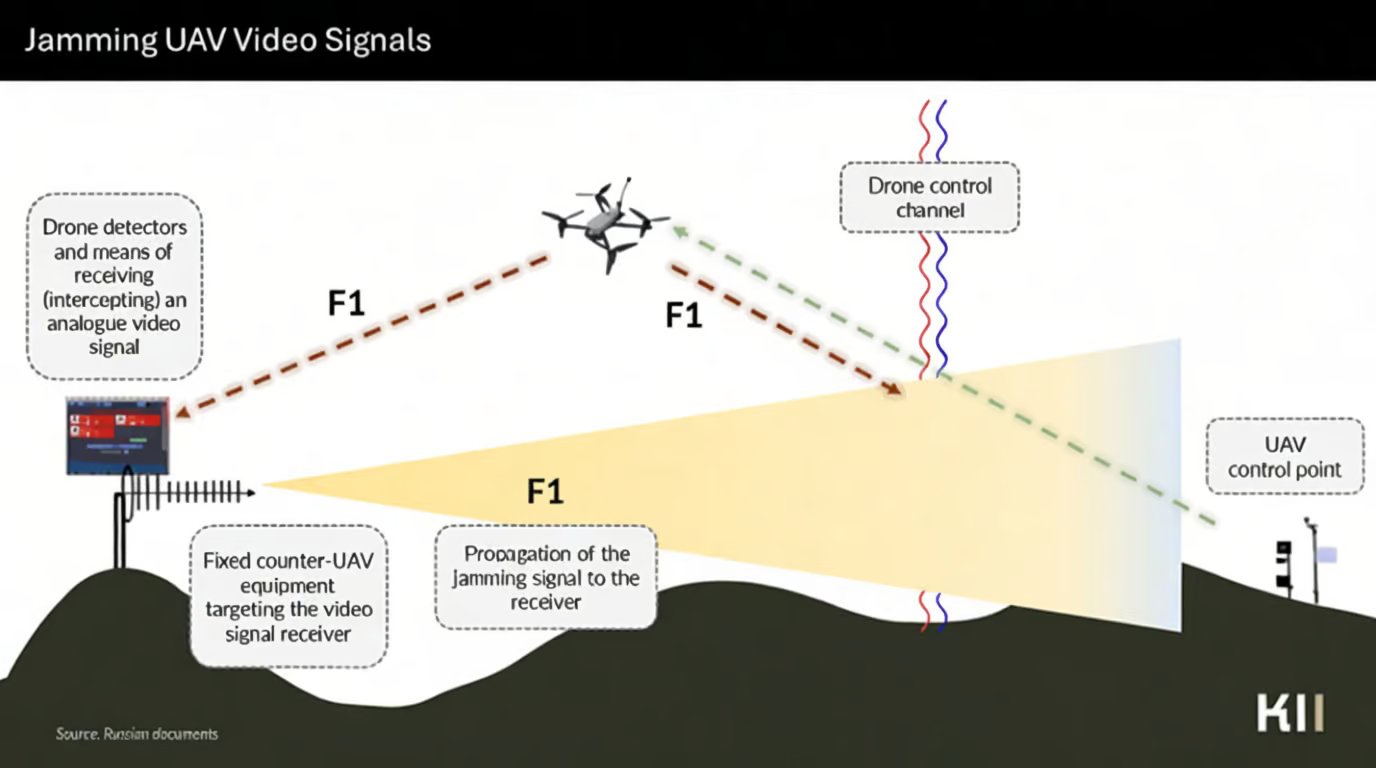
Nonetheless, radio frequency communication systems for UAVs matured and outpaced developments in EW platforms mitigating electronic attack effects. This adaptation triggered a shift in EW tactics, notably causing the Russian military to rely on long-distance jamming at ranges of up to 27 nautical miles/nm (50 kilometres/km) for FPV UAV video signals. These signals are transmitted directly from the aircraft to its operators’ ground control station.[4]
As EW commentator and Ukrainian government adviser Serhii ‘Flash’ Beskrestnov has noted, this tactic requires the consistent emission of very high-power signals from elevated locations like hill tops or towers.[5] Such placements increase the risk of hostile detection and attack.
The past year of fighting has seen a general increase in transmission power levels at the frontlines, whether by electronic warfare platforms or by UAV control links and video signal transmitters. Leaked Russian documents reveal the difficulties caused by this ‘power race’: High-power, broad-beam jamming raises the general noise floor, and increases the risk of electromagnetic fratricide and hostile detection facilitating the Ukrainian use of UAVs to hunt for jamming stations.[6]
The state of generalised Battlefield Air Interdiction (BAI) in areas five to 16 nautical miles from the zero line, depending on the area of operations, complicates the logistics demanded by high-power analogue jammers. Russia’s Groza-07K jammer, for instance, which targets UAV control links in the 100 megahertz/MHz to 1.1 gigahertz/GHz and 2.1GHz to 2.7GHz bands, weighs 130 kilograms (286 pounds), needs accumulators and a 3500W diesel generator.[7] These Size, Weight, and Power (SWAP) requirements are increasingly difficult to accommodate near the frontlines.
To face these challenges head-on, both militaries have had to innovate. Although this process is still ongoing, certain segments of the Russian military have already developed novel and interesting standard operating procedures for electronic attack near the zero line. Much of the innovation is set to happen at the hardware level. Nonetheless, the clearest way to increase the effectiveness of control link jamming and to engage tactical-level UAV employment while decreasing jammer SWAP requirements and reduce likelihood of detection, is to experiment with and deploy software-enabled jamming platforms, with increased integration with CUAV ESM systems.
SDR Jammers
Software-enabled jamming platforms can increase EW performance by opening new vectors of attack for electromagnetic effectors through the integration of SDRs and FPGA processing. Widespread FPGA use by both forces already increases flexibility for Direct Digital Synthesis (DDS) jamming by allowing operators to design and emit waveform-specific interference.
SDR-based jammers can deliver even greater performance by integrating and exploiting high-resolution Electronic Intelligence (ELINT) concerning hostile signal characteristics. Such jammers may effectively conduct systematic attacks against the physical and datalink layers of wireless command-and-control systems by using digital signals which replicate key features of the signals they are attacking. Non-SDR jammers, by contrast, use analogue swept carrier signals, even if jamming waveforms are synthesized using FPGAs.
Crucially, the newfound effectiveness of waveform- and protocol-aware interference can result in a reduction of the SWAP requirements and electromagnetic signatures of EW apparatus. SDR jammers can also enable the edge processing of ELINT and help automate the RF kill chain, as FPGAs directly convert the estimated parameters of adversarial radio signals into a targeted jamming signal. To apply this functional logic to CUAV operations, jamming platforms will need to emit structured interference against two targets: The LORA signals forming the physical basis for most FPV UAV radio control, and the ELRS control system that composes LORA parameters and the data structure of UAV radio control signals.
Countering LORA
The method underlying Tishina’s approach is to use robust electronic intelligence on UAV control links to reverse-engineer key LORA modulation parameters: frequency and bandwidth, spreading factor, In-phrase/Quadrature (I/Q) inversion, and, when recoverable, Frequency-Hopping Spread Spectrum (FHSS) tables.
The spreading factor determines the symbol rate within one LORA chirp, as defined by the relationship Rs = BW / 2SF.
Here, Rs is the symbol rate (the number of LORA symbols transmitted per second), BW is the bandwidth of one LORA chirp (in hertz), and SF is the spreading factor. ELRS and ELRS-based systems generally use spreading factors of five to nine: a lower spreading factor will result in a higher data transmission rate and inferior receiver sensitivity. In the case of ELRS, a lower spreading factor also enables higher configured packet rates and a faster frequency hopping rate, potentially resulting in a lower probability of detection.
I/Q inversion determines the frequency direction of LORA chirps (upchirp or downchirp) and is a determining parameter in a receiver’s ability to decode LORA signals. FHSS is a modulation technique which moves successive data packets into different frequency channels according to a synchronised sequence detailed in the hopping table. FHSS increases resistance to narrowband interference.
Spreading factors and I/Q inversion allow a LORA receiver to filter signals with the expected parameters from undesirable interference. However, a jamming signal of LORA-like chirps that match the control signal’s frequency, bandwidth, spreading factor and I/Q inversion will not be filtered out and will therefore make it harder for the receiver to synchronise and decode the control signal. This method is an example of waveform-specific jamming, which is tailored to match the key parameters of the carrier waveform (i.e. the physical layer).
If a jamming signal further mimics the control link’s FHSS table, interference will then be located at the correct subchannels for maximal effect and complicate the decoding of the control link packets. This is protocol-specific interference, targeting the datalink layer of the control link. In practice, this requires much more detailed signal intelligence than identifying spreading factors and I/Q inversion. It is often impractical if control links exploit pseudo-random (non-repetitive and non-deterministic) sequences or use very long hopping tables as is usually the case of military-grade systems. Tishina attempts to implement these exact methodologies against the ELRS-based control links of Ukrainian UAVs.
Tishina

Tishina is an integrated UAV detection and jamming system.[8] It detects LORA signals at an estimated range of 5.4nm (ten kilometres) with a detection front-end consisting of a log-periodic antenna with a 90-degree beamwidth. Detection appears to function semi-automatically. The operator sets the scan range, gain/automatic gain control mode and processing parameters, while the system automatically monitors the waveband. The operator remains responsible for configuration, target selection, and camera-assisted aiming.
The jammer equipping Tishina can emit structured interfering signals across seven frequency bands using band-specific Kharchenko antennas and 50W power amplifiers. The system integrates an SDR with a Xilinx Zynq-7020 FPGA granting the system the flexibility to generate structured, digital interference. The system’s developers claim it can successfully disrupt a UAV control link at much lower power levels using structured interference against LORA modulation parameters and ELRS datalink structure. For instance, interference structured to match spreading factor and I/Q inversion parameters requires between ten decibels/dB and 14.5dB less power at the receiver to achieve effective disruption of ELRS and MILELRS links. This equates to between ten and 28 times less power.
These power reductions have a direct impact on effective range: Considering the inverse-square law of free-space path loss, the gains achieved by digital interference allow for effective suppression of LORA control links from ranges three to five times greater than non-structured, broadband interference. Assuming a maximal jamming power level of 50W and depending on frequency, Tishina has a claimed effective range of 5.4nm for control link suppression. This is a significantly higher threshold than is currently achieved by most control link jamming at the frontlines.
Conclusion
Tishina is an example of the emerging software-enabled effectors that provide both Russian and Ukrainian forces with increasingly sophisticated jamming capabilities. Both militaries are increasingly deploying systems with software-defined architectures and edge processing. That said, Ukrainian electronic warfare forces have done so at greater scale than their Russian adversaries.[9]
If deployed at scale by the Russians, Tishina and similar platforms could threaten Ukrainian UAVs using vulnerable ELRS-based radio control systems which still make up a significant portion of Ukraine’s uncrewed aerial vehicle fleet. The decreased power requirements and greater effective range of such jammers may present an opportunity for increasingly effective and systematic control link jamming at the tactical level, shielding vital assets and positions in areas located between from 2.7nm to 16.2nm (five kilometres to 30km) from the zero line. This would mark yet another technologically driven evolution of the electromagnetic spectrum landscape of the frontline, and initiate another measure-countermeasure race between command-and-control and suppression systems.
Endnotes
[1] KI Insights is independent, Kyiv-based analytical unit which provides its audiences with an insider perspective on Ukraine’s internal developments. KI Insights’ defence analytics team tracks the evolution of military tactics and technology across Ukraine’s frontlines, the development of the nation’s defence-industrial base, and the transformation of Russian capabilities.
[2] ‘MILELRS v2.30 firmware introduces substantial upgrades based on ExpressLRS 3.3.2.’, 4th June 2025 @ accessed 12th December 2025.
[3] Zaborodskyi, M, Watling, J, Danylyuk, OV and Reynolds, N ‘Preliminary Lessons in Conventional Warfighting from Russia’s Invasion of Ukraine: February-July 2022’, 30th November 2022 @ accessed 18th August 2026.
[4] Remler, B, Segre, J. ‘Jamming Uninhabited Aerial Vehicle Video Signals’, 5th February 2026 @ accessed 21st August 2026.
[5] Beskrestnow, S, Telegram post, 27th February 2025 @https://t.me/serhii_flash/5034.
[6] Author’s confidential sources.
[7] Ibid.
[8] Ibid.
[9] For example see Pokotilo, O. ‘Компанія December1 вийшла з “режиму тиші” та розповіла про свою систему РЕБ “Дамба”’, 14th August 2026 @ Accessed 19th August 2026.
