

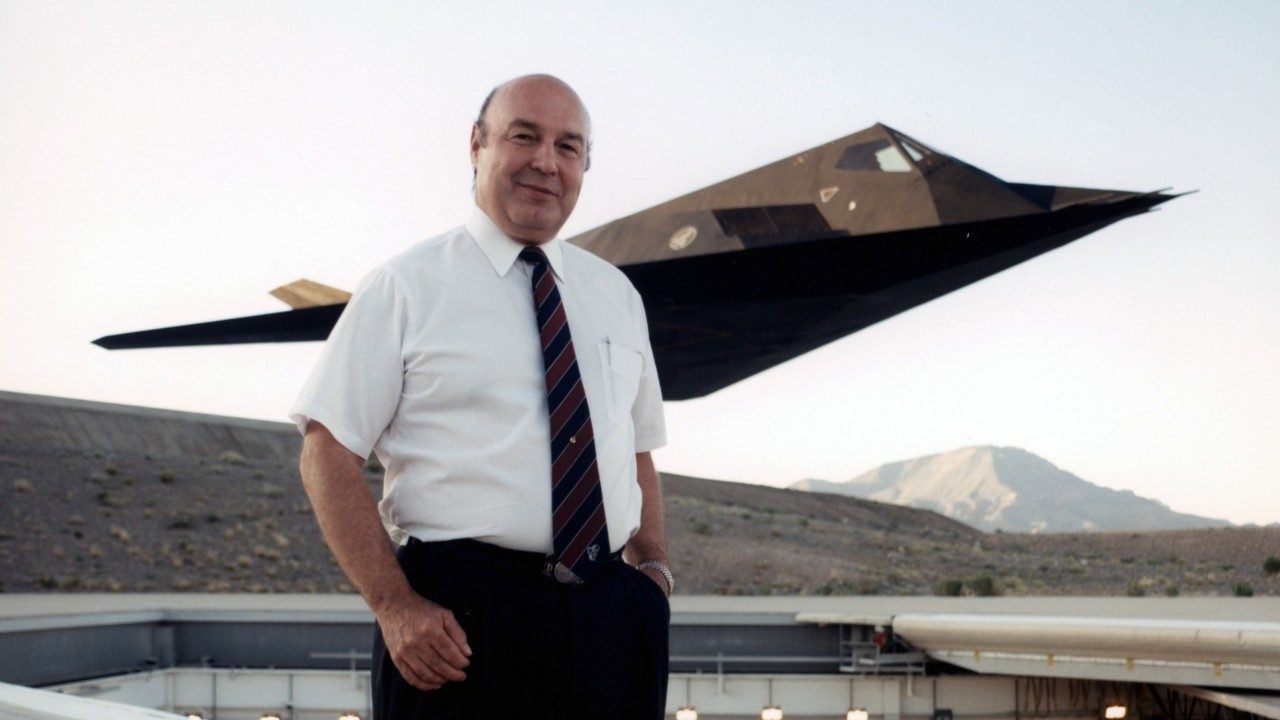
Denys Overholser, the Lockheed Martin engineer whose insights on the mathematics of radar cross section led directly to the first operational stealth attack airplane and permanently reshaped combat aircraft design and tactics, died April 28 at the age of 86.
Overholser came up with the idea of the “Hopeless Diamond” faceted stealth aircraft, wrote the patent for the F-117 Night Hawk stealth attack aircraft, and also earned a place in the National Wrestling Hall of Fame. Much of his work at Lockheed and other defense industrial organizations remains classified.
Ben Rich, the aerospace engineer who headed Lockheed’s Skunk Works advanced projects unit from 1975-1991, recalled in an early 1990s interview that Overholser—“one of my young guys”—came to him with the idea for a new approach to stealth. Overholser had read a forgotten 1962 paper on radar wave scattering, or diffraction, by the Russian mathematician Pyotr Ufimtsev; a paper that the Russian military itself had ignored. The Air Force’s foreign technology unit had translated the paper in 1971.
In his memoir, “Skunk Works,” Rich said “the paper was so obtuse and impenetrable that only a nerd’s nerd would have waded through it.” In the interview, Rich said he asked Overholser, “is this what you do with your free time?”
Until the 1970s, the effort to reduce radar cross section had been limited to radar-absorbing materials and internal structure, as used on the SR-71 reconnaissance airplane and the D-21 reconnaissance drone.
Ufimtsev’s research showed that shaping could dramatically attenuate the radar return of an object, and the work also provided the basis for calculating the radar cross section—radar reflectivity—of objects. Reducing the RCS of an aircraft could allow it to get quite close to a target before being detected by radar, and potentially, the aircraft might not be detected at all.
Holding up a legal pad, Rich summarized some of Ufimtsev’s findings, saying “if I hold it straight up and down like this, it’s one RCS (value). But if I rotate it 45 degrees,” creating a diamond, or kite shape, and tilting it, “I cut RCS by more than half, because of the way radar travels along the edges.”
Looking for ways to get the Air Force interested in new, classified technologies, Rich put Overholser to work on developing ways “faceting” could be applied to aircraft, as well as methods to accurately measure RCS with the computer power then available. Overholser, at 36, was heading up seminal work on the combat aircraft of the future. It was also brave work because Rich said his predecessor, the legendary Kelly Johnson, was not a believer in the whole idea and said so at every opportunity.
Overholser came up with a computer program he called “Echo 1” that could calculate RCS for a portion of an aircraft covered by a series of flat surfaces, or facets. These could then be added to other calculations to obtain an overall RCS for the design. He then drafted the “Hopeless Diamond,” a faceted aircraft concept which Overholser said would have 1,000 times less radar reflectivity than Lockheed’s D-21. A full-size combat aircraft, he told Rich, could have the radar return “of an eagle’s eyeball.”
The work soon led to an Air Force program called XST, for “Experimental Survivable Testbed.” Lockheed and Northrop—which was pursuing stealth along a different path—were given secret contracts to design small, low-observable aircraft to prove out the concept. Northrop’s approach had been to assess RCS of compounds curves and edge shape, and worked better in a forward view, but Lockheed’s approach worked better overall at that point. Lockheed won and built two demonstrators called “Have Blue.” Although both crashed, neither accident was due to stealth, and Lockheed received an Air Force contract to build an operational prototype, which became the YF-117. That in turn led to the F-117, which was phenomenally successful in the 1991 Gulf War and in some later conflicts.
As supercomputers became more powerful, it became possible to calculate RCS for an entire aircraft at once. The basic principles Overholser ported over from the mathematical theory continue to serve as the basis for modern stealth.
Overholser grew up in Texas and earned degrees in mathematics and electrical engineering from Oregon State University, later adding degrees in systems engineering and operations research. He worked on missile projects for Boeing and was one of the first engineers in that company to be chosen for training on computers. He moved to Skunk Works in 1964, hired because he was familiar with computers at a time when most aerospace math was still done on slide rules.
Greg Ulmer, president of Lockheed Martin Aeronautics—of which Skunk Works is a division—issued a statement to employees on April 29 saying Overholser’s worked “unlocked stealth technology.”
Overholser went largely unsung and “in the world of classified programs, that was exactly the point,” Ulmer said. “He spent decades shaping history far from public view through work that demanded brilliance, discipline, and a rare depth of character.” His work on stealth “would reshape airpower forever,” Ulmer said., adding that Overholser’s work was “the Rosetta stone” of stealth.
Overholser received the first-ever award of the National Defense Industrial Association for “Combat Survivability,” and was decorated by the Secretaries of the Air Force and Defense for his contributions to military technology.
Ulmer said Overholser had the rare knack of being a teacher who could “demystify complex concepts and make others feel capable of solving problems they never thought they could.” In later years, Overholser was a consulting engineer for the Pentagon and MIT’s Lincoln Laboratories.
“Our hearts are with his family, loved ones and all who had the privilege of knowing him,” Ulmer said. “We are profoundly grateful for his life, his service, and the extraordinary legacy he leaves behind.”
David Hamilton, who was director of the Air Force’s Rapid Capabilities Office from 2003-2007, said “Denys freely gave countless hours of tutoring and mentoring to many other engineers far more junior. He helped ferment the follow-on generations who continue to pioneer new methods in aircraft survivability. It was his reaching out to help others that elevated him to true unique hero status within the class of engineers and program managers who had the task to bring wild ideas to reality and into operational capabilities for the nation. He was a class act who will be severely missed by the aviation combat survivability community.”
Overholser enjoyed another distinction, having been elected to the National Wrestling Hall of Fame. He wrestled in high school and college, but the honor stemmed mainly from his contributions to aerospace technology.
