

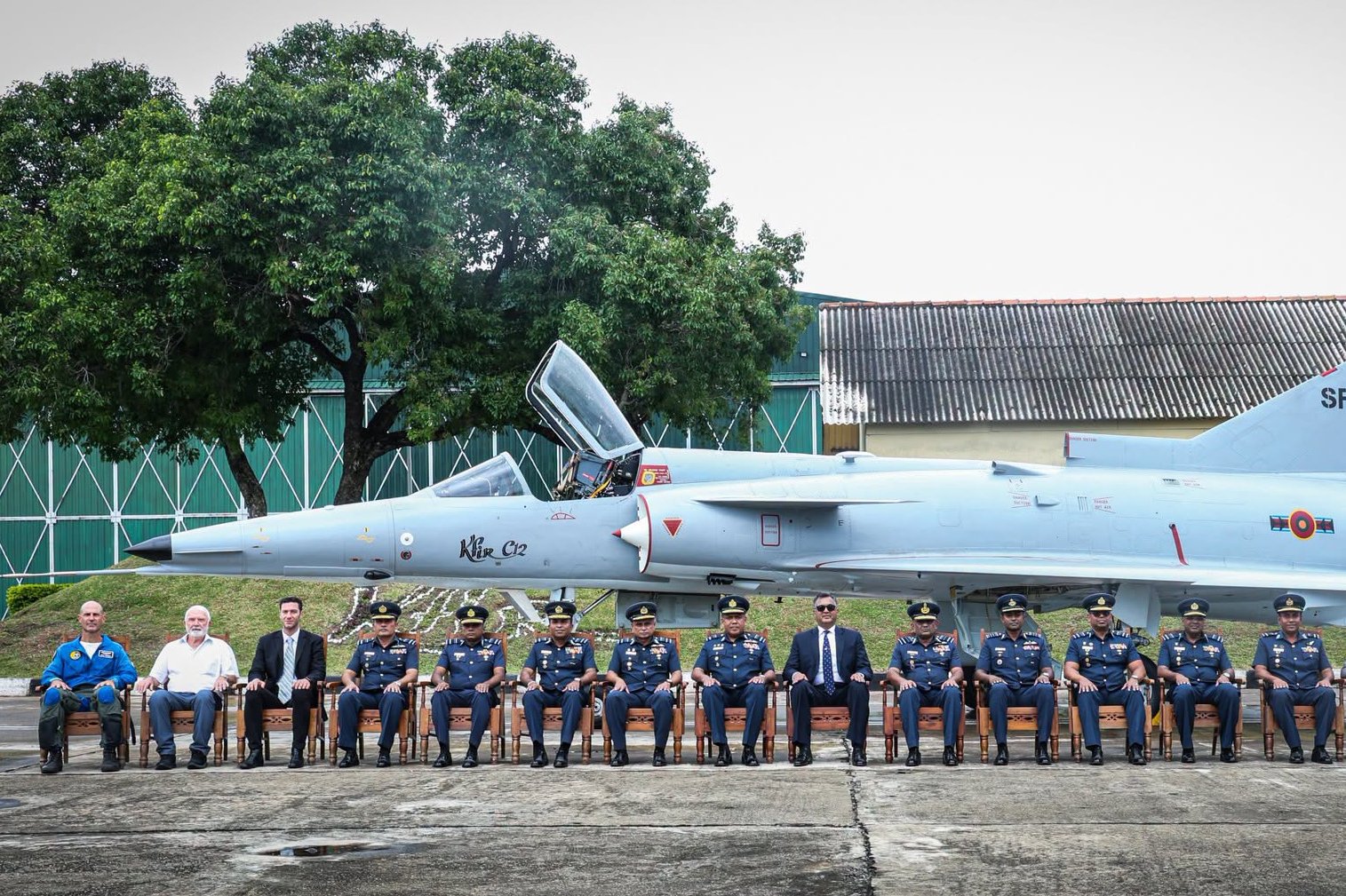
Sri Lanka’s first upgraded Israel Aerospace Industries (IAI) Kfir jet fighter completed its maiden flight on 11 June from Sri Lanka Air Force (SLAF) Base Katunayake. This achievement signalled the reactivation of a fleet that has been grounded for several years.
The upgraded aircraft, bearing the tail number ‘SFM1018’, took to the skies in a ceremony attended by Secretary of Defence Air Vice Marshal (Retd.) Sampath Thuyacontha. Another aircraft, a twin-seater, was on static display at the event.
The initial test flight marked the start of the aircraft’s flight test programme, following the completion of ground validation and system integration activities.
IAI is upgrading five SLAF Kfirs – four single-seat C2 and C7 aircraft, and one twin-seat TC2 trainer – to C12 standard under a US$50 million contract awarded in mid-2021.
While actual details of the upgrade have not been revealed, an IAI statement issued to mark the milestone said the work centred on integration of advanced avionics and mission systems, and that it is intended to extend the operational life of the SLAF’s Kfir fleet.
This includes a modern glass cockpit configuration to enhance situational awareness, navigation and communication capabilities, precision weapon employment, mission planning and debriefing functions.
In addition to avionics upgrades, the programme includes structural refurbishment and the establishment of renewed maintenance capabilities aimed at sustaining Sri Lanka’s Kfir fleet.
The IAI statement announced too that the company had completed the upgrade programme, which is somewhat curious given that only the first upgraded aircraft has completed its initial test flight.
Boaz Levy, Chairman of IAI, said in the statement: “The Kfir represents a significant chapter in Israel’s aerospace industry, and reflects the technological and engineering capabilities that have characterised IAI for decades.
“The successful modernisation of the SLAF fleet demonstrates how advanced technologies can be integrated into proven platforms to address evolving operational requirements and modern battlefield challenges,” he continued.
A total of 15 Kfirs were transferred to Sri Lanka from Israeli stocks between the 1990s and 2000s. The original acquisition comprised five overhauled Kfir C2s and one TC2 trainer, with the first aircraft arriving in December 1995.
Shortly after entering service with No. 10 Squadron, the Kfirs began combat operations against the Liberation Tigers of Tamil Eelam (LTTE), commonly known as the Tamil Tigers. The aircraft undertook many strike missions that continued until the group’s defeat in 2009.
Four additional Kfir C2s and four C7s arrived in 2000 and 2001 respectively, followed by an additional TC2 trainer in 2004.

Two Kfirs were among the SLAF aircraft destroyed on the ground during an attack by LTTE on Katunayake in July 2001, while five aircraft have been lost in non-combat-related accidents over the years.
US sanctions on Sri Lanka made it increasingly difficult to obtain spare parts, and as the aircraft exhausted their available flying hours, the remaining Kfirs were placed in storage.
Over the past decade, Sri Lanka has considered acquiring between eight and twelve new multirole fighter aircraft, but no procurement programme has materialised.
by Roy Choo
