

Key Points
- A Cambridge Aerospace Skyhammer drone interceptor was found crashed on a UK beach and identified by Reddit users before the company collected it.
- UAV engineer Chris Wheat published an analysis of the wreckage, describing his technical conclusions as educated guesses from photos.
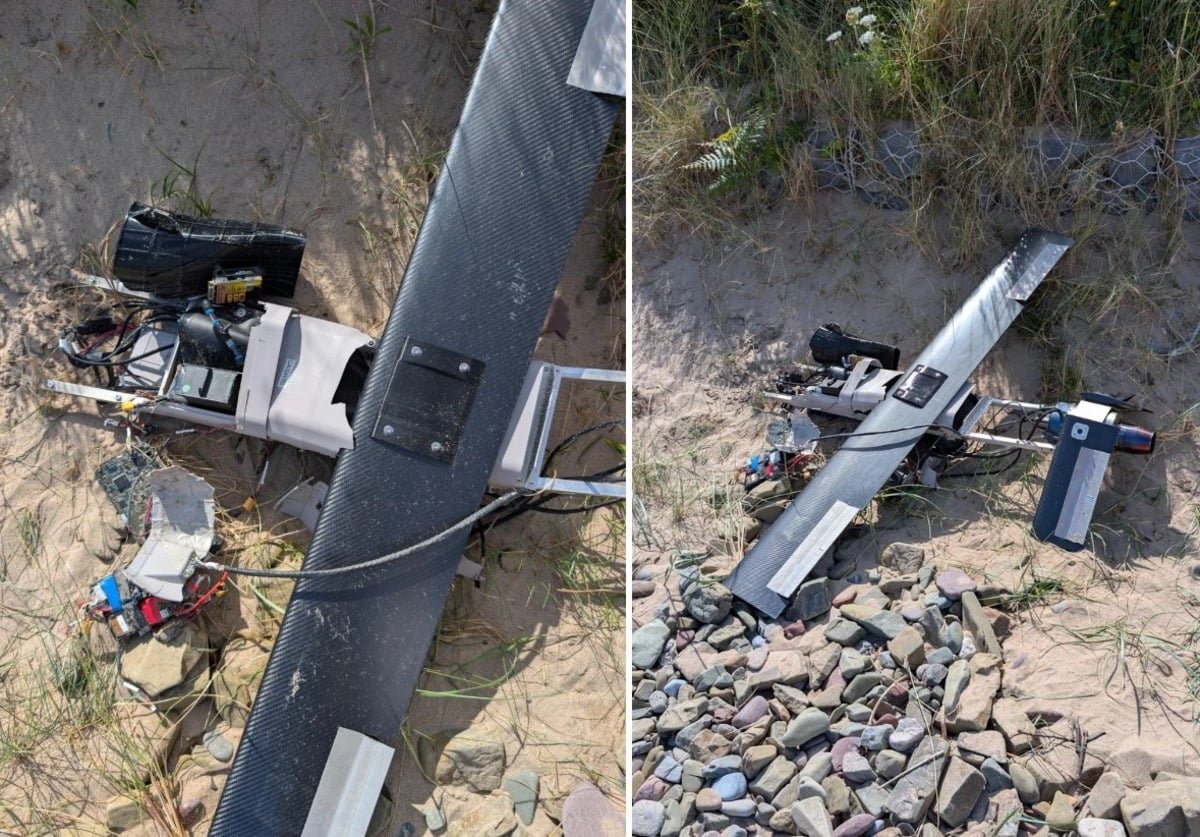
A drone found washed up on a UK beach turned out to be a Skyhammer interceptor built by Cambridge Aerospace, the British startup that closed a $300 million funding round at a $3.4 billion valuation earlier this month, according to a Reddit thread and a subsequent technical breakdown posted on social media by UAV engineer Chris Wheat.
A member of the public posted photos of the crashed aircraft to the r/drones subreddit under the title “Can anyone ID this drone?”, saying an online image search had turned up nothing useful. The poster said they contacted the coastguard, who took custody of the wreckage. Other Reddit users, posting under the names “towelpill” and “Early-Programmer-711,” identified the aircraft as a Cambridge Aerospace Skyhammer. Cambridge Aerospace representatives arrived the following morning to collect the drone from near the poster’s location, according to the thread.
Cambridge Aerospace was founded in 2024 and has raised more than $630 million to date, including the $300 million Series C led by DFJ Growth that closed this month. Skyhammer, the company’s first product, is a low-cost, radar-guided interceptor built to destroy Shahed-type one-way attack drones, with a stated range of more than 30 km (19 miles) and a top speed of up to 700 km/h (435 mph). The UK Ministry of Defence contracted Cambridge Aerospace in April to supply Skyhammer interceptors and launchers to British forces and Gulf partners, with deliveries beginning in May.
– ADVERTISEMENT – CONTINUE READING BELOW –
Wheat, who works as UAV Autonomy Lead at Hybrid Drones Ltd, wrote in a social media post that little technical detail about Skyhammer’s internal construction had previously been made public. He described his analysis of the crashed airframe as “educated guessing from publicly available imagery” and invited corrections.
Wheat identified the propulsion as likely a JetCat P250-Pro turbine, rated at 25 kgf (about 55 pounds-force) of thrust and weighing 2.2 kg (4.9 pounds), a commercially available unit he said costs around 4,000 euros. Based on an assumed fuel burn and cruise speed, he estimated the aircraft’s onboard fuel supply of 2 to 3 liters would give it a flight time of roughly five to nine minutes.

The airframe measures roughly 1.5 meters (4.9 feet) in both length and wingspan and about 0.2 meters (8 inches) in diameter, Wheat wrote. He said the structure is built around two aluminum box-section spars, with an outer shell that appears to be 3D printed using fused deposition modeling, based on visible layer lines, at an estimated material cost of about £150 (roughly $203).

Wheat said the wings appeared to be bolted on rather than folding, differing from a tube-launched, folding-wing concept Cambridge Aerospace has shown in promotional material, and suggested this particular airframe is rail-launched instead. He noted the wings lack sweep, a design choice he said could favor low-speed handling and launch performance over top-end speed, and said the airframe’s size, fixed-wing layout and turbine propulsion suggest the system is built to intercept larger, less maneuverable drones such as Iran’s Shahed-136 rather than faster or more agile targets.
On avionics, Wheat said he could not identify hardware for an active X-band radar seeker, which Cambridge Aerospace’s public descriptions of Skyhammer have referenced, such as a radome or antenna. He said the seeker may not have been fitted to this particular prototype or could still be under development.
