

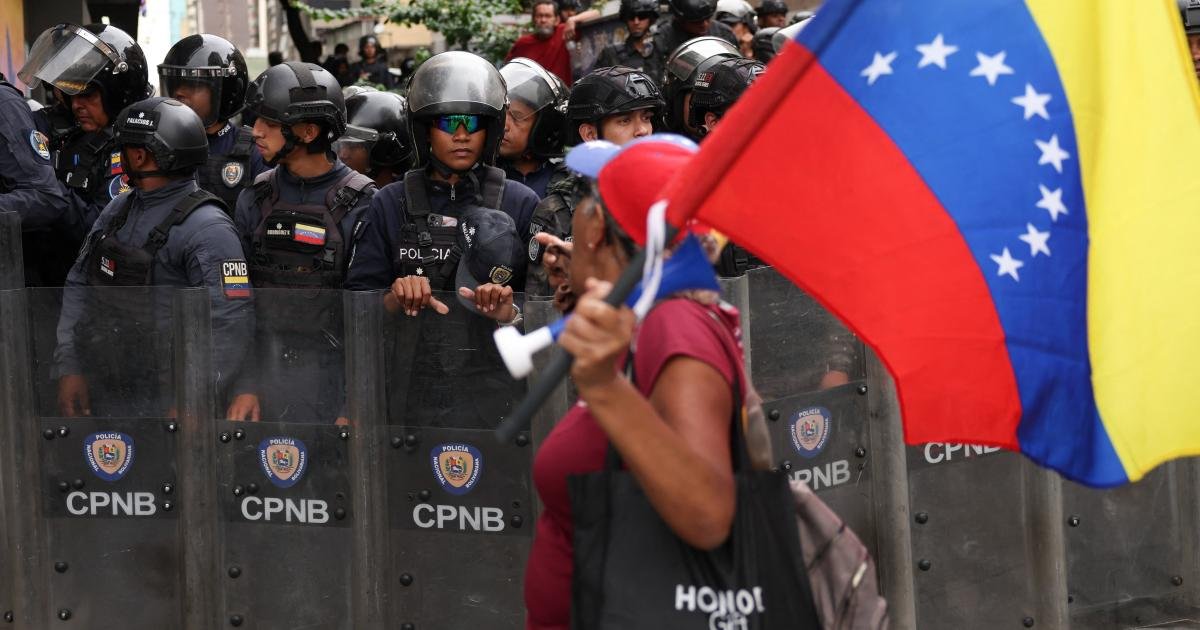
After the U.S. military captured then Venezuelan President Nicolás Maduro in January, the United States set out on a mission to fix what President Donald Trump called a “dead country.” With broad authority over Venezuela’s agenda, officials in the Trump administration promised to free the country from socialism. As Secretary of State Marco Rubio said, when he was called before the Senate in late January, the administration’s ultimate objective was to establish “a friendly, stable, prosperous Venezuela, and democratic, in which all elements of society are represented in free and fair elections.”
Rubio laid out a three-stage framework for managing this democratic transition: stabilization, economic recovery, and, finally, transition. Washington is currently focused on the second stage, recovering the economy, but it is proceeding so quickly and with such little transparency that it is jeopardizing the stated end goal entirely. U.S. deal-making with the country’s oil sector, in particular, is reifying rather than transforming Venezuela’s economic rentism: a model of governance in which the state controls important sectors of the economy and offers business contracts and market privileges to firms that support its agenda. This is precisely the system that facilitated the Venezuelan state’s rampant corruption over the past 25 years, allowing autocratic leaders to drown out democratic forces and win elections.
As it pursues its economic goals with dizzying speed, the Trump administration is also slow-walking democratization efforts. For months, Washington excluded opposition leader María Corina Machado and her party, Vente Venezuela, from any direct involvement in negotiations. Machado had left the country last December to receive a Nobel Peace Prize after nearly 20 months in hiding, and after Maduro’s removal, the United States did little to help her return. Venezuela’s pro-democracy forces have thus been left feeling like they are pushing the regime in Caracas to democratize with the acquiescence, but not necessarily the full enthusiasm, of the United States.
Last month, Machado returned to Venezuela, and now she has the potential to change the game. Machado could become the greatest asset or, possibly, the greatest disruptor to Venezuela’s democratic transition. If Machado coordinates with the faction of the opposition that is currently negotiating with the government, any outcome will be seen as legitimate. But if she opposes and speaks out against the result, Venezuelans will find themselves in a familiar and dangerous place: with a divided opposition, a government with few constraints on its power, and a transition in purgatory.
So far, Washington has squandered its immense leverage over Caracas. By dragging out the transition and pursuing questionable economic deals, Washington is endangering not only its own end goal but also the greatest opportunity Venezuela has had to overcome more than a quarter century of autocratic governance.
STANDARD OPERATING PROCEDURES
During Trump’s first term, his administration centered its criticism of Maduro on the country’s socialist model. In February 2019, weeks after recognizing the opposition leader Juan Guaidó as Venezuela’s interim president, Trump promised in a speech that the “twilight hour of socialism has arrived in our hemisphere.” That campaign to oust Maduro failed, but Trump’s diagnosis of what ails Venezuela was wrong to begin with. Over the past two decades, Venezuela has not been operating primarily under a socialist model but an extractivist one. And since January 3, the United States has seemed only to reinforce it.
Venezuela is an oil state. Under Chavismo, the ideology named for Maduro’s predecessor Hugo Chávez, the state used oil revenues as a political slush fund to reward allies. Little went toward investments in the oil sector or the rest of the economy. Secret deals with oil magnates at home and abroad guided most governance decisions. Whereas the government’s critics faced legal attacks, the well-connected received impunity. Chávez implemented elements of socialism, of course, with massive nationalizations and price controls, but the key priority was collusion and special deals. Many of the state’s allies were poor Venezuelans whose votes kept the autocrats in power, but less noticed were the economic elites. These private actors shunned opposition figures and refrained from any public criticism of the regime; in exchange, they accumulated regulatory favors, access to preferential exchange rates, or exclusive contracts with the state. This model even applied internationally; around 2007, Chávez began redirecting oil sales from the United States to China, both to reward China for being so friendly toward the regime and to preempt a possible U.S. divestment from the Venezuelan oil sector. Oil booms in the first decade of the century allowed the country’s populist leaders to build vertical patronage systems that rewarded loyalty and starved out dissent.
Venezuela has not been operating primarily under a socialist model but an extractivist one.
Eventually, however, this system ran its course, leaving Venezuela’s oil industry in shambles. In the 1990s, before Chávez took power, oil production hovered around 3.5 million barrels per day; by 2019, oil production had dropped to 700,000 to 800,000 barrels per day. The government has recognized this dismal state; acting President Delcy Rodríguez has said that the oil sector will need as much as $76 billion in external capital to recover over the next five years.
The United States is a plausible partner for Venezuela’s oil recovery. Washington is responsive to high domestic and global demand for oil, especially since the war in Iran has disrupted flows from the Middle East. American oil firms have the resources to rebuild Venezuelan production and, just as important, the refineries needed to process Venezuelan oil, which is among the world’s heaviest and most sulfurous.
But rather than replacing, or at least revamping, this Chavista system, the United States seems to have embraced its structure. In August, the U.S. government struck an agreement with North American Blue Energy Partners (NABEP), a private Venezuelan corporation, that Trump called “the biggest oil deal in the history of the world.” According to the White House fact sheet of the deal, the Venezuelan state granted NABEP a 100-year concession to operate 17 oil fields, which could cover one-fifth of Venezuela’s total proven reserves. The company is led by Alejandro Betancourt, a Venezuelan citizen being investigated in Spain and Switzerland for money laundering and widely regarded as having collaborated with Chávez and acting as an intermediary between Trump and Rodríguez. Meanwhile, the agreement gives the U.S. Defense Department a 35 percent stake in NABEP, and the State Department gets the right to buy 20 percent of NABEP’s oil at the cost of production—meaning NABEP makes no profit on that share—and has preferential access, at market prices, to the rest.
Outside of these details, little is known about the arrangement or how it came to be. There was no competitive public bidding on the fields—a practice that is generally recommended every time governments assign contracts to private and foreign actors—and there was no explanation of how Washington will manage the export proceeds or clarity on who will fund the necessary investments. The U.S. Congress has not reviewed the deal, although Democrats, with a new majority starting in January, have promised to investigate it.
The Venezuelan state has also shown little interest in helping the Venezuelan people.
This deal is also wildly unpopular across Venezuela’s political spectrum. Although Venezuelans have generally celebrated the return of U.S. capital to the country, nearly 80 percent of Venezuelans did not support the oil deal, according to a poll released in September by Meganálisis. Even Machado, who rarely criticizes the United States, has expressed reservations, saying that Betancourt has been responsible for “obscene corruption.” Hardcore leftists see the deal as capitalist robbery. Nationalists see it as neoimperialism. Democratic forces see it as a bailout for the dictatorship. Ordinary citizens see it as a missed opportunity to spread Venezuela’s wealth more equitably.
These oil and gas deals could generate an oil boom if investment comes quickly, production capacity is restored, competitive bidding expands, and government spending and welfare institutions are reformed. But as Trump said when celebrating the deal at the United Nations in September, “To the victor belong the spoils,” and the victors, in this case, are Washington, the ruling party, and a private businessman.
The Venezuelan state has also shown little interest in helping the Venezuelan people and directing petrodollars toward human capital or public welfare. Instead, it will likely do what Chavismo perfected in previous booms: bankroll patronage networks, buy off corporate allies, deny funds to competitors, and spend on electoral campaigns. These new deals could very well end up financing the ruling party’s political rebirth.
The rest of the Venezuelan economy’s recovery, meanwhile, remains a mystery. There have been no efforts toward establishing universal property rights, modernizing contract law, reforming the financial sector, or dismantling state monopolies. Without such inclusive economic rights and democratic rules, oil windfalls seldom produce equitable growth. They produce skewed gains for the state and its friends.
The White House sees the deal as locking Venezuela into a secure economic relationship with the United States for at least 100 years. This week, he referred to the country as “our new acquisition.” But this might be a false sense of security. The agreement is so distasteful to so many Venezuelans that, rather than inoculate Venezuela against anti-imperialist socialism, it is making a radical backlash more likely.
BIG BABY STEPS
Almost a year after Maduro’s departure, very few concrete steps have been taken to organize a free and fair election in Venezuela. Instead, the Rodríguez government and an opposition delegation led by Dinorah Figuera, who is president of Venezuela’s exiled National Assembly in Spain, held a series of talks this fall. The parties did make progress, including agreeing to unblock certain banned websites and to allow the government to reclaim sanctioned gold reserves held by the Bank of England. Most significantly, after months of pressure from the Venezuelan opposition, the Venezuelan government agreed in August to replace all 32 judges in the Supreme Tribunal of Justice, accepting nominations from civil society that included the opposition. This is a gigantic baby step. In Venezuela, the Supreme Tribunal of Justice long served at the center of Venezuela’s famous autocratic legalism. It was the regime’s preeminent weapon to disqualify opposition candidates and elected officials, accepting laws that justified repression, refusing to investigate extrajudicial killings, and persecuting opposition figures on fabricated charges. An independent judiciary could invalidate current laws that criminalize dissent and establish new ones to promote fair electoral rules. Establishing even a modest framework for an independent judiciary is indispensable for any transition to minimal democracy.
And yet committing to reform the judiciary, however important, is not enough. A full transition to democracy will require far more: a new constitution with robust institutional checks and balances, new laws promoting civil liberties, and more oversight of intelligence and security organizations, which have been known to engage in arbitrary detentions and torture. This will also require retraining the law and order apparatus, namely the National Police and the military’s internal security forces, the Bolivarian National Guard, to respect civil rights; redesigning the electoral system and naming independent electoral authorities; and rebuilding civil society and a free press. Judicial reform in isolation will not dismantle an entrenched autocratic regime.
This week, Defense Secretary Pete Hegseth announced an expansion of U.S.-Venezuelan military cooperation, mostly targeted at fighting crime. But fighting crime effectively does not necessarily require more brute force but rather good intelligence, a robust criminal justice system, a professional and law-abiding police force, and investments in community building, namely in strengthening ties of trust between neighbors and police. It is not clear that these elements will be part of this new U.S.-Venezuelan security cooperation. Unless new agreements come with commitments for internal state reform, the United States risks helping a dictatorship acquire even more coercive power.
Most important, the transition process has ignored the will of the people. Most Venezuelans want a fair election, plain and simple. In a Meganálisis poll conducted in April, 87 percent of respondents agreed that the “solution for Venezuela is a presidential election in 2026.” Even with so much material deprivation—inflation is in the triple digits, and close to 70 percent of the population still lives in poverty—the people want to vote first.
Rubio and Rodríguez have argued that stabilization is necessary before elections can be held. But there is reason to believe that elections are not the result of stability but the source of stability. Elections produce legitimacy for authorities. The current authorities not only aided the suppression of the last election, in 2024, but they have also passed the limit of 180 days that an interim government can serve, according to Venezuela’s constitution. Any policy that it advances is, thus, also less legitimate than those put in place by an elected government.
Moreover, Machado’s absence from the process so far risks making any major deal between the government and the opposition fragile. She is the most popular politician in the country and the leader of the largest pro-democracy movement that Latin America has seen since the first decade of this century. Across multiple polls, including by Meganálisis and AtlasIntel, she has approval ratings between 57 and 76, compared with Rodríguez’s single digits, and multiple international accounts have shown that her substitute in the 2024 election, Edmundo González, easily won. This popularity makes Machado a threat to the Chavista regime, and her exclusion likely came at least in part as a request by the Rodríguez government.
OUT WITH THE OLD, IN WITH THE OLD
Rather than inaugurating a democratic and economic renaissance, the United States is potentially enabling the survival of a rentist regime. During the oil boom of the first two decades of this century, the Chavista regime insulated itself from domestic accountability by exchanging oil rents for votes and elite support. China served as its primary geopolitical patron, unconcerned with accountability so long as the crude flowed eastward. The United States’ playbook today eerily imitates this model. Venezuela’s main external partner has now changed, but that partner has similar functions. By prioritizing narrow resource extraction over deep institutional reform, the United States has opted to become the senior partner in a rentier compact. Washington is Venezuela’s new toll collector.
Thus far, Venezuela’s democratic transition has delivered only a commitment to reform the Supreme Tribunal of Justice. Nearly a year after Maduro’s ousting, there is no election calendar, no clear plan to reform the electoral system, and no meaningful internal changes to how the government generates and spends its revenues. Despite all the leverage Trump claims to have over the Venezuelan government, outside of business deals, he has very little to show for it.
If this trajectory persists, the United States will not propel a transition to democracy, market principles, and the rule of law in Venezuela. It will instead re-create the very conditions that produced Venezuela’s autocracy in the first place.
Loading…
