

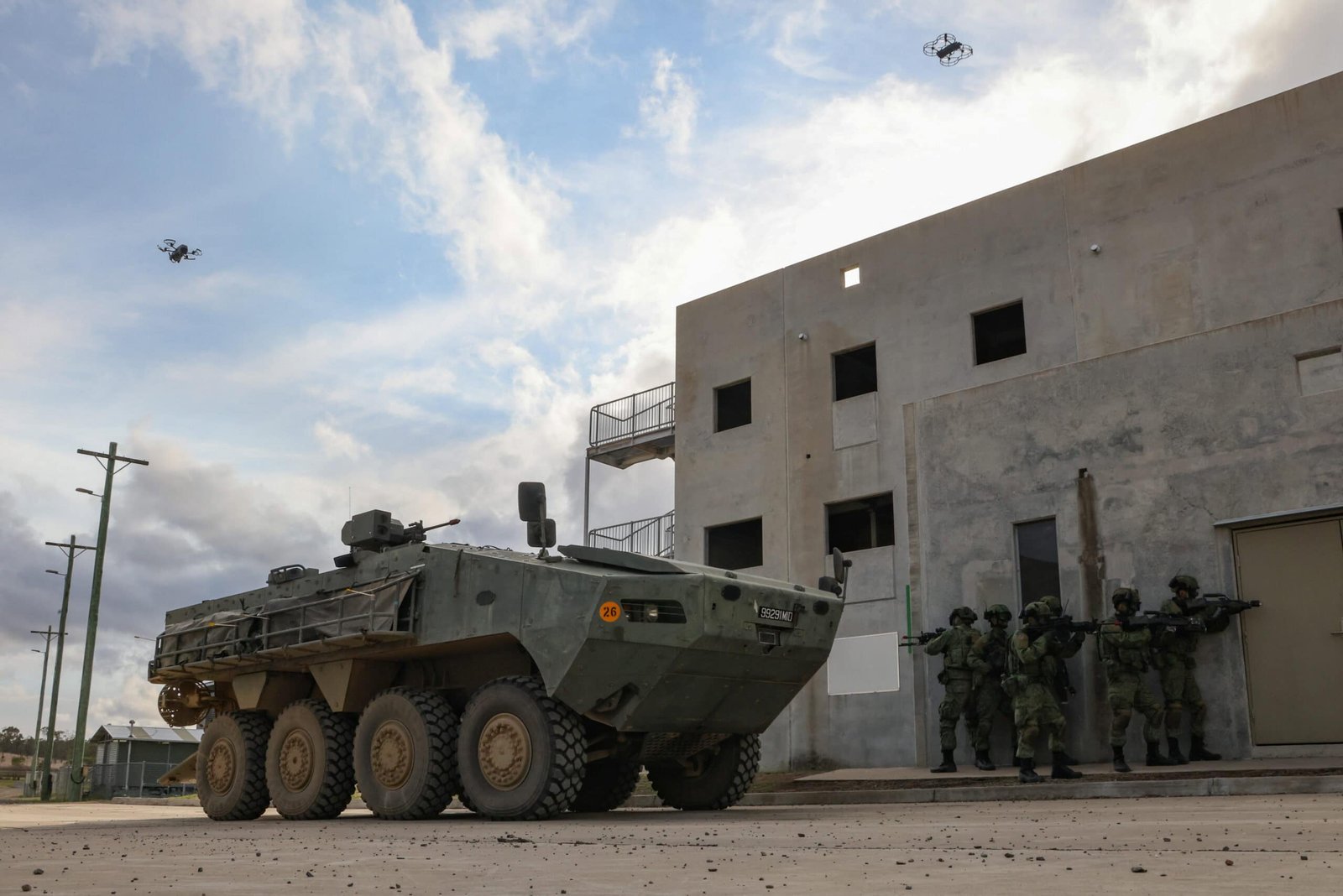
The Singapore Army is reorganising its infantry branch under the Next-Generation Infantry Battalion (NGIB) concept, adapting its force structure to the evolving threats and opportunities presented by drone warfare.
Having transitioned to motorised infantry in 2009, the army is now restructuring its battalions into more agile formations capable of conducting multiple tasks concurrently.
Under the previous structure, a motorised infantry company comprised three platoons, each with three seven-man sections. Under the NGIB organisation, a company will now have five platoons, each comprising two six-man sections.
Two general-purpose machine gun operators will be reassigned to form dedicated “steel net” sections specialising in surveillance and attack drone operations. Each company will have two steel net sections, each comprising two three-person teams.
The steel net sections will operate Vantage Robotics Vesper surveillance drones and ST Engineering Artos attack drones.
However, the total personnel strength and the number of Terrex infantry carrier vehicles will remain unchanged, with each section assigned its own vehicle.
Beyond these structural changes, the army is introducing a section-level battlefield management system (BMS) that extends beyond vehicle-mounted systems. Each section will receive a mobile BMS device, giving commanders greater situational awareness. The system will also connect to drones, allowing imagery to be relayed to decision-makers.
The full NGIB concept was trialled for the first time by the 5th Singapore Infantry Regiment during Exercise Wallaby in the Shoalwater Bay Training Area in Australia in October 2026, and it will gradually be introduced across other infantry units.
The army said it would also share NGIB concepts with other formations, adopting best practices and ideas where applicable.
The Defence Science and Technology Agency, which collaborated with the army on the NGIB’s development, said a future objective is to enable troops to control drones directly from vehicles.

Chief Infantry Officer Brigadier General Fairoz Hassan said the infantry’s role had evolved from conventional light infantry, which fought primarily with direct-fire weapons, to motorised infantry with greater protection, and now towards a force able to engage targets at greater distances using drones.
“We can now fight at a stand-off position. We can use drones to fly far, see far and be able to strike far in our attack missions to be able to hit them. So those are the things that, in the past, line infantry cannot do,” he said.
The army has also recently introduced the Sigma 155mm truck-mounted howitzer and a “precision land shooter”, with these two platforms expected to contribute to the NGIB’s firepower as the formation becomes more integrated with combined-arms units.
The growing use of drones and future robotic systems also presents logistical challenges, particularly in ensuring sufficient energy supplies for field operations. Fairoz said infantry units could no longer rely solely on conventional electrical batteries, and the service is working with Singapore’s defence technology community to develop new power solutions for field use.

Exercise Wallaby expands army training
Exercise Wallaby remains a premier Singapore Armed Forces training activity, making use of Australia’s Shoalwater Bay Training Area, which is approximately five times the size of Singapore.
The addition of the Greenvale training area under the Australia-Singapore Military Training Initiative will add 310,000 hectares of training space, and enable up to 14,000 Singaporean personnel to conduct unilateral training for as long as 18 weeks annually over the next 25 years.
The expansive training area allows the army to test tactics, techniques and procedures under demanding conditions, and to conduct live-fire training. For instance, Asian Military Review observed army sniper training involving the Accuracy International AX50 12.7mm anti-materiel rifle, as well as Sako TRG 22 and Colt M110 sniper rifles.
Operating far from its home supply chain, the army’s Forward Support Group also expanded its 3D-printing capabilities at Exercise Wallaby 2026. Three containerised facilities can now produce resin and metal parts (including components for drones), and help sustain logistics readiness during high-tempo exercises.
The training areas also serve as proving grounds for future army vehicles before they enter operational service. Potential candidates include the Terrex S5 (known to the army as the Titan) and ST Engineering’s Rhino 4×4 high-endurance, damage-resistant, protected vehicle.
by Chen Chuanren
