


Two new products were shown for the first time in public by Skydagger, the Turkish specialist in small size drones. The Toyca05 is a fixed wing loitering munition, while the Hunter is a vertical take-off interceptor
Among the several Turkish drone producers Skydagger specialised in low-tier products, its drones complementing high tier ones; it is therefore not a surprise that the company is supported by Baykar, the leading UAV company in Turkey, and is integrated into its ecosystem.
Also exhibited on the Aselsan stands, both inside and outside, as one of the possible “ammunitions” of the Gökalp C-UAS system, the Hunter is an electrically powered drone which has the typical architecture of interceptors, a cylindrical body with four short cruciform wings carrying at each tip one motor activating a two blade pushing propeller, four small fins rotated at 45° compared to the wings providing stabilisation in flight and support for vertical take-off from a surface. No figures were given about the take-off mass, the Hunter carrying a payload of 500 grams, in the form of an antipersonnel warhead; the company produced the Pence 3.5” compatible with its interceptor drone. Beside the standard vertical take-off procedure, controlled from a box-type ground weapon station, the Hunter can also be launched from a rifle-like support which carries a screen. Usually, the target is detected by a radar, a video showing the Skydagger product operating in conjunction with an Aselsan Aura 100-G C-UAS radar, an improved version of which is installed on the trailer version of the Gökalp.
After take-off the Hunter flies under radar control towards the target, then at around 500 metres distance its locks-up to the incoming threat thanks to an image-based system, it is equipped with day and thermal cameras, which brings it to direct impact, the warhead detonation ensuring full neutralisation of the threat. Manual guidance can also be used, in that case the Hunter becoming an interceptor FPV drone. The Hunter has a cruise speed of 230 km/h while its maximum speed is 320 km/h, operational range being 20 km, with a maximum flight time of 10 minutes. A Lidar can be used to detonate the warhead at a selected distance from the target.
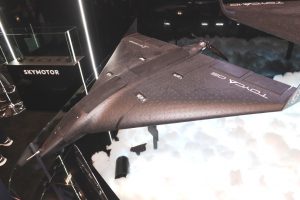
At the Istanbul exhibition Skydagger also showcased for the first time at a public event the Toyca05, a delta wing airframe with a maximum take-off mass of 15 kg, 5 kg being the antipersonnel warhead. Although it was kept away from public hands, at first glance the fuselage and wings seemed made of polystyrene foam, which explains the high payload/take-off mass ratio, and which will favour mass production. The outer wings, which are fitted with winglets at the tip, can be disassembled for transport, a quick lock mechanism allowing readying the airframe for flight in a very short time. The warhead is then installed in a housing at around one third of the fuselage; Skydagger produces the 5 kg Pence 15” antipersonnel warhead, which is also used in it RTF15” drone. The Toyca05 is powered by an electric motor located at the rear, driving a two-blade pushing propeller. It is fitted with an 8-channel anti-jam GNSS receiver. It can fly for a maximum of 50 minutes at a cruising speed of 145 km/h, up to a range of 70 km; launched from a catapult, it autonomously fly towards the target which coordinates were provided by the planning system, and once it is locked on the target, a dual day/thermal sensor suite is installed in the nose, it dives at a 45° angle reaching a maximum speed of 220 km/h, a Lidar sensor acting as proximity fuse, depending on target. The Skydagger catalogue contains an empty page dedicated to a new loitering munition, the Toyca10; this will quite probably be a scaled-up version of the Toyca05, able the Pence 15” Plus 10 kg antipersonnel warhead currently used on the Skydagger 15” Plus drone.
Photos by P. Valpolini
