

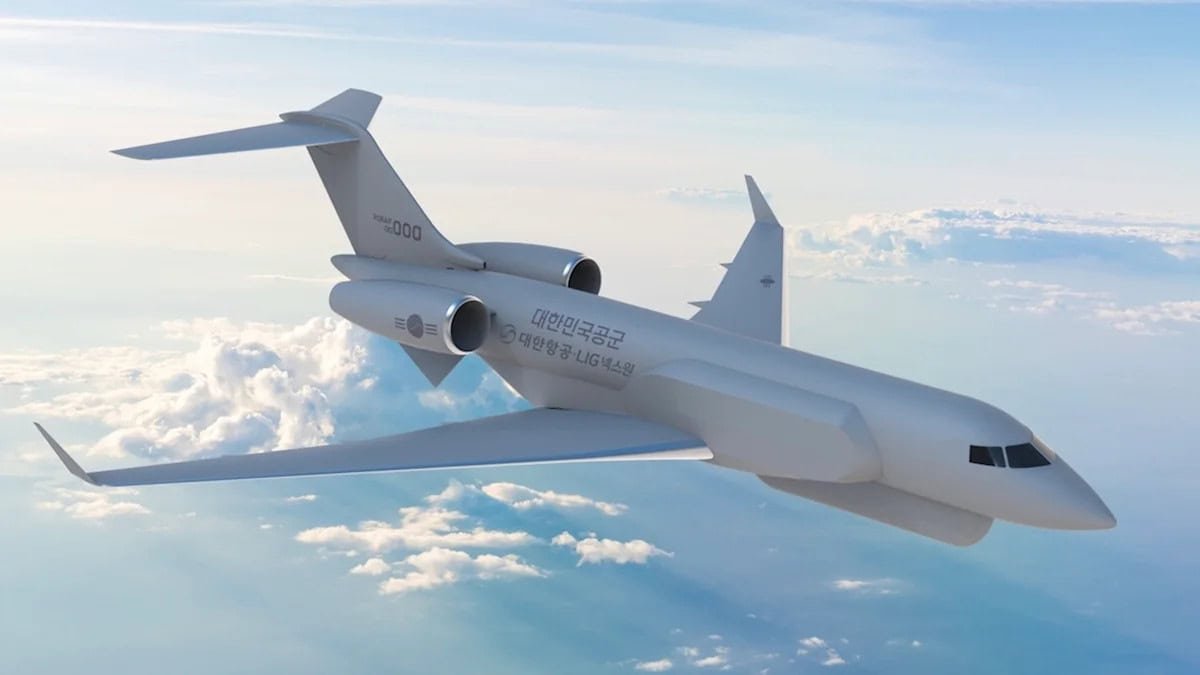
South Korea’s procurement of electronic warfare (EW) aircraft – specifically designed for standoff jamming – is proceeding apace, with Bombardier Defense announcing on 14 July that it had signed a contract to sell two Global 6500 airframes.
This Republic of Korea Air Force (ROKAF) programme is known as the Block I Electronic Warfare System Development Project. The ensuing aircraft will perform a similar role to the US Air Force’s EA-37B Compass Call aircraft.
South Korea’s Defense Acquisition Program Administration (DAPA) said the aircraft are designed to “paralyse enemy air defence networks and wireless command and communication systems in times of crisis”.
Such aircraft typically have a surveillance capability too. They can thus perform electronic intelligence in peacetime, and disrupt enemy air defence and communications during a conflict, from a safe distance.
This airframe contract was for two aircraft, but it is likely two more airframes will follow at a later stage. This is because the ROKAF’s requirement is for four such aircraft. It is unknown how much the two airframes cost, with neither party revealing a figure.
Systems integrator Korean Air partnered with LIG Defense & Aerospace (formerly LIG Nex1) for this project. Competing against them was Korea Aerospace Industries (KAI) that had teamed up with Hanwha Systems.

After bids opened on 15 July 2025, DAPA eventually awarded a KRW1.56 trillion (US$1 billion) development contract to Korean Air in December 2025. This was confirmed in LIG’s securities market filing on 24 December 2025.
Michael Anckner, Vice-President of Worldwide Sales at Bombardier Defense, explained: “The Global 6500 aircraft is in demand around the world because of its performance and versatility, and we’re extremely proud that it was chosen for two very advanced, yet different defence missions in South Korea. This aircraft is trusted because of its proven military track record, yet it remains highly adaptable as defence needs evolve.”
Anckner was referring to the fact that the Global 6500 also forms the basis for four airborne early warning (AEW) aircraft ordered by Seoul last year. L3Harris is working with Elta Systems and Korean Air on that AEW programme.

DAPA earlier released an infographic showing a business jet with conformal cheek side fairings that contain EW sensors for collecting data from and jamming hostile communications and radar systems. This possibly uses active electronically scanned array technology that sends concentrated bands of electromagnetic energy to jam enemy sensors. The Cheosun newspaper suggested the aircraft could have a jamming range of at least 200km.
The same infographic depicts a ventral canoe fairing that contains further signal intelligence, jamming and likely direction-finding equipment. The aircraft has a data link to transmit and receive data, as well as a self-protection measures suite.
The Global 6500 has a flight ceiling of 15.5km, increasing the line-of-sight range of the EW aircraft’s onboard sensors. LIG Defense & Aerospace is developing and installing these EW systems, after performing similar work on KAI’s KF-21 Boramae fighter programme.
DAPA has given this project a 2024-32 timeframe.
Incidentally, KAI is developing the Baekdu II intelligence, surveillance and reconnaissance aircraft for the ROKAF. KAI and LIG will deliver four Baekdu II aircraft based on Dassault Falcon 2000LXS airframes.
by Gordon Arthur
