

Every administration since the Cold War has been looking for a significant foreign policy breakthrough with China. Spanning containment and normalization to opening and reform, U.S. policymakers have long hoped that China would fulfill its place in the international order and transform itself into a “responsible stakeholder.” Despite years of pivots, new visions, trade arguments and agreements, and other policy swings, the lack of transformational progress is now set against the backdrop of rapidly expanding nuclear capabilities under the leadership of a Chinese general secretary doubling down on authoritarianism and revisionist history. Here, I examine a different factor that generates patterns of behavior in international relations: status recognition. Status is a motivating factor that explains China’s perspective and resistance to arms control, and therefore, offers an opportunity to change the outcome of ongoing negotiations.
Status recognition, that is, the position and identity of a state reciprocated by other states, is one area of negotiation and compromise that remains untested. Coercive diplomacy has not achieved strategic stability with China, but there are few alternatives in the public discourse. My intent is to provide some new thinking to address an old problem. The theory I present here is informed by academic experience, 20 years as a military officer in a nuclear career field, personal experience at a 2023 P5 meeting with Chinese defense officials, and ongoing affiliation with a long-term Track 1.5 participant. The sections below include a brief description of status, the critical and continuous role status plays in Chinese culture and national identity, and a status-informed approach with recommendations beyond coercion to build a new era of strategic stability. With a third U.S.-Chinese summit fast approaching, preparation for the upcoming meeting between President Donald Trump and General Secretary Xi Jinping is another opportunity to set the stage for the new era they both seek.
Concerning Status
Status consists of hierarchy and identity. Each state holds a perception of itself and its position in the hierarchy, and other states validate that position and identity through patterns of behavior and social interactions. There are different organizing principles that generate distinct hierarchies within the international system of states. The distinction between nuclear and non-nuclear states is one organizing principle that results in a recognizable hierarchy. Furthermore, among the nuclear weapon states, there are additional perceptions of positions of authority and influence that affect the relationships between states in the hierarchy. For example, North Korea does not have the same global influence as the United States or Russia. The United Kingdom, France, India, and Pakistan are usually described as regional nuclear powers as opposed to global superpowers or great powers. Perceptions of rank within (or outside) the hierarchy generate interactions that reinforce the rank order in the group. This pattern of state behavior among nuclear powers is relatively stable.
Identity is a state’s self-perception in comparison to others. When others do not validate or reciprocate a self-perceived identity, the immediate remedy is to engage in identity-seeking behavior. According to social identity theory, identity-seeking behavior includes emulation, competition, or creativity in order to generate the desired social recognition. Just as individuals rely on others to recognize and reciprocate self-perceptions through social interactions or voluntary deference, states rely on others for validation as well. Social interactions among states generate patterns that reinforce identity throughout the larger system. The presence of a status deficit, defined as a state’s dissatisfaction with others’ reciprocation of its self-perceived identity and position in a hierarchy, results in status-seeking behavior if the state believes it is possible to reorder the hierarchy and/or reconcile its identity-recognition mismatch. China’s observable dissatisfaction with its status, its perception of the existing international hierarchy and its rank in the hierarchy, and China’s self-other comparison to the United States, collectively indicate a deficit China is trying to reconcile. It is helpful to understand why.
China’s Lens: The Past Is Present
Understanding China’s status deficit requires the observer to set aside the outside-in perspective and examine China from the inside-out. Without an intuitive understanding of the Chinese mindset, it is more difficult to predict behavior, discern common ground, and mitigate one’s own biases affecting international relationships. Principally, understanding China requires first and foremost accepting the permanent and collective psychological injury the Chinese people have suffered at the hands of the “foreign other” for a century, and appreciating China’s unique needs, concerns, and historical memory spanning thousands of years. Understanding the past exposes how psychological factors and emotion affect China’s perspectives and behavior today. The Chinese Communist Party has used its grievance-laden narrative as a powerful identity-building and socially unifying tool to shape Chinese perceptions about the West, preserve the party’s legitimacy, and develop renewed Chinese nationalism. China has been doing this for decades, only much more aggressively under Xi.
Just as the West summarily dismissed Putin when he (truthfully) told the world his intentions in 2007, Xi has been sending similar signals for years, and they continue to shape China’s behavior. Recent examples from Xi include his speech to the 20th Party Congress in 2022, the 80th anniversary address commemorating China’s victory over Japan, the summary of the May 2026 summit with Trump, and as recently as the summit of the BRICS economic bloc, comprised of Brazil, Russia, India, China, and South Africa, on September 13, 2026. In these speeches and in countless others, Xi emphasizes themes of respect and equality of all countries and nations, the importance of the past in building the future, the inevitable rejuvenation and peaceful rise of China, and China’s role as a global leader. It is well established that China is uniquely sensitive to status concerns, but now China is growing in confidence and demanding equality and deference as it regains its “rightful” place at the top of the world order.
Connecting Perception to Reality
Evidence of China’s status concerns remains consistent in its international agenda and in the short readouts provided by its press releases as well as its national policy on arms control. The May 2026 readout from the U.S.-Chinese summit describes a “new vision” of “building a constructive relationship of strategic stability.” The words new, together, cooperation, construct, build, joint, create, mutual, equal, and common are all used by the Ministry of Foreign Affairs to describe Xi’s perspective of the summit. The language highlights that for China, there is a mismatch between expectation and reality concerning status. If Xi believed China was already an equal partner with the United States, then the readout would reinforce the relationship as it exists and not as a future objective. The language of dissatisfaction in the summit readout represents the status China aspires to obtain.
China is using its expanding military and growing nuclear capabilities to emulate and compete with the United States because they are symbols of status that generate deference in the international system and the nuclear hierarchy. China cannot be a lesser-included if its arsenal is roughly equal to that of the United States, the current ranking member in the hierarchy whose policy and strategy now acknowledge the two-peer reality. U.S. expectations that China pay a social and material price for the permission to participate in arms control negotiations and succumb to coercive pressure campaigns will not succeed. China will not accept America’s demands that it preemptively give up the very tools it perceives as critical to generate its aspirational status and deference in the international system.
My own experience at a 2023 P5 meeting illustrates this point. Over two days, it was clear to me that China was not interested in joining existing agreements, institutions, treaties, or other regimes set up without China’s input and without equal weight given to China’s security concerns. Despite China’s obvious position, the proposals by the United States were precisely what China said would not be appropriate, but there were no alternatives to consider at the time. As a first-time observer, it was obvious to me that both sides were entrenched in their respective positions. The United States wanted to bring China into its preexisting ideas of risk reduction, and China would never submit to joining anything it did not help to create. Both immovable, both unwilling to compromise.
More recently, a U.S. participant’s personal summary of Track 1.5 dialogues from June 2026 indicates the Chinese position remains the same. China is still communicating that “it is not fair, reasonable, or realistic to ask China to participate at this stage in a so-called trilateral nuclear disarmament negotiation” despite its call in May for “proper limits.” The delegation also requested that the United States continue to refrain from responding to China’s expanding nuclear proliferation. According to the same participant, China’s equally unhelpful suggestions that limit the United States while refusing to limit itself exemplify the importance of perceptions to China. Continuing the existing path, the United States is unlikely to achieve traditional arms control limitations or a grand trilateral agreement based on prior blueprints because it overlooks the unacceptable social patterns of behavior that are so important to China. Status is not the only factor, but these human negotiations are complex, and status recognition is one factor that participants can leverage or manipulate to test a measured outcome.
A New Approach
As preparations are made for the next steps, social identity and status reciprocity are two factors often overlooked in the dominant zero-sum and realist narratives on arms control. China cannot afford to concede valuable leverage before negotiations begin, regardless of how inconvenient that might be for the United States.
China appears to be offering a specific three-year timeframe to negotiate. The first step of a status-informed approach would be for the United States to take the lead and accommodate China’s status concerns. The tone should be set from the top and consistent through the foreign policy enterprise and across all dialogues. As many have acknowledged for several years now, the permissive post-Cold War security environment no longer exists. Why is that not evident in ongoing discussions? Historically, China’s self-perception of its status is not reflected in the behavior, interactions, and activities of the United States or others in the hierarchy. Rather than issuing proposals that China had no say in creating, the United States could set a new tone, treat China as a peer, and confer the high expectations and responsibilities of a great power accountable to all nations.
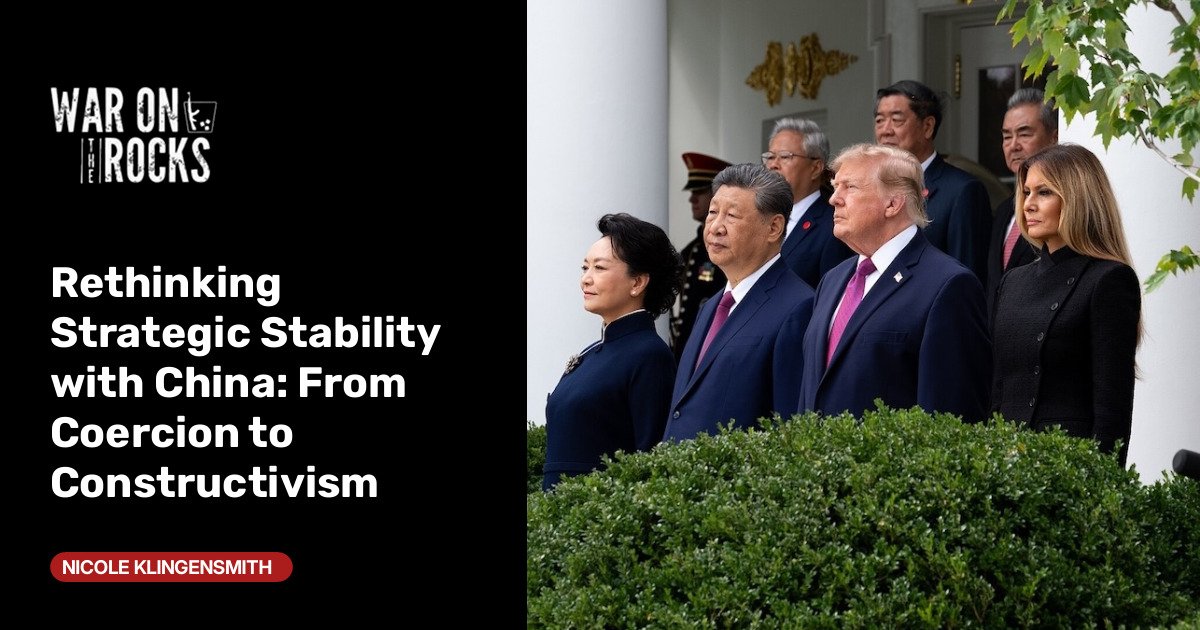
China’s desired status requires others to reciprocate its identity as an equal great power. Accommodating China’s desired status in future dialogues is an approach worth considering and could possibly be at the earliest stages of implementation. After rolling out the red carpet, in U.S. readouts from the May summit, Trump acknowledges that China is one of the two “most important and most powerful countries in the world” and promises that Americans “respect and value” China. It is but one example of Trump making some social accommodations that reciprocate China’s desired status in the international order. On the world stage, Trump is validating Xi’s perceptions of his nation. Others have noticed the shift as well. This is a positive first step toward the recognition Xi is seeking, but Trump was criticized for “desperately needing Beijing’s favor,” for his offer of praise, conciliation, and respect, and for his willingness to walk away with little more than the summaries. The pattern of criticism is not surprising when there is nothing tangible to show after such a high-stakes meeting, but perhaps it is not a failure. Perhaps it is indicative of a small, incremental change in behavior from which to build.
Next, the United States should openly demand China contribute at a level commensurate with the status it desires. Deferment is no longer an option for China. The summit readouts’ use of the word “constructive” is no accident. Xi called for “healthy stability with competition within proper limits” and said that “the building of a constructive China-U.S. relationship of strategic stability should not be a mere slogan, but concrete action taken by both sides toward the same goal.” The more recent September readout reiterates much of the same. If China wants to be treated as an equal, then the United States is right to demand that China come to the table with new, concrete proposals to consider. Setting aside the intractable Taiwan issue, the United States should broaden the agenda to look for convergence in a different area and find new common ground. Start by identifying something, anything, both countries can claim as an advantage. For example, rather than using a legacy term like arms control, try starting with a clean sheet or a new multilateral proliferation management or cooperation concept. Look at emerging technology like artificial intelligence, other critical areas like space and cyber, or look at undersea activities as a starting point. Negotiations should refrain from opening discussions with capability limitations or weapons counting until there is a new framework to use and a new (modest) objective to achieve first.
Another idea is to simply consider what Beijing is saying and adjust. Given the long-term predictability of U.S. nuclear forces and an absence of growing nuclear threats to China, its expanding nuclear arsenal might be exactly what it tells the world: a path toward equality. If true, then China should actively demonstrate the reconciliation between its nuclear breakout and artificial intelligence activities with promises of “peaceful development” and “never” engaging in “any form of arms race.” China cannot indefinitely have it both ways. Reciprocating China’s social status as an equal great power offers more promise than continuing the practice of inviting it to participate in existing mechanisms that reinforce the superior-subordinate relationship it rejects. This approach could mitigate some of China’s identity-seeking behaviors. From China’s perspective, continuing its current trajectory is arguably its best option, so what else is there to offer? Status recognition is one step that could enable a new era of strategic stability dialogues rather than allowing old paradigms and beliefs about what success looks like to get in the way of progress.
For those involved, consider an evolution of engagements that do not conform to existing expectations. Any long-term agreement should reflect language that is sensitive to the perceptions it creates. For example, preemptively describing the conditions of reciprocal restraint is conceptually appealing, but given China’s firm position against any perception that it is less than an equal great power, it is unlikely to succeed. China is approaching negotiations from a perception of inequality, whereas the United States is approaching from a higher position in the global hierarchy, with reliable external recognition and deference that enables action with near impunity because of its status. China cannot afford to give up its status symbols and compromise its progress like the United States is able to do without equivalent repercussions.
For the domestic audience in the United States, quick political wins for the short-term news cycle are unlikely. The United States should start playing an apolitical and impersonal long game. The only constraints should be new rules that genuinely benefit all parties, not just what U.S. policymakers or the U.S. media think will benefit all parties. Successful negotiations will require creativity and compromise. Starting with a recognition of China’s status concerns has a better chance of generating progress than pressuring China to agree to arms control limitations it has more incentives to reject.
Opportunity and Risk
The most troubling risk and compelling counterargument to the above approach is that accommodation will look like appeasement. However, conditions in the international system have changed, especially in the era of Xi Jinping, and policy adjustments to these changes are necessary. Accommodating status concerns, which are perception-based, is not the same as appeasement and should not be misconstrued as such. I do not advocate retreat from competition with China, nor do I think the United States should compromise its national security interests or those of its allies and partners. There are choices to be made, though. Hindsight being what it is, how could Putin have been deterred between 2007 and 2014? Consider the parallels of Xi’s ongoing commentary. Looking ahead, the United States could simply continue to spend on deterrence, or the United States could continue to spend on deterrence and attempt to make progress by leveraging a multi-layered approach that includes psychology, social identity theory, and status recognition as part of its toolkit.
Constructing a new form of dialogue with an objective to reset the existing pattern of social interaction comes with minimal risk. Status recognition is a negotiation tactic of little cost compared to other bargaining tools. If China really is offering an opportunity to advance an agenda of strategic stability, the United States would do well to discard the social barriers that inhibit creativity and new ideas. If the approach fails, then the immediate result is maintaining the stagnant status quo. For the United States and China to achieve a win-win, the agreement or commitment must be better for both parties than the existing best alternative. It will not be easy. It will take the United States, China, and the global community to create and participate in a new paradigm of major-country relations. Permitting status reciprocity might unlock a more productive era not only in U.S.-Chinese relations, but throughout the international system.
Nicole Klingensmith is a retired Air Force officer with experience in nuclear operations, planning, and policy and a certification in strategic foresight. She has a Ph.D. in international relations from Salve Regina University and currently works as an independent contractor.
Image: The White House via Wikimedia Commons
