

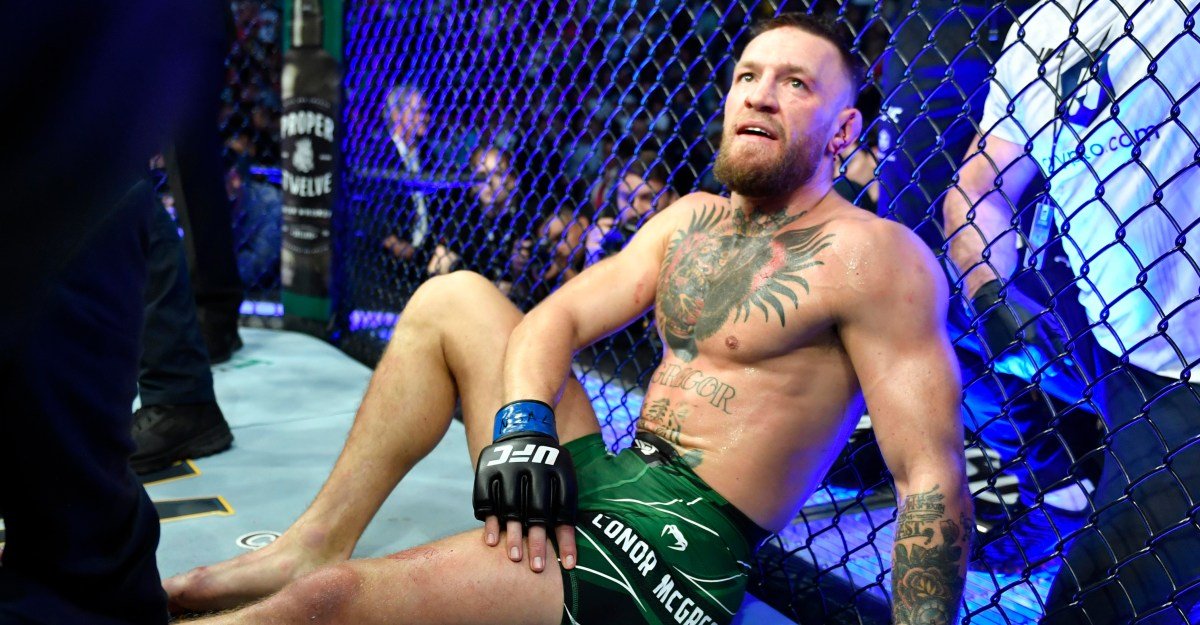
Conor McGregor is set to fight again for the first time in five years when he rematches Max Holloway at UFC 329 this July, but his road to recovery may have involved the use of performance-enhancing drugs, according to a report from The New York Times published Thursday.
The report alleges that McGregor used “powerful, banned drugs” during his recovery from a devastating leg injury suffered in his most recent fight against Dustin Poirier at UFC 264 in July 2021. In the third meeting between the two men, McGregor was aiming to gain a measure of revenge after losing via knockout to Poirier six months earlier; instead, McGregor broke his leg at the end of Round 1, leading to emergency surgery on fractures in his fibula and tibia, and an extended stay on the sidelines.
Dr. Neal ElAttrache, who performed McGregor’s 2021 surgery, told The Times that he did not “prescribe hormone or steroid treatment” for the former two-division UFC champion, but he did write a letter supporting an application for a special exemption that would allow McGregor to use performance-enhancing drugs in his recovery. The report cites sources that believed McGregor and his team were attempting to take advantage of a loophole in the United States Anti-Doping Agency—then the UFC’s official anti-doping partner—testing program, and the exemption was not granted.
During his time away from competition, fans and fighters openly questioned whether McGregor was using steroids, in part because during his recovery, McGregor would periodically post images to social media of himself looking noticeably bulkier, a physique that was also prominently featured during his starring role in the 2022 film Road House. UFC veterans Justin Gaethje and Matt Brown were among those who agreed with the suggestion that McGregor was exploiting a loophole in the system.
Because McGregor was not actively competing following his 2021 injury, McGregor removed himself from the USADA testing schedule with the understanding that when he was to return, he would require six months of testing before being allowed to step back into the octagon.
The Times reached out to McGregor’s manager, Audie Attar, who also declined to comment on McGregor’s specific recovery regimen and whether or not banned substances were involved. Attar said, “even with surgery there was a real risk Conor might not walk again, a high likelihood he would face numerous lifelong side effects that would limit his mobility and serious doubts he would ever return to the octagon.”
Attar denied any nefarious intentions on McGregor’s part, calling the withdrawal from the USADA testing pool necessary for the fighter “to focus fully on his recovery.” Attar also told The Times that McGregor’s medical team “oversaw a combination of a gruesome surgery, intense physical therapy and appropriately prescribed medicines. It is an unfathomable breach of health and privacy protections that my client’s purported personal medical records would be disclosed.”
UFC CFO Hunter Campbell provided additional comments in the report, explaining that McGregor “maintained proper communication with our team” and was “in full compliance with the rules of our comprehensive drug program.”
ElAttrache told The Times that he wrote his letter supporting an exemption after consulting experts who said, McGregor “could optimize his chance of solid union and healing of his fractures and decrease the chances that he would be left with incompletely healed fracture lines.” However, he maintained that he was not involved in the evaluation of the injury nor did he prescribe any specific medication.
“You are acting as if ‘banned drugs’ are somehow ‘illegal drugs’ or that they have no legitimate therapeutic use and only have performance enhancement use,” ElAttrache added, defending the exemption recommendation. “There are many ‘banned drugs’ on the list which are necessary to medically treat various conditions which occur in people. That is why a therapeutic use exemption application exists.”
The Times consulted anti-doping expert and former World Anti-Doping Agency committee chairman Dr. David Gerrard in its report, with Gerrard explaining that the official stance would normally be for a review to determine that an exemption would not result in an athlete receiving performance-enhancing benefits beyond their recovery. In his opinion, McGregor’s case did not fit the bill for an exemption.
“I could not recall ever seeing a case or agreeing to any performance-enhancing drug to help heal a broken bone,” Gerrard said. “I cannot think of any banned substance that’s proven to help heal bones.”
Disagreements between UFC and USADA came to a head in late 2023, after UFC CEO Dana White scoffed at USADA’s six-month testing requirement for McGregor to return to competition. By then, the relationship between the companies had deteriorated to the point that UFC ended the partnership, with the promotion threatening to sue USADA after its CEO, Travis Tygart, revealed to MMA Fighting that the disagreement over the handling of the McGregor situation played a part in the split.
According to sources that spoke with The Times, McGregor had to disclose if he used banned substances while he was out of the testing pool prior to returning to the pool in October 2023. Allegedly, officials discovered McGregor had taken banned substances.
Under the new drug-testing regime, McGregor was announced to fight Michael Chandler at UFC 303 in June 2025, but later withdrew from that contest due to a toe injury. The following October, Combat Sports Anti-Doping announced that McGregor had received an 18-month suspension after failing to provide testing samples on multiple occasions. The suspension was retroactive to September 2024, making a 2026 return possible, which led to McGregor campaigning and eventually failing to land a spot on the June 14 UFC White House event.
McGregor is instead scheduled to headline UFC 329 opposite Holloway in a welterweight bout scheduled for July 11 at T-Mobile Arena in Las Vegas.
