

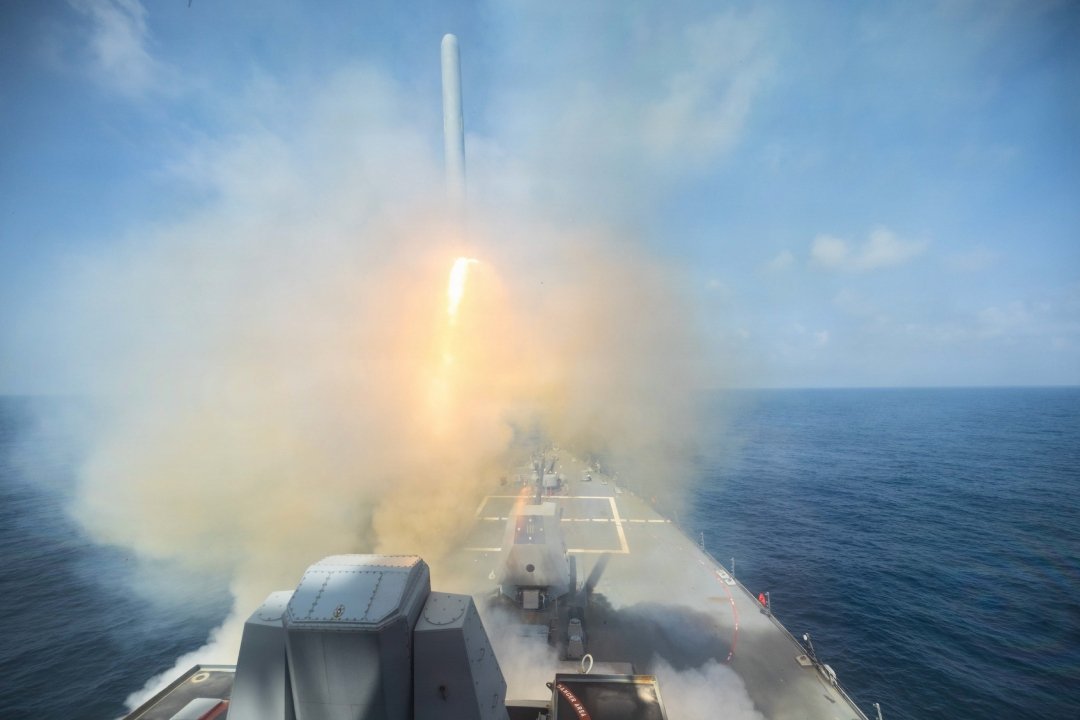

The United States has awarded US company Raytheon (an RTX business) a USD22.9 billion multi-year contract to accelerate production of the Tomahawk land-attack cruise missile.
The contract will also underpin production of more weapons. In a 17 August statement, Raytheon said the seven-year deal “supports the annual production ramp to more than 1,000 Tomahawk missiles and associated support, ensuring a stable, predictable supply for the [US] Navy and allies.” The contract will allow Raytheon to increase capacity and reinforce supply-chain links to help rapidly scale output to meet long-term needs, the company said.
In the statement, Raytheon President Phil Jasper added: “We are making significant investments in our workforce, technology, supply chain, and facilities to boost production capacity and meet surging demand dramatically.”
This latest contract builds on investment already underway by Raytheon, as the Navy moves to expand its Tomahawk inventory.
“Tomahawk provides military leaders with reliable, flexible options against high-value targets from a variety of launch platforms,” Raytheon said.
With four other navies having purchased Tomahawk – the UK Royal Navy, Royal Australian Navy, Royal Netherlands Navy, and Japan Maritime Self-Defense Force – and with a ground-launched variant available alongside the sea-launched original, Tomahawk is very much a multi-national, multi-domain weapon.
Equally, if not more, significant is the longevity and flexibility Tomahawk has demonstrated through the development of seven separate variants to date, all drawing on a concept devised in the late 1960s.
The original version, Block I, was nuclear-capable.
Then came the conventional variant – bringing the long-range, stand-off precision strike capability the navy recognised as potentially ‘game-changing’ before the weapon was even deployed. This was why successive US administrations fought to keep the nuclear variant out of Cold War strategic arms control talks.
Blocks II and III brought that punch and reach – the Block II being pictured pivoting around the Al-Rashid hotel in downtown Baghdad during the 1991 Gulf War, before Block III brought 360-deg guidance and targeting through a GPS capability.
Tomahawk’s tactical era arrived with the Block IV, whose principal capability upgrades were a two-way communications link and in-flight re-targeting.
Then came Block V, introducing three sub-variants: Block V, with improved navigation, communications, and range; Block Va, with anti-ship capability; and Block Vb, with an integrated joint multi-effects warhead system (JMEWS) enabling strikes against a broader land target set.
These developments illustrate the efforts to improve and broaden Tomahawk’s capabilities, expanding and enhancing its original focus around precision conventional strike. Capability highlights among the evolving variants include the 360-deg attack angle, in-flight re-targeting, and hard-target capability.
What the Block II demonstrated in Operation ‘Desert Storm’ in the Gulf in 1991 that remains strategically relevant today is Tomahawk’s range. Raytheon and US Navy officials have long publicly stated the range as 1,000 miles, although newer Blocks have reportedly achieved greater reach. Moreover, experts and analysts have often assessed the ‘straight-line, tanks-dry’ range as considerably farther.
Such range may no longer be a selling point unique to Tomahawk; for example, the Russian Kalibr sea-launched land-attack cruise missile has a similar range. Yet Tomahawk’s strategic relevance endures, not only through the fact that three more navies have recently procured it (Australia, Japan, and the Netherlands) but by the fact that significant numbers of rounds have been fired in combat operations in very recent years, including against Houthi targets in Yemen during the 2023-24 Red Sea shipping crisis and during the current US/Israel versus Iran Gulf war.
Such ordnance expenditure – plus the system’s continued, demonstrable utility – may explain in part the new investment in the system through Raytheon’s contract to replenish warfighting stocks.
by Dr. Lee Willett
