

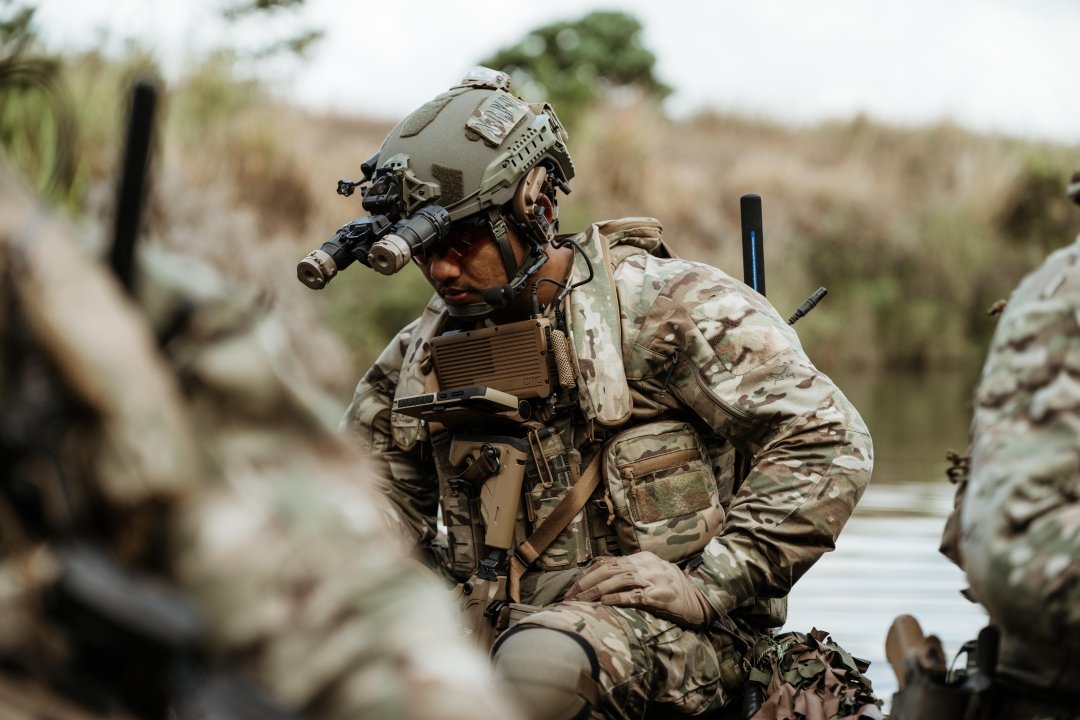
Traumatic brain injuries (TBIs) remain one of the most serious and complex threats facing military personnel. Even so‑called “mild” TBIs can have profound, long‑term consequences for service members, affecting physical performance, cognitive function, and psychological health.
“Concussions, or mild traumatic brain injuries (mTBI), can lead to life‑altering forms of impairment,” Doug Caffoe, Team Wendy, said. “At stake is an individual’s ability to function physically, cognitively and psychologically.
“The realities of modern military operations, high‑velocity impacts, and unpredictable environments, demand the highest level of equipment performance to ensure tactical operators go home safely at the end of their mission.”
Team Wendy approaches the head protection challenge with a comprehensive strategy grounded in scientific research, materials innovation, and “truer than life” testing.
Key to its solutions is the understanding that what goes inside the helmet is as important as the ballistic/bump properties of the shell. The company’s proprietary Zorbium® foams are engineered in‑house to deliver precise stiffness, density, and performance. These foams respond differently depending on impact speed—softening pressure points during normal wear while stiffening to absorb energy during high‑velocity events.

“This rate‑sensitive behaviour results in increased energy absorption during impacts, falls, helmet strikes, or when stopping ballistic projectiles,” Caffoe said. “This is enabled by the way the polymer intertwines and cross-links at a molecular level, as well as influence from the shape and size of open pores created during the foaming process, known as the microstructure.
“Other helmet manufacturers commonly use “elastic” pad materials, which deliver a response similar to riding in a vehicle with a blown shock absorber, purely bouncing on a steel spring. Conversely, our pad systems are designed to respond like a premium sports car suspension.”
Testing is the final pillar of their approach. Traditional helmet testing relies heavily on linear drop impacts, but real‑world events involve complex rotational forces. Team Wendy’s testing methods incorporate angular acceleration, and realistic impact scenarios.
“Our teams conduct everything from the standard drop and ballistic testing to new rotational impact testing ensuring that helmet liners mitigate real world threats,” Caffoe said. “Together, this approach to research, materials innovation and testing empowers us to design better helmets that offer advanced protection for the realities of the battlefield.”

The results are evident in Team Wendy’s two newest products developed for the military market: the RIFLETECH ballistic helmet, and RECON Tactical bump helmet.
RIFLETECH builds on decades of innovation and deep collaboration with military and law enforcement professionals to produce a helmet with NIJ RF1 protection. This means it’s built to stop rifle rounds, including 7.62×39 MSC, 7.62x51mm FMJ, and 5.56 M193 BT—all at muzzle velocities. While delivering this capability, RIFLETECH™ stays light, delivering an advanced mix of protection and comfort to keep wearers going through demanding missions.
Also designed to meet the highest standards of performance and reliability, the RECON Tactical meets NATO AEP 2902–H and US ACH AR/PD 14-02 blunt impact protection levels. Its lower profile Hybrid shell with carbon fiber panel reinforces crown protection; and its proprietary Zorbium foam pad liner set with lattice cooling pads provides impact protection while ensuring maximum comfort even during long wear. RECON Tactical provides lightweight head impact protection while ensuring compatibility with the full range of mission critical systems that enhance the user’s situational awareness in dynamic environments. This includes accessory mounting with mil-std interfaces for Night Vision Goggles, headsets, and lights.
With these two new products, Team Wendy continues to push helmet technology beyond traditional limits—bringing military personnel closer to a future where TBIs are far less likely to define their service or their lives.
