

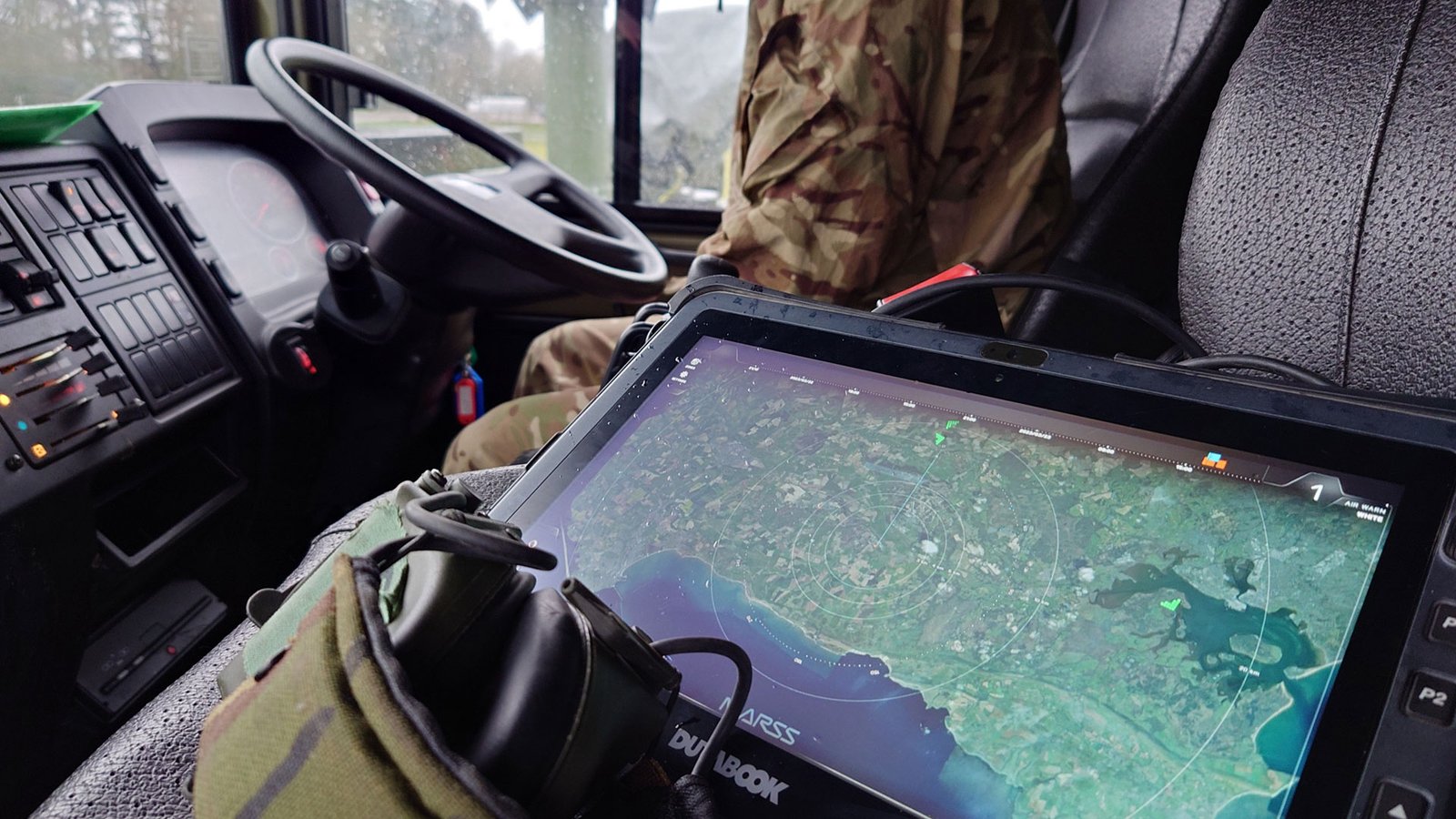
With parts of the Middle East engulfed in war after Israel and the USA attacked Iran on 28 February, the importance of marshalling air defence and counter-unmanned aerial systems (C-UAS) is more important than ever. Indeed, one company already doing that in the Middle East is MARSS.
Asian Military Review spoke to MARSS at World Defense Show 2026, held in Riyadh from 8-12 February, where it unveiled a new artificial intelligence (AI) capability for its NiDAR platform.
With this upgrade, NiDAR can display and fuse feeds from unmanned systems in the air, on the ground and at sea onto a single screen. NiDAR can also task, deploy and recover unmanned systems.
Rob Balloch, Chief Growth Officer at MARSS, told AMR that the old way of doing this is no longer valid, especially with the rapid proliferation of low-cost threats like drones. He said the decision cycle to deal with threats can be reduced to less than ten seconds because NiDAR does it faster and more efficiently.
Balloch added: “NiDAR’s Autonomous Mission Management (AMM) isn’t just an incremental step – it’s a huge capability leap in the C4 space. For the first time, we can manage available resources and task multiple assets to fly, drive or sail a mission, patrol or intercept profile with a simple tap on the screen, and then seamlessly fuse the data they gather back into the wider operational picture. This isn’t just situational awareness – it’s a whole new way of thinking about how AI can transform what autonomous platforms deliver.”
NiDAR can also cue, direct and manage weapon systems, and enable commanders to make snappier decisions. Balloch commented, “With AMM, we’re demonstrating NiDAR as a complete C4I system. It’s deployable now and gives commanders something they’ve never had before: the ability to extend their layered defence with autonomous assets, all controlled from a single screen.”

National scale
What happens if individual AI-enabled NiDAR bubbles are unified on a far grander scale? Then the system becomes NiDAR Nation Shield, a product that MARSS also launched at WDS 2026.
The company stated, “Initially developed to meet the bespoke requirements of a Middle East customer, the newly upgraded system – NiDAR Nation Shield – extends NiDAR to the national mission command level for the first time.”
The unified operating system covers every tier of operations, from the tactical edge to sector-level activity all the way to national and strategic oversight. From individual solder tablet to a national control hub, all are able to access a coherent operating picture.
Robbie Draper, Director of Operations at MARSS, said: “With every level of operational decision-making now unified within NiDAR – from personnel, vehicles and mobile defences at the tactical edge, through brigade, division and air operations, all the way up to national mission command – everyone can access the same data, displayed simultaneously and consistently. This delivers a decisive advantage, cutting decision cycles from minutes to seconds, and enabling seamless coordination between manned and autonomous systems.”
At the Riyadh show, the company highlighted NiDAR’s intuitive nature, a system that can “protect nations, critical infrastructure, naval assets, special forces, heads of state, commercial shipping and millions of lives worldwide”.
In fact, the MARSS product is already used in a command centre by a member of the Gulf Cooperation Council, and AMR understands NiDAR commands air defence bubbles over royal palaces in Saudi Arabia and Bahrain.
MARSS claims that NiDAR has achieved more than 60 deployments worldwide, including fixed sites and military assets. In the Asia-Pacific region, the New Zealand naval tanker HMNZS Aotearoa has it aboard, as do Malaysian Maharaja Lela-class warships.

EOS acquisition
In January 2026, Australian firm EOS acquired MARSS. The two firms’ business areas dovetail nicely, one producing C-UAS and remote weapon stations, and the other C2 and AI system to unite them.
Dr. Andreas Schwer, CEO of EOS, told AMR that MARSS “from our perspective, is the world market leader. We’ve integrated our effectors into many different C2 systems. None of them was so intuitive and modern and innovative as the one from MARSS. And with the acquisition of MARSS, we can now offer turnkey counter-UAS solutions for any kind of civil, homeland security and military client. That’s a big game-changer.”
He also highlighted that the MARSS solution is “extremely cheap” compared to sophisticated C4 systems offered by big defence contractors. “You don’t need that in order to protect a palace, airport and power station. The command-and-control system can be less sophisticated, but it should be more user intuitive, because the multitude of clients operating those kind of systems are not as skilled as highly skilled militaries. So it’s all about simplicity, user interface easiness and stuff like that.”
He declared MARSS is “the market leader in the Middle East” for such systems.
by Gordon Arthur
