

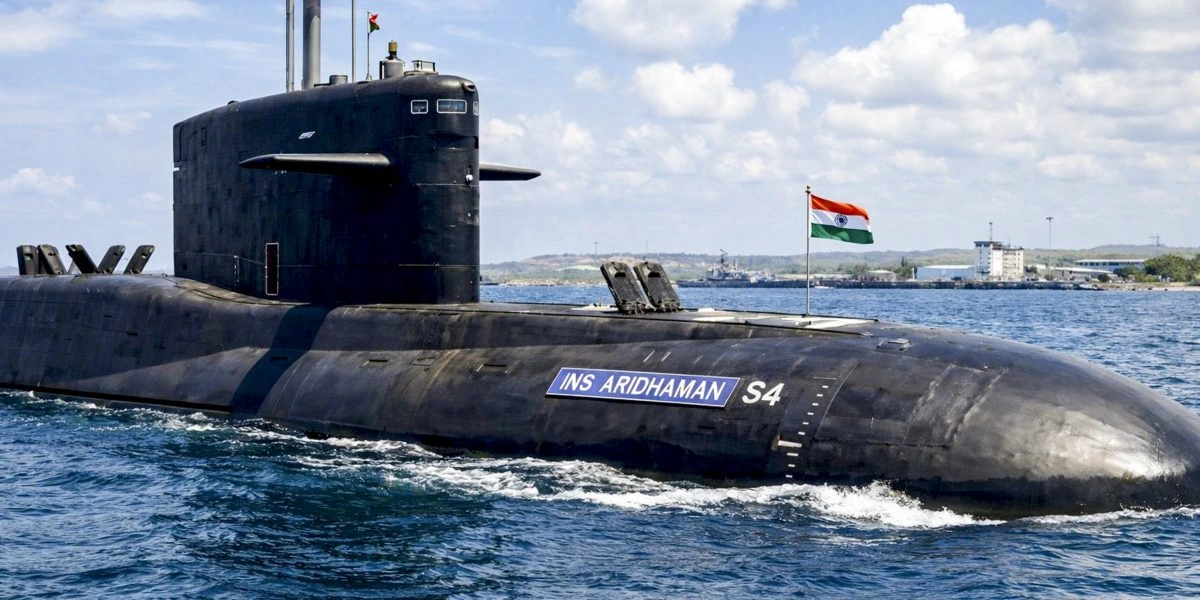
Defense Feeds, New Delhi — India nuclear submarine program achieved a significant milestone with the commissioning of INS Aridhaman, the Indian Navy’s third indigenously designed Arihant-class nuclear-powered ballistic missile submarine.
While the SSBN program continues to progress steadily, conventional submarine projects remain stalled by years of bureaucratic delays. A fourth SSBN, codenamed S4 and likely to be named INS Arisudan, is expected to enter service by 2027–28.
This divergence exposes a fundamental organizational weakness within India’s defense industrial ecosystem. While strategically prioritized SSBN programs bypass procedural drag through Prime Minister’s Office oversight and DRDO insulation, conventional submarine projects remain trapped in layers of procurement complexity and shifting naval requirements. The pattern reveals that technical capability exists, but institutional failures prevent consistent execution at scale.
The SSBN Success Model: Insulation and Priority
India nuclear submarine program success stems from unprecedented institutional protection rarely extended to other military projects.
The Advanced Technology Vessel program, formally launched around 1984, operates as a tightly controlled national mission managed by the Prime Minister’s Office. This insulation shields the SSBN effort from routine audit pressures, bureaucratic scrutiny, and political disruption that plague conventional programs.
The SSBN program benefits from steady funding, flexible timelines, and built-in buffers that allow it to absorb setbacks without risk of cancellation. It is run by a small, empowered group from DRDO, the Department of Atomic Energy, and select naval personnel, keeping the structure lean and efficient.
In contrast, Project-75 India—the conventional submarine program launched in 2007, remains stalled nearly two decades later, still awaiting final collaboration agreements with Germany’s ThyssenKrupp Marine Systems.
Conventional Submarine Stagnation and Systemic Dysfunction
India nuclear submarine program momentum highlights the SSK program’s organizational paralysis rooted in fragmented decision-making and rigid procurement culture.
Project-75 India’s delays stem less from technical complexity than from the Ministry of Defence’s stringent requirements, evolving naval qualifications, and inconsistent long-term planning. This bureaucratic inertia was compounded by the “lost decade” between 1995 and 2005 when the HDW corruption scandal halted MDL’s submarine construction facilities completely.
Former Indian Navy Chief Admiral Arun Prakash attributes the dysfunction to a fundamentally risk-averse defense establishment unable to accept developmental failure. Officials prioritize procedural correctness over results, creating a culture where any misstep triggers audits or investigations.
This environment discourages bold decisions, prompting officials to defer responsibility and opt for proven foreign platforms rather than riskier indigenous SSK development.
One Indian Navy submariner likened the divergence to building a Formula 1 race car versus an advanced sports utility vehicle.
The system delivers extraordinary strategic feats under prioritization yet stalls on routine conventional output amid procedural drag. This reveals an ecosystem capable of delivering efficiency in isolation but struggling with consistency at scale across multiple simultaneous programs.

Propulsion System Challenges and Indigenous Capability Gaps
India nuclear submarine program advanced reactor miniaturization contrasts with conventional fleet propulsion deficiencies. SSK effectiveness depends on endurance, stealth, and acoustic discretion, all governed by integrated propulsion ecosystems combining diesel engines, batteries, and air-independent propulsion systems. India’s most serious deficiency lies not in individual components but in integrating entire propulsion chains with acoustic controls reflective of limited industrial depth in submarine design.
DRDO’s indigenous AIP system is moving from land trials toward deployment, with plans to retrofit Kalvari-class submarines starting next year. Its fuel-cell technology could extend underwater endurance to about two weeks, though its real-world reliability remains unproven compared to established German systems.
At the same time, India faces challenges in battery technology, as global fleets shift to lithium-ion systems—capabilities it has yet to field in fully combat-ready, domestically developed form.
India nuclear submarine program success relies substantially on Russian technical collaboration, though this partnership remains understated in domestic media coverage. Russian specialists proved crucial for miniaturizing the Arihant-class submarines’ 82.5 megawatt pressurized light water reactors.
This Indo-Russian partnership stretches back to Project 932 in the late 1970s, catalyzed by the 1971 war when American carrier task forces deployed to the Bay of Bengal supporting Pakistan.
India leased the Charlie I-class SSN INS Chakra from the Soviet Union for three years starting in 1988, making India the sixth nation to operate nuclear submarines. Operations supervised by Russian engineers provided foundational lessons directly informing Arihant-class development.
A second Akula-class Chakra lease from 2012 to 2021 further boosted Indian expertise. A third SSN lease originally scheduled for 2025 now faces delays until 2027-28 due to Russian supply-chain disruptions and Ukraine-related sanctions.
