

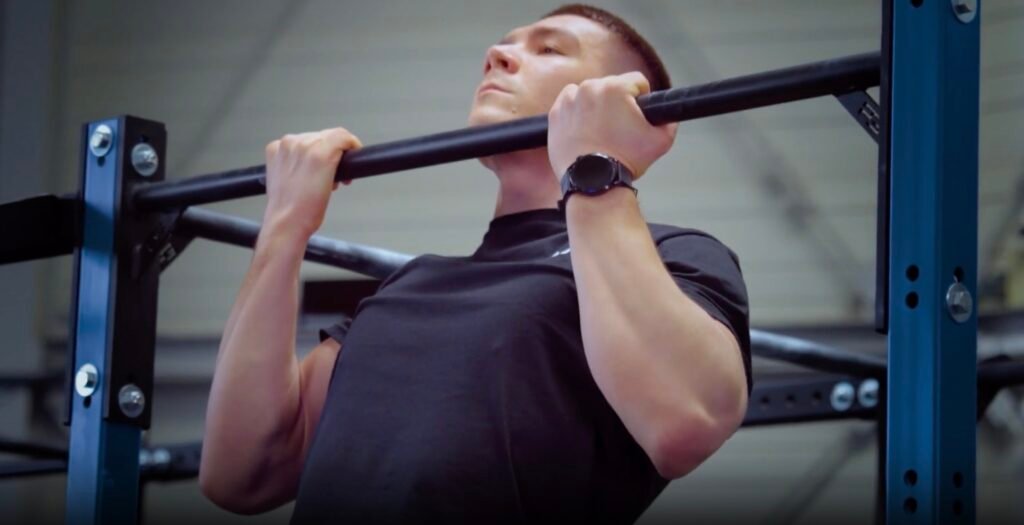
Building bigger biceps is not simply a matter of choosing the exercise that feels hardest. Chin ups and preacher curls both train elbow flexion, but they load the biceps in very different ways. One is a compound pulling movement that asks the upper back, forearms, shoulders, and core to work together. The other is an isolation exercise designed to make elbow flexion the main job.
So, which movement builds more biceps muscle mass?

For most people who can train both consistently, preacher curls are the more direct tool for maximizing biceps growth. Chin ups are still excellent for developing the biceps while building a stronger back and improving relative strength. The best answer is usually not to pick one forever. It is to understand what each exercise offers, then give each one the right role in your program.
What Makes the Biceps Grow?
The biceps brachii crosses both the elbow and shoulder joints. Its primary role is elbow flexion, meaning it bends the arm. It also helps turn the palm upward, a movement called supination, and assists with shoulder flexion.
Muscle growth occurs when a muscle is exposed to enough challenging resistance over time, followed by adequate recovery and nutrition. Research consistently shows that resistance training can increase muscle size across a wide range of loads, provided sets are performed with sufficient effort. In practical terms, the biceps need repeated hard sets that take them close enough to the point where another clean repetition would be difficult.
Exercise selection matters because different movements can alter how directly the biceps are loaded, how easy it is to progress the resistance, and whether another muscle limits the set first. If your grip, upper back, or body control fails before your biceps have been challenged properly, the exercise may be great for general strength but less efficient for biceps hypertrophy.
Both preacher curls and chin ups can create meaningful biceps tension. The question is which exercise lets you apply that tension most reliably and progressively.
The Case for Preacher Curls
A preacher curl places the upper arm against an angled pad while you curl a dumbbell, barbell, cable attachment, or machine handle. The pad limits shoulder movement and body momentum, so the elbow flexors must do most of the work.
The Biceps Are the Main Limiting Factor
The biggest advantage of preacher curls is simple. They make it difficult to shift work away from the biceps. You cannot lean back, drive with the hips, or use the upper back to get the weight moving. The biceps, brachialis, and brachioradialis must produce the force needed to curl the load.
This is valuable for hypertrophy because it allows you to train close to muscular failure with less interference from other body parts. A chin up can end because your hands are slipping, your lats are fatigued, or you cannot keep your body moving as one unit. A preacher curl usually ends because your elbow flexors cannot complete another repetition with good technique.
The ability to take a target muscle close to failure is especially useful when your goal is to add size to that specific area. Isolation exercises give you more control over that process.
They Are Easy to Progress
Preacher curls also make progression straightforward. You can add a small amount of weight, add repetitions, improve the range of motion, or slow the lowering phase while maintaining strict form. These small improvements matter because hypertrophy is built over months and years of training, not from occasional all out workouts.
Compound exercises can be harder to progress in small increments. With chin ups, even a small amount of added weight can significantly change the difficulty. If bodyweight chin ups are already challenging, adding enough load to create a useful progression may be difficult without fractional plates. You can add repetitions, but eventually very high repetition chin up sets may create more fatigue in the hands and upper back than in the biceps.
Preacher curls let you manage the dose of biceps work with more precision.
They May Challenge the Biceps Well at Longer Muscle Lengths
The position of the shoulder affects how the long head of the biceps is placed during an exercise. Preacher curls position the upper arm in front of the torso. This changes the relationship between the shoulder and elbow joints and can create a demanding bottom position when the elbow is more extended.
Research has increasingly supported the idea that resistance training performed at longer muscle lengths can be particularly effective for hypertrophy in some muscles and exercises. This does not make any single exercise magical, and it does not mean the bottom of every curl should be forced into an uncomfortable joint position. It does suggest that controlled training through a challenging, comfortable range of motion is a useful hypertrophy principle.
The lower portion of a preacher curl can feel demanding because the biceps must produce force while lengthened. That makes good technique important. Lower the weight under control, avoid aggressively snapping the elbow straight, and stop short of any position that creates sharp pain at the front of the elbow.
The Case for Chin Ups
A chin up is performed with an underhand grip and the palms facing toward you. The movement requires you to pull your body upward until the chin reaches or passes the bar, then lower under control. It trains the latissimus dorsi, upper back, forearms, biceps, brachialis, and other muscles around the shoulder and elbow.
Chin ups are not merely a back exercise with incidental biceps involvement. The biceps contribute substantially to elbow flexion throughout the pull, especially when the grip is supinated.
Chin Ups Build Useful Biceps Strength
Chin ups load the biceps with your bodyweight, which can be a substantial resistance. For a strong trainee, adding external weight can make the exercise a powerful stimulus for the upper body. The biceps must work while coordinating with the lats, scapular muscles, forearms, and trunk.
That full body demand is part of their appeal. Chin ups develop strength that carries over to climbing, gymnastics, grappling, obstacle events, and many other physical activities. They also allow you to train the biceps and back efficiently when time is limited.
Electromyography research has shown meaningful biceps activation during pulling exercises, including chin up variations. However, muscle activation data should be interpreted carefully. A higher reading in a laboratory does not automatically predict more muscle growth over months of training. Growth depends on training volume, effort, range of motion, recovery, exercise execution, and the ability to keep progressing.
Still, chin ups clearly offer enough biceps involvement to contribute to growth, particularly in beginners and intermediate lifters.
The Underhand Grip Helps the Biceps Contribute
Compared with many overhand pulling variations, the underhand chin up places the forearm in a supinated position. Since the biceps help supinate the forearm as well as flex the elbow, this grip can make the movement feel more biceps focused than a standard pull up.
Grip choice alone does not turn a chin up into an isolation exercise. The lats and upper back remain essential. But using a comfortable underhand grip and a full range of motion can make chin ups a more valuable biceps builder than wide grip overhand pull ups for many trainees.
If an underhand grip irritates your wrists, elbows, or shoulders, neutral grip chin ups are a sensible alternative. Comfort and consistent training matter more than forcing a grip that causes pain.
Chin Ups Have Limits for Pure Biceps Growth
The drawback is that chin ups are a shared task. Your biceps may be capable of more work when the set ends, but your back, grip, or technique may already be at the limit. This means that chin ups can sometimes underdeliver as a pure biceps exercise, particularly for advanced trainees with strong backs or those who use very heavy added weight.

There is also a learning curve. A beginner who cannot yet perform controlled chin ups may need assistance from a machine, resistance band, or a foot supported variation. These are useful options, but they may still be harder to standardize than a preacher curl.
For a person who wants the fastest route to more biceps volume, preacher curls are generally easier to program and execute.
Which Exercise Builds More Biceps Muscle?
If the comparison is strictly about biceps hypertrophy, preacher curls have the advantage. They isolate the elbow flexors, reduce the role of other muscles, and allow precise progression. You can accumulate hard biceps sets without turning every session into a demanding back workout.
That does not mean preacher curls are automatically superior in every context. A novice may gain plenty of biceps size from chin ups alone because nearly any challenging resistance training is a new stimulus. Someone with little training time may reasonably prioritize chin ups because they strengthen the back and biceps together. A person who enjoys calisthenics may also build impressive arms with regular weighted chin ups.
However, as training experience increases, direct biceps work becomes increasingly useful. Compound pulling can supply some stimulus, but curls make it easier to ensure the biceps receive enough focused weekly volume.
A useful way to think about the decision is this. Chin ups are the better total upper body exercise. Preacher curls are the better targeted biceps exercise.
How to Use Both Exercises for Bigger Arms
The strongest programming choice for most lifters is to use chin ups as a compound strength movement and preacher curls as dedicated biceps work. This gives you the benefits of both without relying on one movement to do everything.
Start With Chin Ups When Strength Is the Priority
Perform chin ups earlier in the workout when you are fresh and able to use good technique. Use a controlled ascent and lower yourself without dropping. Keep the chest lifted, avoid excessive swinging, and use a range of motion you can repeat consistently.
If you can perform fewer than five clean repetitions, assisted chin ups can help you build strength while practicing the movement pattern. If you can comfortably perform more than ten to twelve repetitions, adding a small external load can keep the sets challenging.
Two to four hard sets of roughly five to ten repetitions can work well for strength and muscle development, depending on your current ability and total training volume.
Use Preacher Curls to Add Direct Volume
After your pulling work, preacher curls can provide the direct stimulus that chin ups may not fully deliver. Use a load that lets you control the lowering portion and move through a comfortable range of motion without lifting the upper arm from the pad.
Sets of approximately eight to fifteen repetitions are practical for most people, although lighter and heavier loading can also build muscle when effort is high enough. The key is to keep the resistance challenging while maintaining clean repetitions.
Aim to finish most working sets with perhaps one to three repetitions still possible. You do not need to reach complete failure on every set, but the final repetitions should require real effort. If every set feels easy, the biceps have little reason to adapt.
Weekly Volume Matters More Than a Perfect Exercise
Research suggests that greater weekly resistance training volume can support greater muscle growth, although the best amount varies between individuals. A practical starting point is to include several challenging biceps focused sets each week, then adjust based on recovery and progress.
For someone who performs rows, pulldowns, and chin ups, six to ten direct sets of curls per week may be enough to produce results. For someone prioritizing arm growth and recovering well, a higher amount may be appropriate. More is not always better. Persistent elbow soreness, falling performance, and poor recovery are signs that volume may need to be reduced.
Train the biceps two or three times per week if that makes it easier to perform quality sets. This can be more manageable than trying to complete all your arm training in a single session.
Technique and Injury Considerations
Neither preacher curls nor chin ups should produce sharp pain. Mild muscular discomfort during hard training is normal. Pain at the front of the elbow, in the shoulder, or along the wrist is a reason to modify the exercise, reduce the load, or seek advice from a qualified clinician if it persists.
Preacher curls have a reputation for irritating the elbow when lifters use excessive weight or forcefully lock out the bottom position. Avoid bouncing the weight, keep the lowering phase controlled, and maintain a slight softness at the elbow rather than aggressively forcing full extension.
Chin ups can cause problems when grip width, shoulder position, or loading does not suit the individual. Use a grip that feels natural, keep the movement controlled, and progress gradually. A neutral grip is often a comfortable option for lifters whose elbows or wrists dislike a fully supinated position.
The Verdict
Preacher curls are the better choice if your primary goal is to build as much biceps muscle as possible. They give the biceps direct, repeatable work and make progressive overload easier to manage. Chin ups are still a highly effective exercise that can build the biceps, especially for beginners and anyone who wants stronger pulling performance alongside arm development.
The most productive approach is to keep chin ups in your program for compound pulling strength, then use preacher curls to ensure your biceps receive enough direct work. Train both with good technique, progress patiently, and judge your plan by whether your strength, repetitions, and arm measurements improve over time.
Key takeaways
| Question | Best answer |
|---|---|
| Which exercise is more targeted for biceps growth? | Preacher curls, because the biceps are usually the main limiting muscle. |
| Which exercise is better for total upper body strength? | Chin ups, because they train the biceps, back, forearms, shoulders, and trunk together. |
| Can chin ups build bigger biceps? | Yes, particularly for beginners and when progressive overload is applied consistently. |
| Should advanced lifters include curls? | Usually yes, because direct curls make it easier to add enough focused biceps training volume. |
| What is the best overall strategy? | Use chin ups for compound pulling strength and preacher curls for direct biceps hypertrophy work. |
| How often should biceps be trained? | Two or three weekly sessions can help distribute quality training volume and support recovery. |
References
- American College of Sports Medicine (2009) ‘American College of Sports Medicine position stand. Progression models in resistance training for healthy adults’, Medicine and Science in Sports and Exercise, 41(3), pp. 687–708.
- Baz-Valle, E., Fontes-Villalba, M., Santos-Concejero, J. and Balsalobre-Fernández, C. (2022) ‘Total number of sets as a training volume quantification method for muscle hypertrophy: A systematic review’, Journal of Strength and Conditioning Research, 36(3), pp. 871–878.
- Brandon, S.C.E., Brown, J.M. and Graham, R.B. (2015) ‘The effects of grip type and wrist angle on muscle activity during the lat pull down’, Journal of Electromyography and Kinesiology, 25(5), pp. 749–756.
- Coratella, G., Tornatore, G., Longo, S., Esposito, F. and Cè, E. (2020) ‘An electromyographic comparison of barbell, dumbbell and machine preacher curl exercises’, Journal of Sports Science and Medicine, 19(3), pp. 517–523.
- Grgic, J., Schoenfeld, B.J., Davies, T.B., Lazinica, B., Krieger, J.W. and Pedisic, Z. (2018) ‘Effect of resistance training frequency on gains in muscular strength: A systematic review and meta analysis’, Sports Medicine, 48(5), pp. 1207–1220.
- Lasevicius, T., Schoenfeld, B.J., Silva, V.R., Barros, T.S., Leite, T.I., Filho, P., Aihara, A.Y., Cardoso, F.N., Tricoli, V. and Ugrinowitsch, C. (2018) ‘Muscle failure promotes greater muscular adaptations in low load but not in high load resistance training’, Journal of Strength and Conditioning Research, 36(2), pp. 346–351.
- Maeo, S., Yoshitake, Y., Takai, Y., Fukunaga, T. and Kanehisa, H. (2021) ‘Training at longer muscle lengths enhances the hypertrophic response in trained men’, Medicine and Science in Sports and Exercise, 53(2), pp. 407–415.
- Schoenfeld, B.J., Ogborn, D. and Krieger, J.W. (2017) ‘Dose response relationship between weekly resistance training volume and increases in muscle mass: A systematic review and meta analysis’, Journal of Sports Sciences, 35(11), pp. 1073–1082.
- Schoenfeld, B.J., Grgic, J., Ogborn, D. and Krieger, J.W. (2017) ‘Strength and hypertrophy adaptations between low versus high load resistance training: A systematic review and meta analysis’, Journal of Strength and Conditioning Research, 31(12), pp. 3508–3523.
