

“If one is to judge by the fire and ardor with which this book is sought after, it is the most excellent of all books. Never were so many copies printed of any work; never were so many editions made of a single book; never has any writing been read by so many people.”
-Pierre-Valentin Faydit in La Télémacomanie (1700), snidely critiquing the “mania” surrounding the initial publication of The Adventures of Telemachus.
A sprawling epic that thrills the public, mesmerizes it with its aesthetic qualities and technical prowess, and reignites collective interest in some of the most foundational texts of the Western canon. A runaway success that baffles some high-minded critics, spawning reams of impassioned commentary, and fanning the flames of vicious culture wars. And last but not least, a bold, almost wantonly provocative retelling of Homeric mythology — one which unapologetically transmutes The Odyssey’s pagan ethos, both out of a desire to render it more palatable for a modern audience, and as a means of advancing the creator’s own idiosyncratic moral vision.
One could be forgiven for assuming that this description refers to Christopher Nolan’s blockbuster adaptation of the Odyssey, the cultural event of the summer. Yet it applies just as readily to François Fénelon’s The Adventures of Telemachus. First published at the turn of the 18th century, the French archbishop’s scintillating spin on the Greek epic quickly became one of the greatest literary sensations in European history, and arguably one of the most influential works of political instruction ever written.
Today, however, it has largely disappeared from readers’ bookshelves. This neglect may be easy to explain but difficult to justify. For all the visual panache and booming spectacle promised by cinematic retellings of Homer, few, if any, possess the moral depth, psychological insight, or political wisdom of Fénelon’s novel. In fact, any War on the Rocks reader with a rekindled interest in the great ur-myths of antiquity may find The Adventures of Telemachus more durably rewarding. Part of this is undoubtedly due to its immense literary qualities, which were immediately recognized by its legions of avid readers at the time, with the great English essayist Joseph Addison raving that the quality and cadence of this “beautiful romance” was such that it appeared “formed altogether in the spirit of Homer.” And indeed, even in its myriad English translations, Fénelon’s painterly prose, with its vivid depictions of sun-bleached landscapes, lush Arcadian groves, and shadow-drenched grottoes, never ceases to shine through. Barring perhaps Shelley and Lawrence Durrell, few authors have captured the luminosity, sensuality, and beauty of the ancient Mediterranean like Fénelon. But second, and perhaps most importantly, The Adventures of Telemachus is worth reading for what it has to say about power, leadership, and statecraft.
Indeed, three principal lessons, all of which are, to a certain extent, interconnected, can be extracted from this 18th-century masterpiece. First, it provides keen insights on the inherent loneliness of power, and the degree to which all leaders — however wise and accomplished — must avoid succumbing to such isolation for fear of corroding their capacity for sound judgment. Second, it stresses the degree to which self-mastery serves as the foundation of that most princely of virtues — prudence. And finally, in its not-so-veiled critique of Louis XIV’s expansionist policies, it articulates a compelling vision of what constitutes a balanced foreign policy: one capable of weighing immediate gains against the requirements of long-term strategic stability, and of projecting strength without engendering foreign hostility.
Unusually Entertaining and Influential
By the time The Adventures of Telemachus escaped into print in 1699, François de Salignac de La Mothe-Fénelon was one of the most celebrated and controversial figures in France. Born in 1651 into an old but impecunious family from Périgord, Fénelon had risen through the church by virtue of an unusual combination of brilliance and charisma. Whether in private conversation or preaching at the pulpit, his magnetism was such that it seemed, recalled Saint-Simon, as though “fire and intelligence” poured from his eyes “like a torrent.” King and pauper alike were mesmerized and “had to make an effort to stop staring” at him. Fénelon had already established himself as an educational reformer with his innovative Treatise on the Education of Girls, when, in 1689, at the age of 38, he was selected as tutor to Louis, Duke of Burgundy, the eldest grandson of Louis XIV, and future king of France.
A relatively junior clergyman, he was thereby entrusted with shaping the soul and character of a notoriously brattish seven-year-old who would one day inherit the most powerful monarchy in Europe. Prodigiously intelligent, the young prince was also arrogant and irascible, gazing down on his fellow mortals with disdain and “viewing them as little more than a collection of atoms.” Fénelon’s task was not simply to fill his contumacious charge’s head with religious instruction or antiquarian knowledge, but to bring about a deeper moral transformation, much as Seneca and Plato had attempted (and failed) to do, respectively, with Nero and Dionysius II of Syracuse.
Fénelon set to his task with gusto, striving first and foremost to tame the prince’s passions, cultivate his conscience, and impress upon him that kingship was a burden of service rather than a license for sloth or self-glorification. Toiling alongside a group of reform-minded courtiers — later known as the “Burgundy circle” — Fénelon hoped to mold a monarch who would correct what he regarded as the gravest excesses of Louis XIV’s reign: fiscal oppression, courtly extravagance, over-centralization, and violent religious persecution. Above all, he virulently opposed the king’s policy of belligerent expansionism, “twenty years of blood and ruin,” which had, in his mind, not only left the kingdom exsanguinated, but had also rendered the “French nation, as a whole, unbearable to its neighbors.”
Until an incomplete manuscript of The Adventures of Telemachus was purloined by a valet, Fénelon had never intended it for public consumption. Instead, the epic belonged to a much wider set of pedagogical writings privately crafted for his callow young pupil: fables, historical narratives, penetrating examinations of conscience and the Dialogues of the Dead, in which shades of former statesmen and heroes, from Achilles to Richelieu, debate complex moral issues. In his earlier treatise on female education, Fénelon had urged instructors to take advantage of the curiosity of children, stressing that “everything that delights the imagination facilitates the process of learning.” Children had little patience, he suggested, for dour maxims imposed from above, whereas lessons embodied via vivid characters, charged vignettes, and gripping narratives tended to seep far more deeply into their bubbling psyches.
The Adventures of Telemachus proved so successful precisely because of these cultivated literary qualities. It was also the culmination of a master pedagogue’s intellectual enterprise: at once a continuation of Homer, a Christianized epic, a political treatise, and a classic “mirror for princes.” Its moral tone and political messaging bore a close relationship to Fénelon’s extraordinary Letter to Louis XIV, probably written in the early 1690s but apparently never delivered to the king. In that private remonstrance, the cleric had engaged in one of the most searing indictments of monarchical absolutism, charging Louis XIV with destroying “half of the real strength within your kingdom in order to make, and then defend vain conquests abroad,” and of turning his proud kingdom into “a vast, desolate, poorhouse.” Whereas the Letter disgorges its arguments with biblical severity, The Adventures of Telemachus transposes them into the safer and more seductive medium of fable and fantasy.
Its plotline is somewhat ingenious. Rather than rewriting The Odyssey, Fénelon occupies a space Homer left tantalizingly open: the youthful wanderings of Telemachus, the son of Odysseus, whose departure occupies the first four books, before the narrative swivels back to his father. The novel thus opens with Telemachus and his tutor, the wise Mentor, shipwrecked upon the island of the nymph-goddess Calypso, who rapidly makes the son of her former paramour the object of her libidinous attentions. Much as in Christopher Nolan’s cinematic adaptation, Telemachus’ reminiscences in the company of Calypso provide a series of convenient expository flashbacks. As the duo crisscrosses a semi-imaginary ancient Mediterranean, it is revealed that Mentor is in fact the goddess Athena in disguise. Peeking out beyond the shimmering aegis of this divine disguise is Fénelon himself, smuggled into the narrative as Telemachus’ stern but loving counselor.
The Rapturous Reception of a Controversial Text
When the manuscript was leaked, Fénelon’s contemporaries immediately picked up on its controversial nature. Indeed, its eloquent critiques of wars of choice and zero-sum trade policies were clearly a censure of Louis XIV’s growing autarchy, aggressive mercantilism, and expansionism. These parallels would become only clearer with the launch of the War of the Spanish Succession, in 1701. Moreover, it appeared obvious that, in its repeated lampooning of sinful monarchs and slithery counselors, Fénelon’s book was also an indictment of the sprawling, labyrinthine Versailles court “system” which had spread its rotting tendrils in the Sun King’s shadow.
By the time of its publication, Fénelon had already experienced a dramatic fall from grace. Appointed archbishop of Cambrai in 1695, he had become a lead protagonist in the so-called Quietist Controversy, a bitter dispute over theology that convulsed the French Catholic elite. Leading quietists such as Fénelon appeared to espouse a spiritual doctrine which elevated inward experience above traditional social obligations, alarming the governing structures of church and state. Indeed, for icy-veined proponents of raison d’etat, the Quietists’ intense focus on self-renunciation and “disinterested love” had potentially unsettling ramifications. And while Fénelon remained a committed monarchist, there was a nagging fear among his opponents, such as Jacques-Bénigne Bossuet, that this ideology might be repurposed in service of sedition.
Fénelon was ordered away from court and stripped of his luxurious Versailles apartments. A few months later, he was condemned by the pope himself for the quietist ruminations contained in his Maxims of the Saints. Yet scarcely had this controversy subsided when the bootlegged first copies of The Adventures of Telemachus began flooding the market. Its publication only reinforced the king’s suspicion that the disgraced prelate was not merely an errant theologian, but also a nettlesome political critic. Royal censors swooped in to halt the initial printing, but — somewhat predictably — news of this suppression only served to further stimulate demand.
Political Controversy and Literary Triumph
Indeed, its success was nothing short of extraordinary. In the space of a few decades, pirated editions and translations had mushroomed across Europe. The Adventures of Telemachus had become the most widely read book in 18th-century France after the Bible. Pedantic critics produced multi-volume critiques of the “inaccuracy” of Fénelon’s appropriation of antiquity, while prudes decried the fact that its young hero cavorted with scantily clad nymphs. Its popularity with younger audiences was a particular concern for parents, who groused that their teenagers had begun smuggling the book into church to read during mass. Every denunciation, rebuttal, and pedantic attack only seemed to further enlarge its audience, with Voltaire scoffing that the book’s detractors were as many “gnats who go and lay their eggs on the hindquarters of the finest horse.” And indeed, Telemachus’ riveting peregrinations would go on to inspire paintings, operas (including by Mozart), plays, and political commentaries.
The book’s admirers were legion — ranging from Thomas Jefferson to Alfred Tennyson. Montesquieu, who revered Fénelon and characterized The Adventures of Telemachus as “the divine work of this century,” used it as a source of inspiration for his Persian Letters. The persnickety Jean-Jacques Rousseau made it the only novel he would allow his ideal pupil Emile to read. And more broadly across Europe, the book became a standard text in the formation of royal and aristocratic youth. The young Frederick the Great thus encountered Telemachus as one of his earliest works of political education, while Catherine the Great personally annotated a copy for her grandson Alexander, inscribing maxims counseling humanity, accessibility, and compassion.
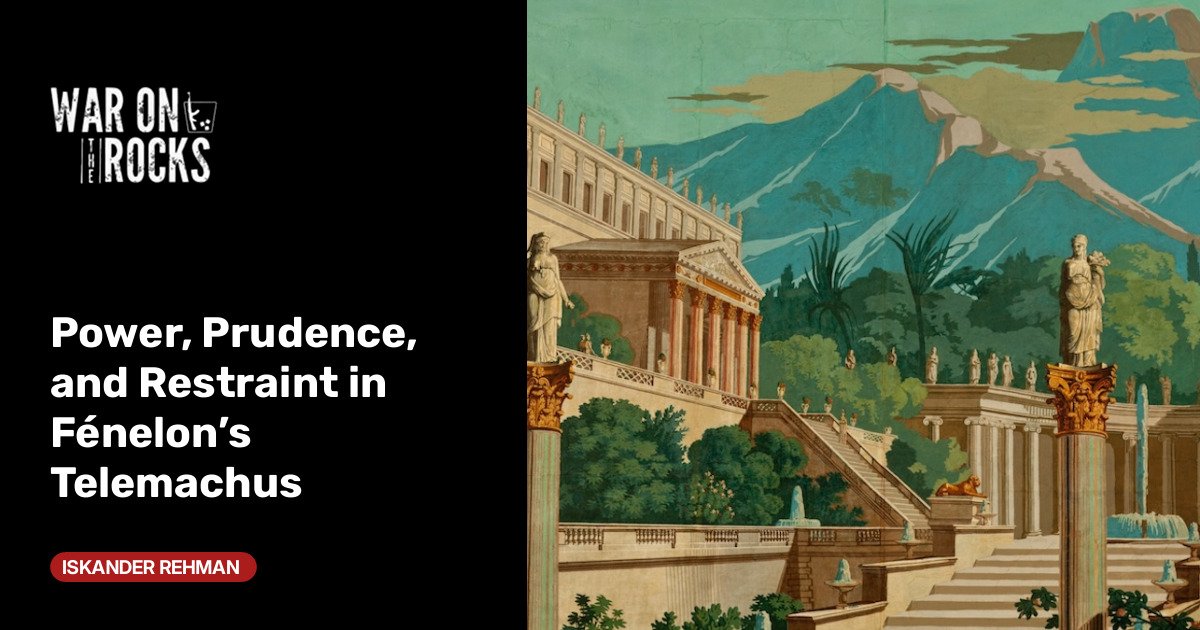
Across the Atlantic, its language of moderation and resistance to tyranny could be conveniently detached from Fénelon’s royalism and adapted to constitutional or republican purposes. Indeed, it was especially popular in the early American republic, and one of the authors most frequently assigned in academies and colleges alongside Cicero, Plutarch and Virgil. Jefferson placed it at the very top of his fictional reading suggestions for his brother-in-law, alongside The Iliad, The Aeneid and Milton’s Paradise Lost. John Adams directly drew on the novel when writing his A Defense of the Constitutions of Government of the United States of America, and a young John Quincy Adams stopped to pay his respects in front of Fénelon’s tomb while traipsing across France. Andrew Jackson even went so far as to festoon the entrance hall of his Tennessee home with panoramic scenes drawn from the novel. Later, prominent abolitionists, such as Harriet Beecher Stowe, would openly profess their admiration for Fénelon, and most notably his insistence on the spiritual equality of all human beings.
Only later, as classical education crumbled and boundaries began to harden between imaginative writing and political thought, did the picaresque adventures of the prince and his adviser begin to fade from public consciousness. This is regrettable, for few works have exercised so lasting an influence upon the moral vocabulary of European and early American statecraft. Three of its themes merit particular attention: its penetrating analysis of the isolating effects of power, its insistence that effective leadership begins with self-mastery, and, finally, its distinctly counter-Machiavellian conception of statecraft, with its focus on the importance of moderation and trust in international relations.
Power as Isolation
“The failing of Pygmalion was to suspect the most ingenuous and upright. He knew not how to distinguish the native features of integrity from the mask of dissimulation; for the good, who disdained to approach so corrupt a prince, he had never seen. He had been so often defrauded and betrayed, and had so often detected every species of vice under the semblance of virtue in the wretches who were about him, that he imagined every man walked in disguise, that virtue existed only in idea, and that all men were nearly the same.”
-Narbal, a virtuous Phoenician official, describing King Pygmalion’s paranoid brand of tyranny to Telemachus, in Book III of The Adventures of Telemachus.
One of the most persistent insights running through the book is that power corrupts judgment by isolating its possessor from the corrective influence of other minds. Given that nearly all the counselors and courtiers who approach the throne have powerful incentives to flatter and dissemble, even an initially well-meaning monarch may gradually lose the ability to distinguish appearance from reality. The more absolute said monarch’s authority becomes, the less reliable the information reaching him is likely to be. And the less reliable his information, the more suspicious, arbitrary, and warped by cynicism his government is likely to become.
Pygmalion, Fénelon’s murderous and paranoid king of Tyre, represents the rotting, terminal stage of this degenerative process. Wracked by paranoia, he prepares his own food and eats alone, eventually retiring, “pale and emaciated,” a pathetic, ghoulish figure, to the innermost recesses of his palace. Reportedly inspired by tales of Oliver Cromwell’s elaborate security precautions, Pygmalion never sleeps two nights in the same bed. His predicament closely recalls Plato’s tyrant in Book IX of The Republic, a man “beset with fear and full of convulsions and distractions,” outwardly master of others but incapable of mastering his own paranoia. It also evokes the well-known lore surrounding Dionysius the Elder of Syracuse, whom both Plutarch and Cicero described as being so fearful of assassination that he refused to entrust his throat to a barber’s razor.
Fénelon was also writing within a distinctly Tacitean political culture. The cerebral Roman historian’s Histories and Annals — with their vivid, almost clinical, dissections of the anatomy of authoritarian rule — had captivated generations of early modern statesmen and political theorists, as I wrote about in these same pages. Tacitus was especially skilled at portraying the depressingly circular aspect of autocracy — fear produced dissimulation or servility, which in turn only intensified the ruler’s suspicions or contempt. That same noxious feedback loop evidently also deeply preoccupied Fénelon. In his extraordinarily blunt Letter to Louis XIV, he had directly warned the king that the truth had become common knowledge everywhere except at the heart of power, openly stating that the king was “scarcely accustomed to hearing the truth,” and that “everyone sees it, and no one dares make you see it.” Louis, he continued, had willingly lent his ear “only to those who flattered him with the vainest hopes,” while those of sound judgment were those he “feared and avoided the most.”
Fénelon’s Pygmalion also anticipates a central finding of modern scholarship on authoritarian rule: Hyper-concentration of power often leads to narrower advisory circles, distorted information flows, and increasingly brittle decision-making. The result is something of a recurrent paradox — even as personalist rulers become more powerful, they also become less capable of accurately perceiving the world around them. Vladimir Putin’s Russia provides a particularly stark illustration of these pathologies. Early in the Russo-Ukrainian War, Western intelligence had already concluded that subordinates were deeply averse to conveying unwelcome military news. Four years later, both Russian insiders and outside observers describe an even narrower wartime information environment — one in which overly optimistic briefings, studiously curated information, and a deep, clammy terror of the cost of elite dissent combine to reinforce the aging autocrat’s insulation — and his resultant detachment from battlefield reality.
If Pygmalion were Fénelon’s only cautionary tale, however, The Adventures of Telemachus would lack nuance and sophistication. It is the presence of subtler, more tragic characters such as the Cretan king Idomeneus that provides the book with its celebrated moral profundity. Idomeneus is neither vicious nor irredeemable. In fact, he often appears quite genial and likable. Yet for all his avuncularity, he remains weak, anxious, and overly impressionable. Time and time again, he prefers to take the advice of his chief favorite, the oleaginous Protesilaus, a “sprightly and enterprising” courtier who knew how to “enter into all the king’s pleasures and flatter all his passions,” over that of the righteous Philocles, whose “morose severity” the king finds uncomfortable.
In contrast, one of the book’s more virtuous royal models, the Egyptian king Sesostris, studiously strives to keep himself informed of the conditions of his subjects, hear complaints, and penetrate the distortions introduced by provincial officials. Good rule, suggests Fénelon time and time again, depends upon more than simply resisting flattery. The ruler ought to also forcibly pry open the narrow avenues by which disagreeable realities can fray their way toward the throne. And in effect, Telemachus’ entire wandering education can be read as an antidote to princely insulation. Accompanied by Mentor, the future king of Ithaca experiences shipwreck, enslavement, war, foreign courts, bustling commercial cities, and tranquil agricultural societies. He encounters wily sailors and grim-faced soldiers, hollow-eyed refugees and wealthy merchants, humble servants and grotesque tyrants. As numerous scholars have observed over the centuries, there is something distinctly Christian to Fénelon’s narrative, with the theologian constantly impressing upon his audience that no ruler can govern from above without learning, and perhaps even experiencing, what government looks like from the lowest, most downtrodden rungs of society.
This inversion is made most nakedly apparent when Telemachus braves the forlorn reaches of the underworld in search of his father, a dread realm where earthly rank is stripped away and rulers are uniquely — and mercilessly — judged. Nabopharzan, the dead king of Babylon and a paradigmatic oriental despot, is thus placed at the mercy of his former slaves. Granted “absolute power,” the vindictive slaves now hold the tyrant “who once made all the nations of the East tremble” in chains and subject him to “the cruelest indignities.” As Telemachus continues his journey deeper into the smoky bowels of Tartarus, he discovers, to his horror, that the kings condemned to never-ending torment far outnumber those who have found felicity in the lambent fields of Elysium.
Perhaps most significantly, among the kings caught within hell’s “abyss of darkness of misery” are many whose cardinal failure was not overt wickedness per se, but rather weakness and susceptibility to flattery. Forced to contemplate a mirror revealing their real vices and inadequacies while a snarling Fury flits before them, mockingly reciting the fulsome praises once offered by their courtiers, these weak-minded rulers are condemned to eternally confront the gulf between flattering illusion and naked reality. Even kings once lauded for their personal virtues find themselves cast down into the sulphureous gloom, but this time for crimes of negligence, having “left their administration of government” in the hands of “wicked and crafty men” rather than properly planning their succession. Shellshocked, the young prince leaves hell noting that most of the doomed kings “had been neither virtuous nor vicious,” but rather overly impressionable, “supinely taking the color impressed upon them from without.”
Prudence as Self-Mastery
“I have been informed that when Ulysses went to the siege of Troy, he placed me upon his knees, threw his arms about me, and after he had kissed me with the utmost tenderness, pronounced these words, though I could not then understand their import … ‘O my friends, I leave you with this son, whom I so tenderly love: watch over his infancy; if you have any love for me, keep flattery far from him; teach him self-mastery; and while he is yet flexible, like a young plant, keep him upright.’”
-Prince Telemachus in Book III of The Adventures of Telemachus
If power threatens to embalm even well-meaning rulers inside chambers of honeyed praise, the first part of Fénelon’s remedy lies within the monarch himself. Indeed, a central theme of The Adventures of Telemachus is not so much the importance of the acquisition of knowledge as that of the disciplining of character. Telemachus already possesses courage in spades, in addition to generosity, intelligence, and a deep-rooted sense of honor and decency. The danger lies in the volatility — or potential spillover effect — of these virtues. Courage thus threatens to shade into rashness, honor into hypersensitivity to insult, indignation into rage, and the prince’s constant, nagging desperation to prove himself worthy of his more illustrious father risks morphing into the naked pursuit of glory.
Mentor’s task, therefore, is less to implant new virtues than to discipline existing ones through judgment, self-command, and prudence in the classical sense — i.e., practical wisdom. Here Fénelon both draws inspiration from and recasts Homer. Already, a key scene in The Odyssey (one inexplicably absent from Nolan’s film) had subtly undercut the cult of imperishable glory (or kleos) in Ancient Greek warrior culture. When Odysseus encounters the shade of Achilles in the underworld, the former champion dolefully confesses that he now regrets having made the choice of a short, but glory-filled existence, and would far rather “live off the earth as the serf of another man,” than rule over his bleak realm of shadows “as the lord of all those who are dead and gone.” Fénelon seizes upon this tension and transforms it into an education in political morality. The quest for glory is not abolished (indeed Mentor urges his young ward to show personal courage on the field of battle) but transmuted — distinction as a ruler lies far less in what one accomplishes individually, and far more in how one durably improves the life of one’s subjects.
This helps explain Mentor’s contrast between Achilles and Odysseus. Achilles possesses almost superhuman martial prowess, but his actions remain governed by rage, wounded honor, and an almost adolescent demand for recognition. Telemachus’ father, on the other hand, possesses a less spectacular but ultimately more useful greatness: courage disciplined by foresight, patience, adaptability, and self-mastery. These values are best embodied by Athena, the Ithacan royal line’s patron deity. The goddess represents the superiority of metis, or prudence — and force governed by intelligence, over Ares, or force ruled by thumos, i.e., raw, seething passion.
Telemachus repeatedly fails Mentor/Athena’s tests while attaining maturity. Enraptured by Eucharis, the nymph whose nubile charms threaten to arrest his journey, he burns for distinction on the battlefield, and on occasion appears to succumb to irrational despair. Even his nobler impulses become dangerous or self-indulgent when allowed to escape the control of reason. In one of the most noteworthy passages, Mentor impresses upon Telemachus that a general’s purpose is not to engage in spectacular acts of bravado but rather to preserve a granite-faced composure, for “he who, in danger, does not retain his self-possession is furious rather than brave, he is superior to fear only as he is incapable of thought, … his mind is not at liberty to dispense proper orders, nor to seize and improve the transient but important opportunities, which arise in battle, of distressing the enemy and doing service to his country.”
It is important to note, in passing, that this continuous emphasis on inner life and self-knowledge cannot be disentangled from Fénelon’s own theology. In his spiritual writings, and most controversially during the Quietist dispute, Fénelon repeatedly attacked amour-propre, i.e., the insidious tendency to cloak sly self-gratification in the language of virtue, reputation, and even religious devotion. Yet, as scholars such as Ryan Patrick Hanley have stressed, Fénelon’s political pedagogy does not demand the eradication of every form of fame or distinction. Rather, it seeks to redirect the young prince from a pernicious love of “false glory” toward a healthier desire for the “true glory” and greater renown that accompanies justice and self-sacrificial service to others.
The distinction runs throughout Fénelon’s writings. In the Dialogues of the Dead, figures such as Alexander, Caesar, and Alcibiades are repeatedly forced to ask whether the conquest of peoples is anything more than disguised slavery to their own ambition. A disappointed Aristotle openly rebukes Alexander, his former pupil. In the posthumously published Examination of Conscience for rulers, pride, self-interest and the gnawing hunger for flattery are treated as some of leadership’s more prevalent occupational hazards. In one of its more arresting sections, Fénelon provides a mental checklist for any prince thinking of going to war, some of which, in its enduring wisdom, is worth quoting here:
When there have been questions of war, did you begin by first examining your rights, and by having those who are the most intelligent and the least flattering toward you do so as well? Did you defy the counsels of certain ministers who had some interest in drawing you into war, or who at least sought to flatter your passions in order to draw from you that which might gratify theirs? Have you sought out all the reasons that could be given against you? Have you listened favorably to those who detailed them? Have you taken the time to know the sentiments of all your wisest counselors without forestalling them? Have you not regarded your personal glory as a reason to undertake something, out of fear of spending your life without distinguishing yourself from other princes?
Read in this light, Fénelon’s questions amount to something more useful than a pious admonition. They force a ruler to pause at precisely those points where passion, vanity, groupthink, and bureaucratic self-interest are most likely to corrupt judgment. Modern high-risk professions have institutionalized the same insight. Pilots use checklists not because they lack expertise but because expertise itself does not abolish fatigue, distraction, or error. Surgeons later adopted the same discipline to compel medical teams to verify critical steps in the lead-up to a potentially irreversible procedure. Fénelon’s six questions perform a comparable function for the use of force. Have the legal and strategic grounds been properly interrogated? Have overly self-interested advocates been discounted? Has the strongest case against action been actively sought? Has dissent been heard without fear of punishment? Have the wisest counselors spoken before the sovereign has revealed his own preference? And, finally, is national necessity being confused with a leader’s hunger for distinction?
No checklist, of course, can manufacture prudence. Its value depends upon a government machinery capable of institutionalizing the weighing of competing assessments and arguments. In the American system, this is one reason the national security adviser’s role as an “honest broker” is deemed so sacrosanct. Brent Scowcroft, long regarded as the quintessence in this regard, described his first duty as “making the process work” and ensuring the president received the perspectives he needed, while offering advice unalloyed by departmental interests and — most importantly — not exploiting his proximity to the president in an attempt to “guide his thinking.” Famously, during the Cuban Missile Crisis, President John F. Kennedy’s Executive Committee of the National Security Council considered sharply different courses, from doing nothing to air strikes and invasion, and the president resisted prematurely foreclosing the debate before finally settling on the naval quarantine.
A good national security process should thus do something similar to Fénelon’s book on conscience: slow the rush toward action just long enough to surface hidden assumptions, interested counsel and unwelcome alternatives. Applied seriously, his six questions would shed an unflattering light on a good many recent wars of choice. For example, the February 2026 decision to go to full-blown war with Iran provides a useful — and stark — reminder of the value of always maintaining a disciplined deliberative process. Indeed, a number of senior officials reportedly raised serious doubts about the possibility of imminent regime change, munitions depletion, and the risks to freedom of navigation in the Strait of Hormuz, yet President Donald Trump appeared increasingly committed to military action, often only absorbing advice that reinforced his existing inclinations. The process was further skewed by the disproportionate weight accorded to what Fénelon would term “interested counsel” — most notably regional actors whose forceful advocacy for and optimism about heightened military action appears to have exercised greater influence over the president’s thinking than the more cautionary assessments provided by his own intelligence and national security apparatus.
From the Letter to Louis XIV, it was clear that Fénelon believed that his own aging, legacy-obsessed ruler had repeatedly failed to abide by these strategic guidelines, confusing his individual grandeur with that of France. The subjects whom Louis ought to cherish as his children, the prelate scolded him, were starving, and the greatest kingdom on earth had been exsanguinated by war and taxation, even as the king continued to pursue his quixotic quest of “gloire and amour-propre.” Here again, the theological language of disordered self-love is fused to a very practical theory of political failure. Any prince who cannot distinguish the public good from the satisfaction of his own passions, Fénelon suggests, will almost inexorably wind up feeding the resources of the state into the maw of his own ravening ego.
Fénelon’s third main lesson is, in many ways, the natural geopolitical extension of the second. Like so many early modern authors, he readily anthropomorphizes the state, arguing that polities, no less than rulers, can become prisoners of their own fear, vanity, and hubris. In the quietist’s theory of statecraft, being loved takes precedence over being feared — not only because it is morally superior, but because affection, trust, and a reputation for moderation ultimately generate longer-lasting forms of security and influence.
Moderation and Trust as a Source of Geopolitical Stability
“You erected these towers for your security, but they really are the source of your danger. A kingdom is best fortified by justice, moderation and good faith, by which neighboring states are convinced that their territories will never be usurped. The strongest walls may give way, by various accidents, which no sagacity can foresee; the best conducted war may be rendered unsuccessful, by the mere caprice and inconsistency of Fortune; but the love and confidence of neighboring states that have long experienced your moderation, will surround you with bulwarks which no force can prevail, and which temerity will seldom attack.”
-Mentor admonishing Idomeneus, the exiled king of Crete and founder of the new kingdom of Salente in Apulia, for his expansionist policies, in Book IX of The Adventures of Telemachus.
What self-command is to the prince, he suggests, moderation is to the state, especially when that same state enjoys a position of temporary primacy. Kingdoms, Fénelon argues, all too often mistake the accumulation of power for the acquisition of security, interpreting any form of compromise as an unfathomable humiliation, and hoggishly seizing upon immediate advantages whose effects only render them far weaker over the long term.
Once again, the Idomeneus “case study” in The Adventures of Telemachus proves the most instructive. Driven into exile from his island home of Crete, the king has established a new kingdom on the southern tip of Italy. Understandably anxious about his fledgling statelet’s vulnerability, he has erected formidable defenses, seized territory, and attempted to cow potentially dangerous neighbors into submission.
Mentor criticizes his shortsightedness, which, in many ways, stems from what we would now term a classic security dilemma. Indeed, whereas the angst-ridden Cretan sees his fortifications and territorial buffers as defensive in nature, his neighbors, led by the sage Nestor, a veteran from the Trojan War, see in the newcomer’s building frenzy the infrastructure of their future subjugation. “By attempting to appear powerful,” admonishes Mentor, “you (Idomeneus) have subverted your power; and while you are the object of enmity and terror to your neighbors from without, your strength is exhausted within to maintain a war which this enmity and terror have made necessary.”
The contemporary relevance is not difficult to see. Beijing, for example, has long characterized its land reclamation and large-scale construction of military facilities on artificial islands in the South China Sea as a defensive undertaking, required to protect Chinese sovereignty, energy security and provide it with “necessary military defense facilities.” Yet to the many neighboring powers whose maritime claims overlap with China’s, the steady proliferation of runways, missile systems, hardened shelters and surveillance infrastructure on disputed features understandably looks less like passive fortifications than platforms for sustained power projection.
The perils of such hubris are made even more apparent in the section of The Adventures of Telemachus dealing with the coalition war against Adrastus, the aggressive and faithless king of the Daunians. An altogether less complex figure than Idomeneus, and a “prince who knows no law but his own interest,” Adrastus understands power chiefly as the capacity to intimidate, deceive, and exploit temporary superiority. In his brutish worldview, treaties are conveniences, weakness is an invitation and neighbors are sniveling vassals or prospective prey. Adrastus’ extreme cynicism ends up resulting in his downfall, as his contempt for neighboring states provokes them into a powerful countervailing coalition.
Time and again, The Adventures of Telemachus highlights the fundamentally interactive nature of geopolitics, warning of the isolating effects of nakedly hegemonic behavior, and of the importance of trust in international relations — both for instrumental as well as moral purposes. For early twenty-first-century readers, some of the book’s passages on the importance of free trade may appear almost eerily resonant, with a Phoenician official impressing upon Telemachus the economic importance of establishing a reputation for consistency and fairness. Thus, the tariff-obsessed Pygmalion, by drawing on all the “little artifices of cunning to draw foreign merchants into some breach of his innumerable regulations,” while “increasing under various pretenses, the incumbrances of trade,” and “multiplying taxes,” ends up drawing foreign investment and trade away from the formerly wealthy port city of Tyre, causing its “commerce to languish.” “If you render commerce less convenient or less gainful,” wearily notes the Phoenician official forced to carry out his mercurial ruler’s increasingly nonsensical trade policy, “a habit will soon be contracted of trading without you.”
In short, economic coercion can punish target governments in the short term while simultaneously teaching them how to gradually substitute away from the coercer. When China restricted a range of Australian exports after 2020, the damage was initially severe in some sectors (especially wine) but coal, barley and other commodities found alternative buyers, and Australia’s Productivity Commission subsequently found substantial trade diversion toward other markets. Nor is this logic confined to Chinese coercion: the Trump administration’s increasingly sweeping use of tariffs has encouraged middle powers such as Canada and the European Union to accelerate efforts to diversify their trade, deepen alternative commercial partnerships, and reduce their exposure to the American market. The broader lesson is not that commercial dependence evaporates easily, but that coercive leverage can ultimately be self-consuming. Once suppliers and logistics networks have borne the cost and effort of building alternatives, old trading relationships may prove difficult to reconstruct. Fénelon readily understood that reputations for reliability are strategic assets precisely because commercial habits, once warped or disrupted, can go on to acquire a new life of their own.
This emphasis on trust and fairness in international relations, and on the instrumental importance of what we would now call soft power, left a deep impression on generations of readers. “Compare the prince of Fénelon with that of Machiavelli,” marveled Voltaire and Frederick II of Prussia, and “you will see that one is all about goodness, equity and virtue,” while “the other is filled with villainy, perfidy and criminality,” before adding that “in reading Fénelon’s Telemachus it seems like our nature is lifted toward the angels,” while “it would seem that our soul nears the devil in Hell when we read Machiavelli’s Prince.” And indeed, Fénelon was part of a long and vibrant tradition of anti-Machiavellian statecraft, ranging from the Huguenot polemicist Innocent Gentillet to Catholic counter-reformation thinkers such as Giovanni Botero and Pedro de Ribadeneyra, all of whom had sought — sometimes somewhat gingerly — to reconcile cold raison d’etat with classic Christian virtue.
Most importantly, whereas Machiavelli had famously advised that, if forced to choose, it was better for a prince to be feared rather than loved, Fénelon strenuously counseled the opposite. Fear, he suggests, may compel temporary obedience, but frightened neighboring states possess armies, allies, self-pride, and — perhaps most importantly — long institutional memories. When confronted with a severe threat to their honor or liberty, they will not hesitate to join forces. In short, the seemingly softer currencies of justice, moderation, and good faith generate sturdier security over the long haul than bombastic threats or crude displays of military or economic might.
This argument runs through Fénelon’s later political writings. The Examination of Conscience on the Duties of Kingship treats the quest for “a general system of equilibrium” among European powers as the most enlightened and natural form of statecraft, while the Political Memoranda and Plans for Government, prepared with the possibility that the Duke of Burgundy might soon inherit the throne, advocates respect for treaties, fiscal retrenchment, revived agriculture and commerce, and a more restrained external policy after the debilitating wars of Louis XIV. Thus, for the author of eighteenth-century Europe’s most popular novel, military overextension, oppressive taxation, luxury, and foreign ambition were not a disparate set of isolated phenomena. Instead, they formed one interconnected, monstrous pathology: a state burning through the domestic foundations of its own strength only to expend it in fruitless endeavors overseas.
For Fénelon, there was nothing abstract about this set of insights. Over the years, he had watched the lush frontier lands surrounding his little archbishopric of Cambrai laid waste by fire and steel as Louis XIV pursued a succession of wars and annexations. In so doing, the disgraced clergyman had turned his archiepiscopal palace into a refuge and makeshift hospital for mud-caked refugees and wounded soldiers, extending his hospitality to enemy prisoners and earning a saintly reputation across Europe for his tireless solicitude toward the many victims of his monarch’s hubris. During the War of Spanish Succession, Lord Marlborough ordered protections for Cambrai, safeguarded the archbishop’s property, and requested to interview him — a meeting Louis XIV peevishly declined to permit. The memory of Fénelon’s wartime charity was literally carved into his tomb: one of the bas-reliefs on David d’Angers’ elegant funerary monument shows the literary titan tirelessly tending to battle-scarred veterans. Another shows him kneeling in front of his pupil, his hand on the haughty young prince’s heart, gazing into his eyes with a mixture of hope and expectation. The education of power, it reminds us, is never complete.
Conclusion
“Thus, transitory is man, like a flower that blows in the morning, and in the evening is withered, and trodden under foot. One generation passes away after another, like the waves of a rapid river; and Time, rushing on with silent and irresistible speed, carries with him all that can best pretend to permanence and stability.”
-The shade of Arceisius, Telemachus’ great-grandfather, reminding his descendant of the fleeting nature of earthly glory during Telemachus’ descent to Tartarus in Book XIV of The Adventures of Telemachus.
There is a poignant irony to Fénelon’s grand experiment in princely education. The terrifyingly proud, violent, and impetuous child entrusted to him in 1689 appears to have undergone, with the aid of his own “Mentor,” a truly remarkable transformation. According to the testimony of his contemporaries, the capricious imp had slowly morphed into a serious, devout, and intellectually curious man — one acutely conscious of the moral obligations of kingship. For a brief moment, it almost seemed as though his tutor might have succeeded where Plato, Aristotle, and Seneca had foundered. Tragically, this was not to be, with France’s philosopher king-in-waiting succumbing in 1712, at the tender age of 29, to a measles epidemic.
Fénelon himself died on Jan. 7, 1715, with Louis XIV following him to the grave less than eight months later. Thus, the archbishop who had spent decades warning against the excesses of the Sun King did not live to see the end of his reign, nor, tragically, did the pupil in whom he had invested all his hopes for a new, more humane brand of monarchy. What did survive, however, is one of history’s most remarkable — and intellectually rewarding — adaptations of Homeric legend. Its plucky hero confronts monsters less memorable than the lumbering Cyclops or ravenous Scylla, but dangers no less enduring: rulers insulated from uncomfortable truths, heroes enslaved by their own passions, and great powers tumbling into hubris.
Perhaps one of Fénelon’s most important and moving insights, however, is his quiet insistence on the fallibility of man, for “alas, we never find the virtues or abilities in mankind that we seek.” We should therefore seek to arm ourselves, first and foremost, with humility and self-knowledge, and not “accustom ourselves to expect, even from the greatest men, more than human nature can effect.” In an age once again characterized by personalist rule, geopolitical volatility, and the fraying of longstanding coalitions, The Adventures of Telemachus’ elegantly penned lessons in truth-telling, self-command, and strategic humility may not just feel timeless, but also disconcertingly urgent.
Iskander Rehman is an assistant professor at the Clements Center for National Security at UT Austin, and a non-resident senior fellow at the Atlantic Council. He can be followed at @IskanderRehman
Image: Department of State
