

This is the second half of the final part (I, IIa, IIb, III, IVa, IVb, Va, Vb) of our apparently five-part series laying out some general guidelines for how pre-modern armies are organized, with fictional worldbuilding and historical patterns in mind. Last time we started checking some fictional militaries against the general patterns we’ve laid out and we’re going to continue doing that this week.
This week, I want to turn to some of the more complex militaries structures we’ve discussed and I found they were more common in my repertoire of video games than film or literature, perhaps because the ultra-long-form structure of many video games provides a lot more space to explore complex institutions. So this week, we’re going to look at an example of a professional standing army in the Imperial Legion of The Elder Scrolls series, some private enterprise war through the Vailian Trading Company of Pillars of Eternity II: Deadfire and the finally try to untangle the military system of Baldur’s Gate from the broader Forgotten Realms constructed world (including but not limited to Baldur’s Gate 3).
But first, as always, recruiting and maintaining large pre-modern armies is expensive! Much like many of those pre-modern armies, this project is supported by devolving the costs of my ruinous book-buying habit on to recruits readers. You can help by spreading the word to new readers and by supporting this project over at Patreon. If you want updates whenever a new post appears or want to hear my more bite-sized musings on history, security affairs and current events, you can follow me on Bluesky (@bretdevereaux.bsky.social). I am also active on Threads (bretdevereaux) and maintain a de minimis presence on Twitter (@bretdevereaux).
The Imperial Legion
Now I should start by noting one of the obvious quirks of discussing any sort of worldbuilding when it comes to video games which is that video games are the product not of a single vision but of many hands, even more so than film or tv. After all, even just the dialogue of a single game is the product of more than one writer (Oblivion credits six ‘Quest Designers’ and two more for ‘Additional Writing,’ for instance) and of course a lot of the creative decisions are also made by artists, level designers and so on. And of course that team might be very different from one game to the next: there’s a lot of turnover from Morrowind to Skyrim. So it shouldn’t surprise us that there may be some inconsistencies or contradictions; nevertheless there is enough continuity here to proceed.
We can begin by sketching out our civilian society. I really think the society of The Elder Scrolls is something we should come back to in more depth, because while it often models itself as the most generic ‘generic fantasy world,’ it actually isn’t in some interesting ways. But we’ll have to stay brief here.
Tamriel (the world of The Elder Scrolls) is, like our previous examples, a complex agrarian society, but it is different in important ways: Tamriel is substantially more urban than either Westeros or Middle Earth. That isn’t just reflected in it having larger cities – these games city sizes are invariably products of graphical limitations, rather than direct one-to-one expressions of worldbuilding – but in the organization of society: in the places we’ve seen mostly clearly (Cyrodiil, Morrowind and Skyrim) the Cyrodiillic Empire (from here on, just ‘the Empire’ for short) is able to organize its administration entirely through urban centers. Castles – fortified private homes in the countryside – exist in this world, but local administration is urban, even in a relatively under-developed province like Skyrim, where each of the administrative divisions (‘Holds’) has a capital in an urban settlement, be that a major city for the larger holds (Riften, Windhelm, Whiterun, Markarth and Solitude all seem to be intended as major cities) or smaller towns for the lesser holds (Falkreath, Dawnstar, Morthal and Winterhold). This is a society organized around cities, rather more like the ancient Mediterranean world than medieval Europe in that regard (and given the frequent Roman theming of the Empire, this hardly seems like an accident). Still agrarian – most of what is going on is still farming – but meaningfully more urban.
The Empire is in turn organized into provinces (nine of them) roughly corresponding to the historic areas of settlement of its constituent fantasy races. Cyrodiil is the capital province and by far the largest (only Morrowind comes close and much of it is thinly settled) and most populous – it is the imperial core and its size and population helps explain why the government in Cyrodiil is able to more-or-less (mostly less, by the time of Skyrim) hold the rest of Tamriel. Each of the provinces has its own internal customary local systems of government. That may seem strange but pre-modern territorial empires often left local ruling systems in place when they could and Cyrodiil does as well. In Cyrodiil proper, we see the province is divided into sub-regions (Counties) with a local ruler (a count) who is strongly subordinated to the center. While the position of count is hereditary, the position has very limited authority (as the wiki notes). in practice, Cyrodiil itself is a state with one legal system dictated from the capital and local ‘rulers’ reduced mostly to functionaries who implement that system, rather than independent powers in their own right.
Outside of Cyrodiil, local communities are organized by local laws under local leaders: Morrowind is still ruled by its Great Houses, each with their own territory, while Skyrim is ruled by its Jarls. These entities retain their own local militaries independent of the Empire and so we ought to understand the periphery here as consisting of vassal polities. In short the state part of the Empire is Cyrodiil (and perhaps small parts of the other provinces), but much of the area it rules is non-state client rulers. That also shouldn’t be surprising: this was the normal structure for a lot of large empires – the empires of the Late Bronze Age come to mind especially. Notably though – and we’ll come back to this – the Imperial Legions (the military force of the Empire proper) maintain pretty obvious ‘escalation dominance’ over Cyrodiil’s vassals (at least until things get pear-shaped in Skyrim).
So we have a fairly well-consolidated state in Cyrodiil which provides the imperial core for the Empire and then a periphery of vassal state- and non-state polities (mostly non-state, as we see them) which the Empire very much controls. How does the military system map onto that?
Surprisingly well, actually, so long as we account for the limitations in scale imposed by the genre (an RPG cannot have 90,000 men on the screen or it will crash) and the requirement for things like ‘town guards’ (so they player doesn’t murder-hobo entire towns).
The political structure (an imperial government with a core territory that also rules over vassal polities) is mirrored in the military structure: there is both the Imperial Legion but also local military forces. In Oblivion, these local forces (commanded by the counts) are little more than constabularies, something that actually is expressed pretty well in-game by how immediately out-matched they are by the Oblivion Crisis compared to the heavier forces of the Imperial Legion. In Morrowind and Skyrim, the forces of the local governments (the Jarls in Skyrim, the [dissertation on the wonderfully complex government of Morrowind here] in Morrowind) look to be quite a bit more substantial: particularly in Morrowind, one gets the sense that the armies of the Great Houses and of the Tribunal Temple are quite formidable (heavier, more expensive equipment, more magic, and so on), even if not a match for the Imperial Legion itself. That makes sense: in order to maintain control, the Imperial Legion has to maintain ‘escalation dominance’ – the ability to win at higher levels of escalation (thus dissuading potential foes from escalating) – over the many regional armies of the empire’s provinces.

The major problem with the local military forces is that they appear to be standing forces to a substantial degree. We see a lot of ‘guards’ standing around on duty and such. But in practice, such local rulers aren’t going to have much need for a standing military force on duty all the time: most communities have sporadic security needs and small communities generally do not even require much of a permanent, standing constabulary. Instead, we might expect the permanent force to be a small retinue around the local ruler (we actually do see this in Skyrim with the concept of thanes), but beyond that, we might expect a ‘raised for the moment’ form of military organization: some sort of levy or militia, possibly with a standing component that is just a rotating period of duty among those liable to be drawn into the full militia in an emergency (a select levy to go with the general levy). In that case, ‘guard’ wouldn’t so much be a career as it would be something like a two-week shift every year that you had to do, effectively as part of your taxes.
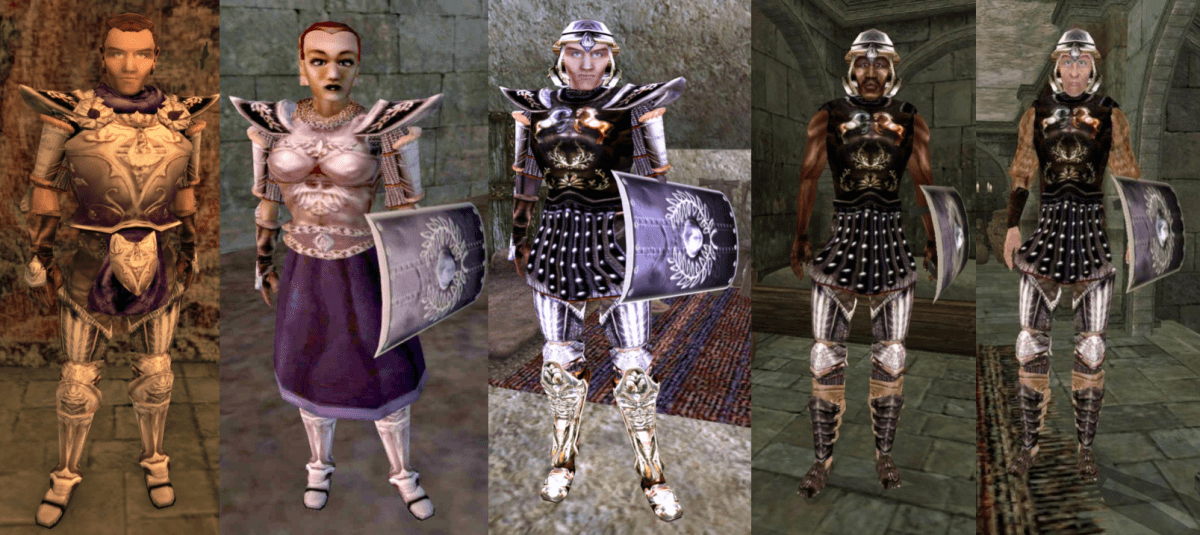
The Imperial Legion (or legions) itself is also a recognizable structure: it seems pretty clearly to be a professional army. Members of the legion are very clearly deployed far from home (a point often exemplified by the legion’s multicultural recruiting) on a permanent basis and are full-time soldiers. Recruiting seems to be done through volunteers. While we see some recruitment of local auxiliary forces in Skyrim, these tend to be lighter troops and might be local auxiliaries: the clear nucleus of the force, we’re told, arrived with General Tullius from Cyrodiil. The legion is most often stationed in permanent fortifications (we see a lot in Morrowind) or key cities (like the Imperial City in Oblivion) – it is not a local militia and makes no effort to be ‘everywhere.’ Its equipment is remarkably (though not perfectly) uniform even in regions where its styles are distinctly foreign such as Morrowind or Skyrim, suggesting that equipment is state-issued and somewhat standardized. It also seems to be a long-service professional organization: we see quite a few ‘old soldiers’ still serving, both in desk-jobs and in combat roles.

And this is a structure that actually makes a fair bit of sense for a state like this: vassal rulers retain smaller local forces and the Empire largely lets them deal with the day-to-day work of order and administration. Meanwhile, the imperial center, with its greater resources, maintains a large, professional, well-equipped standing army that enables it to coerce those local rulers as well as engage in large-scale warfare. One imagines that, in the event of a major security threat, we’d see the Imperial Legion forces form the core of a field army, probably supplemented by non-legion local forces. The amusing thing is, while I think the developers imagine this structure as ‘Roman-ish,’ the state it actually recalls to me most clearly is the Neo-Assyrian Empire (fl. 911-626) which maintained a core professional army of full-time infantrymen (in matched pairs of archers and shield-bearers) who were then supported by levies drawn up from the empire’s vassals.

What I think is somewhat underdeveloped – especially in Oblivion and Skyrim – is the apparatus to pay for all of this. While other kinds of military systems can have their costs effectively devolved, a state-equipped professional army has to be paid out of the treasury, which in turn demands a state with the ability to raise a lot of revenue. Because it is a volunteer professional army, these soldiers would have to be well paid in order to recruit and retain them. Notably, we do not see in The Elder Scrolls, any indication that these costs are being defrayed by private enterprise war – the Imperial Legion is not a contractor-based army and commissions in its officer corps are not purchased, but awarded based in merit and internal promotion.
Now that’s not to say we don’t see any of that apparatus. The Empire clearly raises revenue both through taxes and through state-chartered monopolies. One of the first things we see in Morrowind is the Syda Neen Census and Excise Office, suggesting both head and excise taxes (excise taxes are taxes on specific goods) and there is a quest related to local tax collection. That said, the tax infrastructure in Morrowind is relatively minimal and that makes sense: most of the game takes place on Vvardenfel, which is only in the initial stages of having imperial control established. Notably, what collection we do see is in ports, suggesting customs and excise taxes may be central here, which also makes sense for a region that is only slowly being brought fully into central administration: port duties and excise taxes on luxury goods (I recall, but cannot find the line of dialogue, where we’re told that the excise taxes are on alcohol) are easier and quicker things to set up.
But what we don’t see is a more focused and intense extraction system in Cyrodiil or especially in Skyrim. By the time Skyrim takes place, the Empire is no longer at peace, but is recovering from a large war and trying to rapidly prepare for its seemingly inevitable sequel, which should demand high revenues and thus that taxes would be high as well. Yet ‘tax revolt’ is nowhere in the Stormcloak rebellion’s motivation (they’re focused more on religious persecution and ethno-nationalism) and we see almost none of the apparatus of extraction that we ought to see for a province that has been long-held by the Empire. The same is broadly true for Cyrodiil, though there are a couple of quests in Oblivion related to things like port taxes in Anvil and such.
Alongside that fairly minimal taxation apparatus, we have another major revenue source, which is the East Empire Company, a fairly obvious riff off of the British East India Company (even borrowing the ‘East’ despite appearing in places like Skyrim that are…not in the East), a massive vertically integrated company with a bunch of state-chartered monopolies on luxury goods. That is a very historically rooted way for a state to raise revenue, of course. The problem is that it isn’t enough. Recall, Tamriel is a complex agrarian society: we see no hint of even early mass manufacture, much less industry, so the overwhelming majority of economic activity is going to be in agriculture and pastoralism. That in turn necessarily means that the revenues generated from something like the East Empire Company are going to be somewhat marginal to the state itself. The Roman Empire had, for instance, a slew of state monopolies (on things like silver mines) as well as rents on state-controlled lands and resources which the Romans collectively called vectigalia, but it is very clear that the large majority of Roman taxes were what the Romans called tributum: taxes assessed on agricultural land or produce.
So what we ought to see in order to complete the Imperial Legions is the infrastructure, particularly in Cyrodiil and Skyrim, for substantial tax collection on the common folk, particularly on agriculture. Now that could be structured in two ways: we could see (as we do in Morrowind) direct imperial taxation, with imperial officials in each settlement assessing taxes themselves. Now those officials might be direct employees of the Empire, but an equally likely solution (which we do seem to see in Morrowind in Caldera, as I recall) are tax farmers: private businessmen who have contracted to do tax collection in an area.
Alternately, the Empire might do what the Romans eventually did: assess taxes on communities and leave it up to local leaders and governments on how to collect those taxes. Given how visible and important local ‘vassal’ rulers are in the Empire, this seems to me the more likely solution: tell the local Jarl or Count or Great House that it is responsible for raising a specific amount of money (or revenue in kind, so a specific amount of grain or recruits or whatever else) and then let them sort it out with their own local administrative apparatus. That said, if this was the system, we ought to hear about it more, especially in Skyrim where the local revolt against the Empire ought to mean that imperial taxes are being collected in some places and are not being collected in others.
All of that said, the fact that the Empire in The Elder Scrolls has a somewhat fragmented structure and then has a fragmented military apparatus – with a professional army enforcing imperial power over a bunch of much smaller local militaries which do the day-to-day work of maintaining law and order – works as a reflection of the society we’re shown. What is missing is mostly just the apparatus of empire itself, which has really been neglected in the setting’s worldbuilding since Morrowind.
The Vailian Trading Company
That said, bringing up the East Empire Trading Company of the Elder Scrolls games highlights one odditiy: the EEC lacks its own military force, instead relying primarily on the Imperial Legion (something we see clearly in Solstheim) and only occasionally on local goons. But of course a massive, state-chartered trading company of this sort is frequently going to have to operate far from the center of imperial control and potentially with local communities that object quite loudly to being so obviously exploited. As a result, these sorts of ‘mega-corps’ tend to operate their own independent military forces: the societates of Roman publicani that managed the tax-farming system (prior to Augustus’ reforms to the largely community-centered tax system mentioned above, though some taxes remained farmed) maintained private security forces we can see clearly in documentary evidence from Roman Egypt, while early modern trading ‘mega-corps’ like the British East India Company or the Dutch VOC maintained full-on private militaries, complete with armies and warships.
But we do see that structure in Pillars of Eternity II: Deadfire. And let me also just say: if you are a fan of classic computer role-playing games (BG3, Wrath of the Righteous, Rogue Trader, Solasta, that sort of thing), you really ought to give Deadfire a spin. It is very good and very tightly written (and the stronger of the two Pillars games). It’s also, I think, a better introduction to Eora than the more recent Avowed and I really liked Avowed.
Here the setting is the Deadfire Archipelago, a smaller region in the larger world of Eora, with three principle military powers along with a fourth minor power (the Principi sen Patrena, a very loose pirate confederation that survives to a significant degree in the shatter-zone created by the other three that we’ll leave aside here) and all three are actually pretty well realized. The actually indigenous local power are the Huana. They are significantly fragmented: the strongest tribe (the Kahanga) are a complex agrarian society with a large capital city (Neketaka) that exert an imperial overlordship over smaller tribes and communities in their periphery. Their society is a caste-based one and their military structure follows that: the priests (including ‘Shapers’ who wield powerful magic) and the warriors both are drawn from the highest caste, the Mataru, which thus acts as a hereditary military-and-religious aristocracy which also – not by accident – controls most of the wealth. Their military is thus drawn primarily from this upper-class, drawing its cohesive principle from the exclusivity and strong social expectations for that class, financed by the wealth of its role as the ruling elite (that is to say, wealth extracted from the lower, worker classes). But of course that system imposes strong limits too: the military cannot be readily expanded beyond those classes effectively and the entrenched class interests of the elite render the Huana military static and unresponsive to new technology – though formidable, their position relative to rivals is deteriorating. As a result, the player’s interactions with the Huana are always contextualized by the Huana leadership’s own sense of growing military vulnerability to incursions from foreign colonial powers, of which they have two.

Deadfire is a really good RPG and I really encourage you to give it a try if you haven’t.
The first is the Royal Deadfire Company, which represents the distant maritime kingdom of Rauatai in the Archipelago. The name is something of a euphemism: the institution began as the Rauatai Trading Company, but was brought under the direct control of the ruler of Rauatai (the ranga-nui) and converted into the RDC, which in practice isn’t really a trade company anymore, but an expeditionary force, an army of the government of Rauatai which aims to conquer the region – albeit gradually, because the Huana are still strong enough to make a direct war of conquest a risky proposition. The RDC is thus effectively an expeditionary force of professional soldiers, funded and maintained by Rauatai (itself a large maritime empire) doing ‘ports-and-forts‘ imperialism. Consequently, what we see of them are fortified staging posts (notably Hasongo) to support their navies and channel goods back to the homeland and nearly all of the people we see are military personnel more or less directly employed by the Rauataian state.

Notably, as an aside, we don’t get as much information about the rest of Rauatai’s military that I recall. Honestly, I’d think something like a core army of conscripts might make sense (given how militarized the society is described as being), with only the forces deployed permanently abroad (like the RDC) being composed of professional ‘long-timers.’
In contrast to the RDC which is almost an army of a foreign state, the third power really is a trading company first: the Vailian Trading Company (itself a pretty clear echo of the Dutch VOC, down to the similar acronym). One oddity worth noting is that the VTC is not attached to one state, but several, representing the combined efforts of the Vailian Republics, a loose confederation of city-states. The nearest historical parallel here may actually be something like the historical Hanseatic League. But where the RDC is essentially an arm of the Rauataian state, the VTC is doing something different: private enterprise war. The VTC is a company, run by a board of directors, answerable to investors in the Vailian Republics under a charter sanctions by their confederation.

And (unlike the EEC of the Elder Scrolls series), it has its own military to secure and advance its operations, every bit as predatory as the RDC. And what we see – and I think this makes sense for the society being presented – is a contractor-based military. Indeed, we meet one of these contractors, Atello Valera, who the VTC has contracted to provide a pretty large security presence, including a number of warships. What I do think is missing here is a greater array of contractors and sub-contractors. Realistically, we might expect the regional heads of the VTC (Ignato Castol and Lueva Alvari, who split maritime and land-based operations between them) to have a few key contractors (whatever the Vailian equivalent to colonels or condottiere is), who would then have sub-contractors running individual ships or companies, with basically everyone in the chain effectively functioning as a sort of ‘military entrepreneur.’ We do get a real sense of that entrepreneurship from the Valeras, but they ought not be the ‘only game in town’ on the military side.

The VTC, in short, has a bunch of different people contracting soldiers for different tasks, so while there’s a clear cultural similarity in their equipment, it isn’t uniform (unlike the RDC, which is quite uniform!)
That said, I think Deadfire actually does a good job of correlating militaries and societies: the Huana, Rauatai and Vailians have quite different societies and thus quite different militaries: a warrior-class military with devolved costs that fits the caste-based Huana society, a professional military with standardized state equipment and regular pay that fits the very centralized Rauataian state and finally a private enterprise warfare military using military contractors that fits the decentralized structure of the Vailian Republics.
Defending Baldur’s Gate
Now we turn to the unusual military structure of Baldur’s Gate, drawing not just on the recent Baldur’s Gate 3, but more broadly on the lore of the city as part of the Forgotten Realms setting. We’re picking one city to focus on in part because it has become the most visible part of the Forgotten Realms’ setting and also because, to be frank, the military, social and economic structures of the Forgotten Realms are kind of a mess. That’s not necessarily a harsh criticism – this was a setting built for specific purposes (facilitating D&D gameplay) rather than worldbuilding verisimilitude. But that still makes them interesting to talk about from this perspective because they often test public assumptions about what pre-modern societies look like.
(Note that in BG3 one of the major plot-points is an effort by one of the villains to unbalance the city’s military system by adding on an army of evil metal golems to it, in a bid to take over. I’m going to leave that part out here, because the Steel Watchers aren’t part of the stable military system of Baldur’s Gate. Ironically, if Gortash had succeeded, the military system of Baldur’s Gate would make a lot more sense: you’d have a tyrant monarch who ruled the city by virtue of controlling its military.)

Baldur’s Gate, in the setting, is a major seaside mercantile city with a large population, clearly part of a larger complex agrarian society. Its upper-class are wealthy burghers (rather than large landowners) and it is ruled by a council of four ‘grand dukes’ who are elected for life. It is also a big city by pre-modern standards: the wiki figures a population around 120,000 or so in the urban area.
Now one thing in the lore is that because the city has a natural defensive position (it is located on an inlet) and because it has a very strong outer wall built by the heroic figure Balduran, for whom the city is named, that it is generally peaceful and does not necessarily require a large army. The problem here of course is that Baldur’s Gate doesn’t just need to defend the city core, it needs to defend the agricultural hinterland that feeds it. This is a common problem in fantasy worldbuilding – cities divorced from the agricultural lands they require to survive. Nor can this issue be salvaged by saying the Baldur’s Gate is a city that lives on trade and such. These are agrarian societies, which is to say that food production (via farming) makes up the lion’s share of the economy, with textile production (also via pastoralism, agriculture and peasant labor) making up quite a lot of the rest. Consequently, in the absence of industrial production, there’s no amount of economic activity you can be doing in the remaining small slice (think 10-20% at most) of the economy that is going to allow a city to import all of its food and fabric. The only activity that can manage this feat is empire: the (violent) extraction if someone else’s food and fabric, in which case you still have a hinterland, it is simply held by force and coercion. The city needs a hinterland and it needs to be defended.
That said, Baldur’s Gate does have an army – indeed it has one-and-a-half armies, in practice. Order in the upper city is kept by an armed constabulary called The Watch which, according to the Wiki, has about a thousand members, of whom perhaps 300 or so are on active duty at any given time, making this effectively a civic militia. What keeps the Watch from acting fully like a military is that they are not empowered to operate outside of the city walls. Amusingly to me, this force of – at any given moment – 300 active soldiers and 700 or so reservists, somehow rates a high command with six major generals and two more senior generals despite being no bigger than a battalion (which would normally by commanded by just one major or captain in our world).
Instead, the main force of Baldur’s Gate’s defense is the Flaming Fist, a mercenary company kept essentially on permanent retainer by the city. It is a standing, effectively professional force, organized on the employment principle, consisting of – according to the wiki – approximately 2,000 soldiers (with a peak strength of 6,000). The Flaming Fist was founded by a grand duke and it seems like its leader (the marshal) is generally one of the four grand dukes that governs the city.

It is striking how heavy and expensive their equipment is. Maintaining this organization on a permanent basis would be extraordinarily expensive, which if I was a citizen of Baldur’s Gate would get really frustrating, because as far as I can tell the Flaming Fist’s job is to spend the first two acts of every story about the place losing until the heroes show up and save everyone.
And there are a few problems here. The first is a problem that afflicts a lot of Forgotten Realms armies which is this is not enough army. A city-state with more than 100,000 people in the core urban area certainly ought to be able to muster up a much larger army. Medieval Ghent had a population by the late Middle Ages around 50,000 and was able to put something on the order of 8,000 men on the field to fight against the city militia of Bruges in 1382 and they were outnumbered by the Bruges militia. Baldur’s Gate is well over twice the size and yet has a far smaller total force. Indeed, its fairly close in size to Classical Athens (especially if we account for the missing rural countryside a city of that size must have), which was able to deploy more than 12,000 men against Syracuse, supported by roughly 200 triremes (so around 40,000 rowers) and was able to recover from the total loss of that force.
But that size problem gets us to an underlying problem in matching up this type of society, its resources and security needs with the kind of army it has. If we put the Watch aside for now, the primary defense force for Baldur’s Gate are the Flaming Fists and while the lore describes these fellows as a mercenary company because they sometimes take jobs outside of Baldur’s Gate, they’re really a standing army. No one is going to mistake your mercenary company for an independent outfit if it is also traditional that the marshal of the company is also one of the four elected leaders of the city. That’s not an independent mercenary company being hired, that’s a political alliance with Baldur’s Gate enabling another community to gain the protection of its army.
But you may recall as we discussed recruitment and payment principles that the state-supplied (the Flaming Fists have standardized equipment), full-time, long-service professional army is almost exclusively a creature of large, well-administered empires and there’s a reason for that. For one, only such a large and complex state is capable of mobilizing the resources necessary for such an expensive system and equally only large empires have the kind of round-the-clock security needs to justify one. That is, after all, the feature that makes professional armies so expensive: they have to be fed, paid, housed and equipped in wartime as well as peacetime – there is no option to simply send the men back to their homes and jobs. Thus, while smaller states might maintain a small standing force – a prince’s retinue, a small elite unit or a constabulary force – their military is not built around that force, it is built around forces which can be expanded and contracted to fit changing security needs.
As an aside, this is part of why we can’t just say the Flaming Fist function basically as a condottieri force. Italian states raised condottieri in response to specific military threats – they did not maintain them continuously in peacetime. Indeed, one of the key advantages of condottieri was precisely that: you could pay them in war time and not pay them in peace time, though of course they were also famously untrustworthy.
The Flaming Fists also do not fit the political structure of Baldur’s Gate. There is a reason that states which do use standing armies tend to have a unitary power structure, like a monarchy, because the very nature of a long-service standing professional army is that whoever wields that army is the state. Baldur’s Gate is ruled by four high officials who serve for life, three of whom collectively share control over a gendarmerie of 300-part timers and one of whom has control over and the loyalty of a standing for of at least 2,000 professional full-time soldiers. That is a system that becomes a monarchy very fast. Political power here is fragmented, but for some reason military power is not, which is hardly a stable structure.
And finally, the Flaming Fists do not fit the social structure of Baldur’s Gate either. This is a city dominated by a class of wealthy burghers (the ‘patriars,’ a clear riff off of Roman patricians), whose wealth mostly comes from trade or non-agricultural business. That’s fine – there really should be a landholding aristocracy somewhere too – but the problem is that this class is nowhere represented in the military structure. It’s the ruling class, whose interests the military system is intended to protect yet these families do not make up the elite of the military, nor its officer class.
We can effectively go in two directions ‘fixing’ Baldur’s Gate: we can make the society fit the military or the military fit the society. In the first direction: a city which has a professional military force that answers to just one guy (the marshal of the Flaming Fists) isn’t going to be an oligarchic quasi-democracy. It is going to be some kind of autocracy: the marshal is going to be the autocrat who sets the rules, de iure (as a monarchy) or de facto (as a tyranny). In this case, the weakness of the Watch makes sense: this was the city’s old militia, now sidelined because it would threaten the power of a tyrant-marshal, who is probably also busy breaking the power of the old ruling class (the patriars) and consolidating their wealth into his own political network. Alternately, we might get a sort of monarchy-within-bounds as we see in Venice and to an extent (with its two kings) in classical Sparta: a single leader does have command over the military, but the rest of the political system is heavily focused on constraining that leader, to the point that they have officials whose sole job is to watch their every move and there are other political institutions empowered to unilaterally remove a marshal who behaves badly. Even then, a purely professional force seems like a recipe for a self-coup in which the marshal sidelines everyone else because he alone commands the loyalty of the Flaming Fists, whatever the political system may say.
The alternative is to come up with a military system that fits the society we see: a somewhat representative oligarchy (with some democratic elements) primarily lead by a handful of elite families that wield outsized wealth. That kind of society has little need for a large standing army at all: the people with goons are also the people who wield political power and so the system they need is one that catches petty thieves and resolves disputes between each other, not a system to garrison whole districts of the city. The Flaming Fists are unnecessary for such a society (though the Watch as a gendarmerie which serves the collective interests of the patriars might survive).
Now those elite families could tax themselves extremely harshly in order to maintain a meaningful standing army but why would they? Instead, we ought to expect that Baldur’s Gate would defend itself with a civic militia that mirrors its own social structure: the very poor are excluded (and probably don’t vote), while the bulk of the burghers fight as infantry (and have some token political participation) and the patriars serve as officers and cavalry (and have maximum political roles). Because the patriars – or the middling burghers – would rather not tax themselves, they’re going to devolve military costs: everyone buys their own kit and serves based on wealth. That system might take the form of the sort of conscription-based civic armies we see in Greece and Rome or it might take the form of medieval civic militias, like the aforementioned schuttersgilde. If the latter, we should expect those military guilds to be major political actors in the city’s governance, either de iure (they have fixed places on the ruling council or whatever) or de facto (their members just tend always to get elected). Crucially, unlike the Flaming Fists, they wouldn’t be external to the city’s class system, but tightly integrated into it.
Conclusions
This series has ended up rather a lot longer-winded than I intended, but what I hope it has served to demonstrate first is that not all societies have the same sorts of armies. My critiques here have focused mostly on complex agrarian societies, because this was a series for worldbuilders and that is most of what fantasy worlds get made out of, but of course the armies of nomadic pastoral peoples or hunter gatherers are really different as well.
Importantly, societies do not pick their military structures at random, nor are they necessarily free to pick and choose whatever military system they like. Instead, military systems, which are defined by the interaction of principles of recruitment, methods of mobilization, systems of equipment, payment and supply and sources of cohesion are generally long-standing legacy institutions that emerge alongside larger social structures. Individual leaders are rarely at leisure to change or redefine these systems (though it does happen sometimes).
Perhaps most importantly, these systems are invariably tightly connected to the structure of a society and its political organization. No army can help but recreate its civilian social structures on the battlefield. So a society in which the dominant political and economic force is a mass of middling farmers who elect their leaders are likely to form armies composed of a mass of infantrymen who elect their generals. A society in which a handful of elites lord over the disenfranchised and largely impoverished peasantry is likely to have armies centered on mounted elites, with infantry that is limited and unreliable at best. More complex forms of organization, like private enterprise war with military contractors or standing, long-service professional armies, demand states with matching levels of revenues and complexity as well as a set of security needs which demand these expensive, complex and difficult solutions to the problem of raising military force.
While those rules may feel constraining, I think – and I hope in this post and the last, I’ve shown – they can also, for the worldbuilder, offer storytelling opportunities. After all, if armies reproduce their society’s social structures – often more explicitly than the civilian society itself – that means any time an army is ‘on screen,’ it provides an opportunity to say something about the underlying society. An observer who noticed, for instance that British military leadership in the early 1900s was generally drawn from the same handful of schools would have learned something about the structure of power in British society. The same might be said if the person glanced at Europe and noticed that despite its modern industrial economy, most of the high military command of early 1900s Germany in the first World War continued to be drawn from the old Junker class (visible because of the ‘von’ in their names), a trend which continued into the second.
And indeed, someone who glanced at the modern American military and noticed that American officers functionally always have college degrees, that high ranking officers generally have advanced degrees and that American enlisted personnel generally do not have either will have learned something about the structure of class, power and wealth in the United States: our ruling class is defined more by where you went to school and for how long than by your last name or hereditary titles (which we do not have). And the military cannot help but replicate that structure.
The same is equally true in fictional worlds. Of course one shortcut to producing these kinds of interesting linkages is to adopt a historical pattern wholesale by imitating a real polity and making modest changes. That said, it can be equally interesting to think about the implications of odd combinations, especially for societies in transition. Because, of course, societies are never static things and as they change – be that change swift or slow – their military structures will be forced to change with them, or else will be bent and deformed by the attempt not to change. In fiction, civil-military failure can be as interesting as success.
And in the end, a society whose institutions are interwoven and interlinked – as all real societies are – is just more interesting to read about than a fictional society which is a mere jumble of tropes.
