

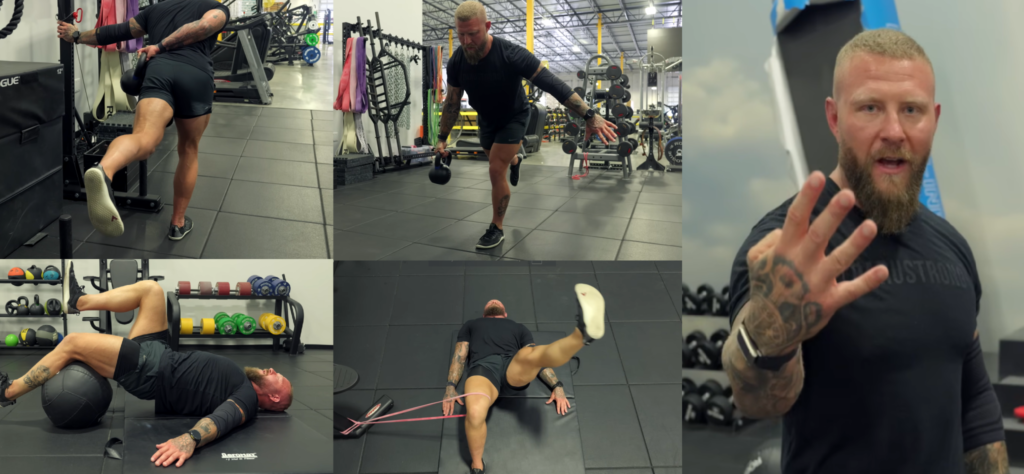
Back pain and knee pain often seem like separate problems, but according to renowned strength and conditioning coach Phil Daru, the real issue frequently starts elsewhere. In a recent YouTube video, Daru explains that poor hip mobility and pelvic instability can force other joints to compensate, increasing stress on the lumbar spine and knees.
To address those underlying limitations, Daru demonstrates four exercises designed to improve hip range of motion, strengthen stabilizing muscles, and restore better movement mechanics.
1. Loaded Assisted Hip Airplane Improves Hip Rotation and Stability
The first exercise is a loaded variation of the hip airplane using a kettlebell and a sturdy support for balance.
Daru explains that the movement develops foot stability while strengthening the muscles responsible for internal and external hip rotation. Holding onto a rack allows athletes to focus on quality movement while the kettlebell increases the demand on the hips.
Throughout the exercise, he emphasizes maintaining knee alignment while rotating through the hip, avoiding the knee collapsing inward during the movement.
He recommends performing three to four sets of five to ten repetitions per side while pausing for two to five seconds at both the internally and externally rotated positions.
2. Single-Leg Romanian Deadlift Builds Pelvic Stability
The second drill combines a single-leg Romanian deadlift with a kettlebell hand pass.
While balancing on one leg, the athlete hinges at the hip before transferring the kettlebell from one hand to the other. The constant weight shift forces the hips, trunk, and foot stabilizers to work together to maintain balance.
According to Daru, the movement strengthens the glutes, adductors, lats, and core while reinforcing proper posture throughout the hinge.
He recommends three to four sets of either 30 to 60 seconds or six to eight kettlebell passes on each side.
3. Single-Leg Isometric Glute Bridge Reinforces Hip Extension
The third exercise shifts the focus toward glute activation.
Using a medicine ball or slam ball beneath the hamstring, Daru performs a single-leg glute bridge while maintaining a 90-degree knee angle. The ball provides tactile feedback, encouraging athletes to drive through the hamstring and glute while keeping the pelvis stable.
Rather than chasing repetitions, he recommends holding the bridge for 15 to 30 seconds while maintaining tension through the glutes, hamstrings, core, and rib cage.
Two sets per side are enough to challenge the muscles responsible for hip extension and pelvic control.
4. Banded Single-Leg Glute Bridge Targets Hip Rotators
The final progression introduces a resistance band to increase activation of the muscles responsible for controlling hip rotation.
One variation places the band above the knee to challenge the adductors and internal stabilizers during a controlled leg whip. The second variation moves the band to the outside of the knee, increasing the demand on the glute medius and external rotators.
Throughout both versions, Daru stresses maintaining pelvic alignment while moving only the working leg.
He recommends performing three to four sets of five to ten repetitions on each side.
Stronger Hips Can Reduce Stress on Your Back
Daru concludes that many cases of chronic back and knee discomfort originate from limited hip mobility rather than the painful area itself.
“If you have a bad back, if you have bad knees, it’s because you have immobility of the hips or immobility of the ankles,” he explains.
By improving hip mobility, strengthening pelvic stabilizers, and restoring functional movement patterns, athletes may reduce unnecessary stress on the lumbar spine and knees while moving more efficiently during both training and everyday activities.
About the Author
Jeremiah Oliva

Jeremiah Oliva is a writer passionate about fitness, sports, and active living. He has experience in songwriting and managing content and social media for online radio and magazine platforms.
He covers HYROX, CrossFit®, and competitive fitness, with a focus on performance, mindset, and athlete development.
Outside of writing, Jeremiah trains in boxing, cycles, explores the outdoors with his kids, and plays the guitar.
