


Pearson Engineering, the British company owned by Rafael Advanced Defense Systems, has supplied mobility and counter-mobility equipment to armed forces for over 40 years.
Based in Newcastle, its factory is the largest in Europe, and its family includes Responsive Engineering, which produces steel and aluminium armoured structures, including Challenger MBT turrets, Boxer mission modules, and Ajax armour packs for the British Army. Over the past three years, more than £16 million has been invested in the company, with 80% of its revenue generated from exports.
Looking ahead, the company’s CEO, Ian Bell, stated, “The rise of global mine contamination is putting both military personnel and civil communities at increased risk. At Person Engineering, we believe robotics and automation are central to addressing this challenge.”
This has led to the introduction of the latest member of its MineWolf family of advanced uncrewed mine and route clearance platforms, the MW370 Next Generation. It is designed to operate at stand-off distances.
To achieve high-volume clearance of up to 4,500 square metres per hour while safeguarding personnel, increased automation and improved situational awareness reduce operator workload. Interchangeable flail and tiller systems provide flexibility for use in various contaminated environments.

Threat-Sense has been developed from lessons learned in Ukraine, using artificial intelligence (AI) to identify, characterise, and alert to the presence of scatterable laid threats from both friendly and enemy forces. Taught within a simulated environment to provide the highest levels of flexibility, Threat-Sense offers real-time detection at a distance and has been successfully demonstrated to NATO members during trials while integrated with a UAV. The Threat-Sense displays can be accessed on a soldier’s smartphone.
The combination of Threat-Sense with MineWolf MW370 Next Generation can enhance demining operations, and both will be showcased at Eurosatory 2026.
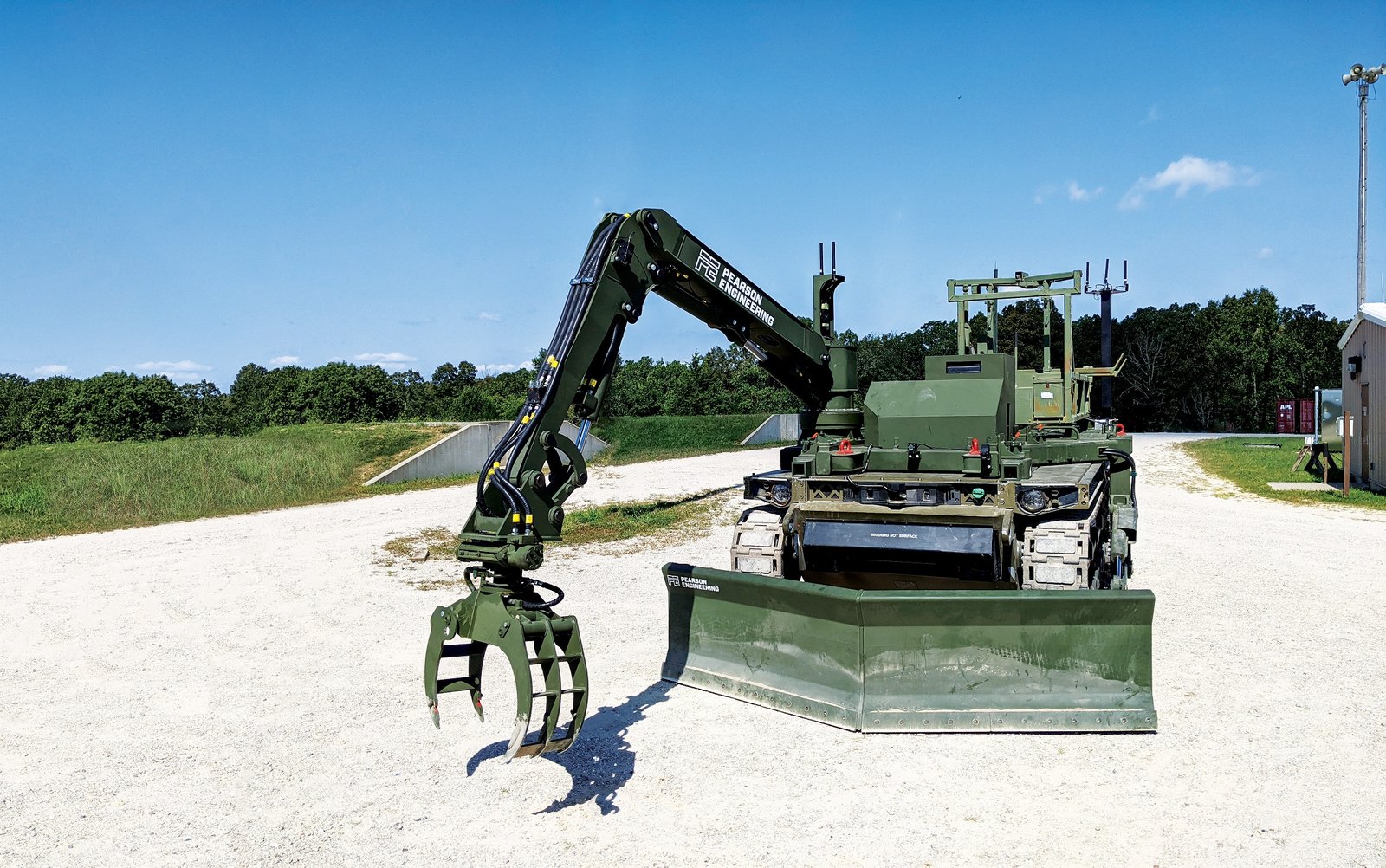
Pearson has also developed the RCV-Pioneer, designed to provide remotely controlled engineering capabilities for robotic combat vehicles (RCV). Any RCV with enough mass can be equipped with interchangeable mission payloads, including those for minefield breaching, route verification, and urban obstacle clearance. The Threat-Sense product can also be integrated into the system to give operators real-time threat detection information directly on the operator control unit (OCU).
by David Oliver
