

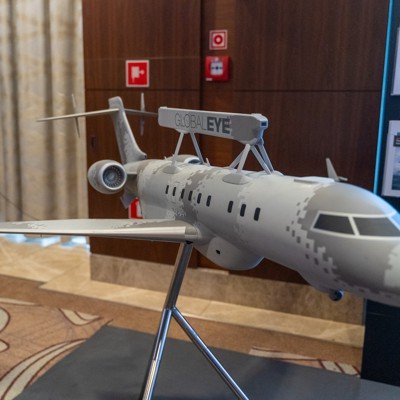
NATO allies plan to buy 10 of Saab’s GlobalEye aircraft as the alliance’s next-generation radar plane, snubbing Boeing and its E-7 Wedgetail offering, officials announced on Tuesday.
The alliance would replace its Boeing E-3 Airborne Warning and Control aircraft with the Swedish company’s offering, NATO Secretary General Mark Rutte said during the alliance’s Defence Industry Forum in Ankara, Turkey.
“For decades, NATO has relied on a fleet of E3 Airborne Warning and Control Systems, that have been our ‘eyes in the skies’. They have been deployed from Northern Norway to Southern Türkiye. They have served us well and continue to do so, but they are reaching the end of their lives,” Rutte said. “Today, several Allies are announcing the joint procurement of up to 10 SAAB GlobalEye aircraft to replace them.”
Saab CEO Micael Johansson told reporters at the summit that he estimated the deal would be valued around $4.5 billion and that deliveries could begin in 2030, depending on when the deal is signed.
Belgium, Canada, Denmark, Germany, Latvia, Lithuania, Luxembourg, the Netherlands, Norway, Romania, and Sweden are joining together to procure Saab’s aircraft, NATO said in a press release.
Their choice was influenced by the Pentagon’s decision—later reversed—to request no money for E-7s in the 2027 budget, one analyst said..
“When the U.S. ‘27 budget came out, and there was no money for E-7, and NATO looked at that and said, ‘Well, if the U.S. isn’t buying it, why should we?,’ and they made an announcement right then that because the administration was not behind E-7 they did not expect to be favoring
it.” said J.J. Gertler, an aerospace analyst for the Teal Group. “That was both a matter of timing when the administration decided actually to buy E-7 later, but also something of an own goal.”
That “leaning toward Saab” announcement was reported in April, just days after the Pentagon’s budget rollout showed no plans to fund the E-7 Wedgetail, by La Lettre, a French publication.
Boeing defended the E-7 aircraft in the wake of NATO’s formal announcement.
“Boeing remains fully committed to supporting the mission needs of NATO allies and partners. With an active production line, the E-7A is the most capable and mature airborne battle management, command and control system fielded today,” a spokesperson said in an emailed statement. “The E-7 is a combat-proven platform already in the hands of NATO allies, delivering a family of systems approach, driven by unmatched interoperability with allied capabilities, and an industrial and sustainment framework ready to meet operational timelines.”
Saab said in a press release that the company has “not signed a contract or received an order related to the announcement.”
The GlobalEye uses a collection of sensors mounted on a Bombardier Global 6500 aircraft to detect a wide-range of threats in contested combat zones, including drones, ballistic and hypersonic missiles, according to the company’s website.
“We are confident that GlobalEye is the right choice for the Alliance, delivering proven capability, adaptability and long-term operational advantage. Today’s announcement clearly positions GlobalEye as the world-leading solution for advanced airborne early warning and control. We look forward to the next steps in the negotiations,” Johansson said in a statement.
In May, Defense Secretary Pete Hegseth reversed course and said the initial decision to omit E-7 funding reflected an outdated “austerity” and “divest-to-invest mindset.”
Last month, House appropriators backed the White House’s $1.5-billion budget amendment to fund E-7 Wedgetail development and pushed back on an attempt to raid the Navy’s airborne early warning account in the process.
NATO delivered its own Wedgetail whiplash last fall. In 2023, the alliance announced plans to buy six E-7s. Then, in July 2025, the Trump administration withdrew from the deal. Four months later, the Netherlands and other countries declared they would no longer seek to buy the aircraft, citing “strategic and financial” woes.
