

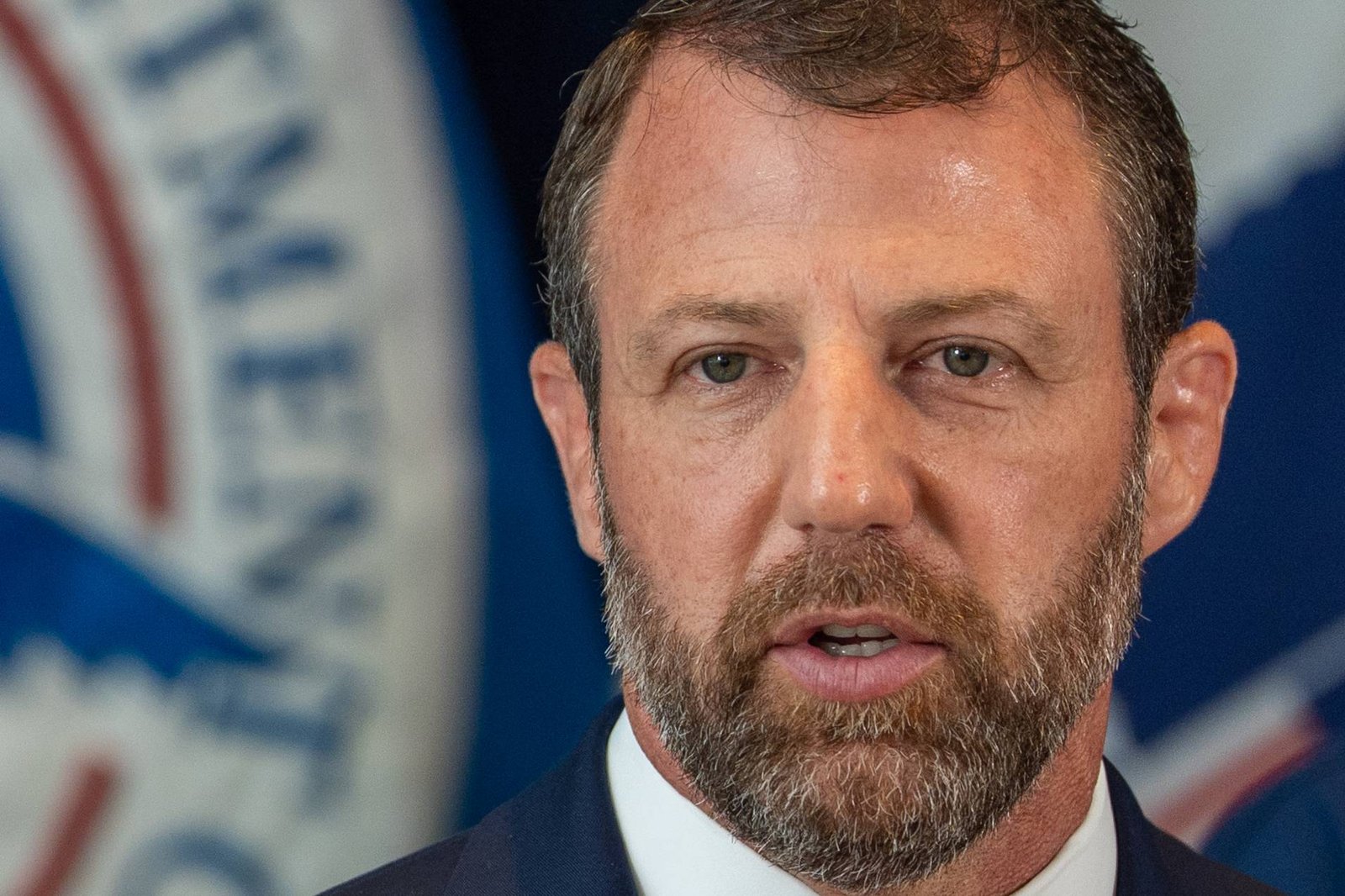
Homeland Security Secretary Markwayne Mullin defended plans for a leaner workforce at the Federal Emergency Management Agency and criticized a federal judge’s ruling that a now-abandoned plan to cut FEMA’s workforce in half was advanced unlawfully.
In remarks to reporters at a FEMA roundtable in Omaha, Neb., on Monday, Mullin argued that “it’s not always personnel that you need.” He said the Trump administration’s goal is “more efficiency,” including using technology at the emergency management agency.
“Throwing people at a problem that aren’t passionate about or not being an added value to it doesn’t help,” Mullin said. “For some reason, we’re constantly getting — not just with FEMA, but all across the federal agencies — they’re saying, you can’t let people go. You got to keep them there. When we know, being in the private industry like myself, usually in a large corporation, 20% of the people do the majority of the work, 80% of the people do their job.”
Mullin’s remarks come on the heels of U.S. District Judge Susan Illston’s ruling that DHS officials under former Homeland Security Secretary Kristi Noem unlawfully moved forward with plans to cut FEMA’s workforce by 50% late last year.
“When you’re in a disaster, you need 100% of people doing the majority of the work every single day,” Mullin said. “So when some federal judge tries to come in and tells us how many people we have to have on staff, yet they’re not in the building, they’re not running the agency, it’s laughable. Stay in your lane, deal with law, prosecute criminals, send them to prison, and rule from the bench.”
Illston found that DHS officials violated rules under the Post-Katrina Emergency Management Reform Act of 2006. The law protects FEMA from political decisions made at DHS headquarters. Illston found the evidence showed DHS officials overrode objections by FEMA supervisors to advance the plan for a 50% cut.
The lawsuit, brought forward by union groups, sought to block FEMA from issuing blanket non-renewals to Cadre of On-Call Response and Recovery, or CORE, employees. CORE staff make up about 40% of FEMA’s staff and typically work for terms lasting between two and four years.
The lawsuit argued the wave of CORE non-renewals late last year and early this year were the start of DHS and FEMA’s plan to implement the steep workforce cuts.
But FEMA quickly began renewing most CORE staff again following a major winter storm and did not ultimately move forward with the 50% cut. However, court declarations show that FEMA officials still require approval from DHS headquarters to renew CORE terms for up to six months.
“The undisputed evidence shows that defendants violated the Post-Katrina Act when DHS revoked FEMA’s authority to renew COREs (and then granted it back, but only for a limited time and for term lengths that DHS prescribed) and ordered that FEMA submit a staffing plan to DHS with a 50% FEMA staffing cut,” Illston wrote.
The ruling doesn’t restore broader staffing levels at FEMA, which saw thousands of employees depart under the Trump administration’s voluntary resignation programs.
In an August report, the Government Accountability Office found FEMA was down roughly 4,500 employees from the start of the Trump administration.
GAO found FEMA and DHS allowed the workforce reductions to take place without assessing its current and future workforce needs. The staff reductions and lack of planning “may impact mission readiness,” the report states.
Hamilton highlights tech investments
Meanwhile, Cameron Hamilton, the recently confirmed administrator of FEMA, highlighted how the agency is making technology investments that “will rapidly reduce the timeframes that we have to process claims that we have to some of the levers and tools.”
Speaking alongside Mullin in Omaha, Hamilton said FEMA is looking to “overhaul” its “entire IT footprint” to improve customer service and deal with requests “significantly faster.”
“You’re going to find that we can process things faster, and we’re ultimately able to push out at a faster pace with far less bureaucracy,” Hamilton said.
IT investments and customer service improvements are among the recommendations in the Trump-appointed FEMA Review Council’s final report.
The council had been planning to recommend FEMA also make steep staffing cuts when Noem was in charge of DHS, but the final report, issued in May after Mullin had been confirmed, only recommended that DHS and FEMA review its workforce requirements.
The council also recommended the Trump administration and Congress shift more responsibility to state and local governments to handle disaster response activities.
Mullin echoed that sentiment during his remarks in Omaha.
“You have other states that just sit there and wait until the federal government comes in,” Mullin said. “FEMA was never designed to be the first responder. It was there in your worst day to help the state, to help the local government recover, not take over and take charge of the situation. It’s always going to be better from that point. So when we’re doing this, we want to make sure we get it right.”
Copyright
© 2026 Federal News Network. All rights reserved. This website is not intended for users located within the European Economic Area.
