

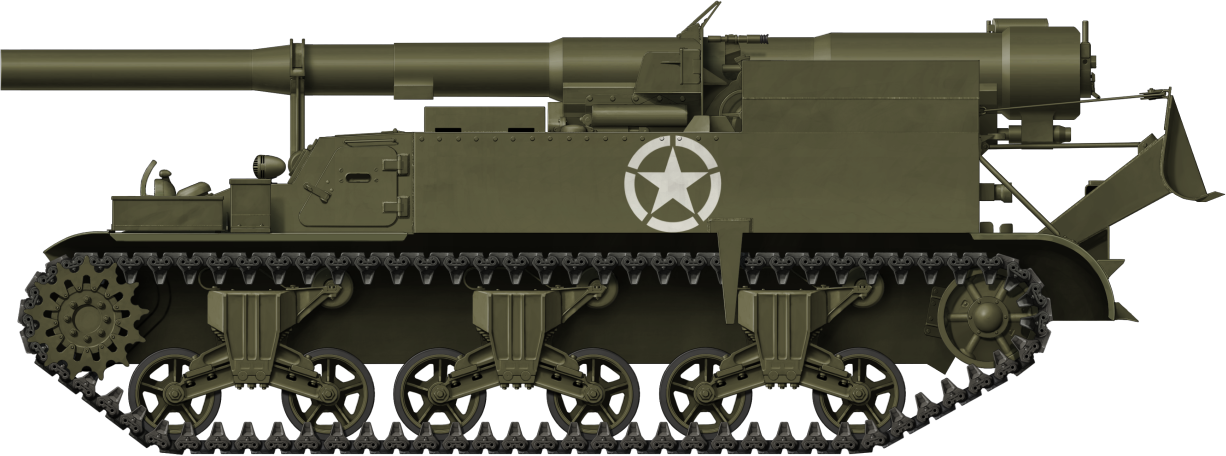
United States of America (1942-1945)
Gun Motor Carriage – 100 Built
As the Second World War progressed and the need for more mobile artillery became evident—particularly following Germany’s early successes in Europe—US military planners began to focus on developing self-propelled artillery. The Ordnance Department successfully mounted the 155 mm gun on the M3 Medium Tank’s chassis, creating the M12 Gun Motor Carriage (GMC). The M12 GMC offered superior mobility and reduced setup times compared to its towed counterparts, proving invaluable in breaking through fortifications, especially the Siegfried Line. Despite its limited production, the M12 GMC played a crucial role in several key battles in Europe and earned a reputation as a formidable bunker buster.

Image Source: warhistoryonline.com

Context
In the First World War, the standard field gun of the American Expeditionary Force (AEF) was the French Canon de 155 Grande Puissance Filloux (GPF) modèle 1917 (Canon de 155 mm GPF). This gun was the idea of the French Lieutenant-Colonel LJF Filloux, a French artillery pioneer, who presented the idea but was initially ignored as the French military thought the Canon de 75 modèle 1897 (‘the French 75 mm’) would be enough. It was accepted in 1916 because the French Army wanted a gun capable of firing at least 16,000 m, which could be towed at high speeds, and with a large traverse angle. The gun entered production in 1917 and first saw action in Flanders during August 1917.
When US troops arrived in France, they saw the effectiveness of the Canon de 155 mm GPF, so the US bought 48 Canon de 155 mm GPF, which were designated M1917. Later, a production license was acquired, but no guns were delivered until after the Armistice. US-manufactured guns were designated M1918. In June 1940, approximately 973 guns were still in service, making it the most common heavy artillery in the US arsenal.

Image Source: commons.wikimedia.org
There were several attempts to mount the M1917/M1918 155 mm gun on a self-propelled mount. During 1918, Rock Island Arsenal built a 155 mm SPG (Self-Propelled Gun) based on a Holt Manufacturing Companies chassis, then a Mark IX (M1921) in the early 1920s. This likely led to J. Walter Christie (the prolific Interwar designer who adapted his tanks to many roles and the inventor of the Christie suspension) to build four vehicles using their own chassis, which were modified in the 1920s. At least one was mounted on a vehicle using Christie’s characteristic convertible (meaning it could run on its road wheels without its tracks) design, which was designated the 155-mm Gun Motor Carriage, M1920. It resembled the future M12 GMC, except the gun pointed backward.

Image Source: yuripasholok.livejournal.com
Overall, there was not much will to modernize the 155 mm gun, either by placing it on a self-propelled mount or modernizing the gun itself. The guns were only modernized with pneumatic tires and air breaks in 1937. Even then, this effort did not start on a large scale until 1941, when the US was readying to enter a potential war.
Development
In June 1941, the Ordnance Department began studies to create a self-propelled mount for the 155 mm M1918 gun using the M3 Medium Tank’s chassis. Before this, self-propelled mounts were not in the doctrine because it was felt horses, tractors, or some combination could meet the artillery’s needs. However, this changed with the “lightning war” in Europe. After a discussion with the Artillery Branch, there was an agreement to build a pilot vehicle. Under Ordnance Council Minutes (OCM) 16912, this pilot vehicle was designated the 155mm Gun Motor Carriage T6. The pilot model consisted of an M3 Medium Tank chassis with an M1918M1 155 mm gun mounted using its top and bottom carriages.

Image Source: tankarchives.ca

Image Source: commons.wikimedia.org

Image Source: tankarchives.ca
The T6 pilot was constructed at Rock Island Arsenal (Illinois) and subsequently arrived for testing at Aberdeen Proving Ground (Maryland) on 12 February 1942. The prototype used a riveted hull, bogies, idler, sprocket, and engine, taken from the M3 Medium Tank. The top of the upper hull was likely assembled with hex bolts. The firing tests revealed the T6 to be a stable firing platform, but firing damaged the hydraulic spade, causing it not to raise. This was fixed by modifying the raising mechanism to be manual. However, even when fully-retracted, the spade limited the cross-country abilities of the T6. In addition, dust interfered with the traversing mechanism, necessitating a dust seal.

Image Source: the.shadock.free.fr

Image Source: 6030 – U.S. WWII & Korea Heavy Self-Propelled Artillery
After the problems were rectified, the T6 pilot was sent to the Field Artillery Board at Fort Bragg (North Carolina) for service tests. These revealed that the T6 was better than stationary guns at relocating six miles and setting up, at 35 minutes compared to three hours. On 17 July 1942, the Artillery Board recommended that, after the interior and stowage were modified, the T6 should be adopted into service, along with a similar ammunition carrier (this project was already in progress, designated the Cargo Carrier T14).
At an unknown date the T6 prototype was sent to the Pressed Steel Car Company to be turned into a prototype for the T14 Cargo Carrier. This has been deduced from the fact they share a registration number and other other small details.

Image Source: the.shadock.free.fr
The T6 was recommended for standardization as the 155mm Gun Motor Carriage M12 in OCM 18584 and 50 M12 GMCs were authorized to be procured. This was later increased to 100 on 10 August 1942. The modest number was likely due to the limited availability of 155 mm M1918 guns, some of which allegedly had to be removed from First World War memorials.
The first M12 GMC left the production line in September 1942 followed a month later by the first M30 Cargo Carrier. This first vehicle was then sent to the Erie Proving Ground (Ohio) to finalize the stowage arrangements, which were approved by the Field Artillery and Armored Boards, after which it was tested at Fort Bragg. The only additional modifications were to the vapor lock (to solve a problem inherent to the design), the flame arrester, and exhaust pipes. The final five M12 GMCs left the production line in March 1943.

Image Source: the.shadock.free.fr

Image Source: 9th Army Ord. Pictures of Artillery Proving Grounds
| M12 GMC production figures | |
|---|---|
| Month and year | Numbers produced |
| September 1942 | 1 |
| October 1942 | 37 |
| November 1942 | 12 |
| December 1942 | 10 |
| January 1943 | 16 |
| February 1943 | 19 |
| March 1943 | 5 |
| Total | 100 |
Design
From the front, the M12 GMC had the transmission cover, then the driver’s compartment, then there was a centrally located engine compartment (with the engine mounted at an angle), and then the open fighting compartment with the gun. On the front plate of the driver’s compartment was a headlight on either side with a tool between them, a ventilator in the center, with tools and storage on the mudguards.
The driver compartment had a centrally located transmission, with a seat in front of controls on either side of it for the driver and commander. On the driver’s side was a side hatch. There were also two hatches on the roof, and another pair of hatches with vision devices on the front plate.
The middle section had a vent for circulation, a set of tools, then dipped down slightly and allowed for a vent. The fighting compartment at the rear had an exhaust on each side, then the gun, a spade winch on the right side, ammunition storage (four shells to the right and six to the left) alongside which was a device for loading shells, a pair of seats behind the ammunition left stowage, then the spade on the edge of the chassis with three steps, and on either side of the spade on the fenders were foot holds.

Image Source: the.shadock.free.fr

Image Source: 6030 – US WWII & Korea Heavy Self-Propelled Artillery

Image Source: panzerserra.blogspot.com

Image Source: panzerserra.blogspot.com
The M12 GMC was 6.77 m (266.5 in) long, 2.67 m (105.3 in) wide, 2.88 m (113.5 in) high, with a tread of 2.11 m (83 in), and 43.2 cm (17 in) of ground clearance. It had a combat weight of 26.8 tonnes (59,000 lbs) and an unloaded weight of 25 tonnes (55,000 lbs). The ground pressure was 12.1 psi.
The M12 GMC’s armor was a combination of welded, rolled, and cast homogeneous steel, with the front transmission cover being bolted. The M12 GMC had a deep water fording set, which consisted of a box superstructure around the fighting compartment with exhaust extensions.

Image Source: iwm.org.uk
| M12 GMC armor layout | ||
|---|---|---|
| Area | Armor thickness | Angle (from vertical) |
| Upper front | 25.4 mm (1 in) | 30° |
| Lower front | 50.8 mm (2 in) | 0° to 46° |
| Upper side | 15.9 mm (0.625 in) | 0° |
| Lower side | 19.1 mm (0.75 in) | 0° |
| Rear | 19.1 mm (0.75 in) | 0° |
| Top | 25.4 mm (0.5 in) | 90° |
| Floor | 25.4 mm (0.5 in) | 90° |
| Gun shield | 19.1 mm (0.75 in) | 0° |
Engine, Drivetrain, and Suspension
The M12 GMC used a 350 hp Continental R975-C1, 9-cylinder, air-cooled, 4-cycle radial gasoline engine which was originally an aircraft engine. This sent power through a synchromesh transmission with controlled differential steering brake assemblies, with five speeds forward and one in reverse. The vehicle held 909 l (200 gals) of 80-octane gasoline. The maximum speed the M12 GMC could reach was 38 km/h (24 mph) for short periods, the highest sustained speed was 34 km/h (21 mph), with a cruising range of 225 km (140 mi). Fire protection was provided by two fixed 4.54 kg (10 lbs) and two portable 1.81 kg (4 lbs) carbon dioxide (CO2) fire extinguishers. The engine was accessed through a hatch in the center of the vehicle or a pair of inspection hatches on the rear bulkhead. The fuel tanks were located in the sponsons beside the engine. The exhaust was piped out between the center and rear bogies.

Image Source: TM 9-1725 Ordnance Engine Model R975-C4 Continental 1944
The M12 GMC used the Vertical Volute Suspension System (VVSS). The VVSS used a thirteen-tooth front drive sprocket, three bogie assemblies, and an idler wheel (paired with a skid on later models). The initial production type had an symmetrical skid and the retrofitted bodies had an asymmetrical skid.

Image Source: TM 9-731A Technical Manual Medium Tanks M4 and M4A1 and TM9-1750K. Trucks and Suspension, Turret and Hull For Medium Tank M4 and Modifications
The main tracks were T48, T49, T51, and T54E1. The core structure was made of steel with two pins to hold the teeth and a steel or rubber face. The M12 GMC used 158 track links (79 on each side) with a ground contact length of 3.7 m (147 in) The steepest gradient a tank with VVSS could climb was 60%, the longest trench it could cross was 2.29 m (7.5 ft), the minimum turning diameter was 18.9 m (62 ft), and the largest vertical obstacle it could climb was 61 cm (24 in).

Images Source: the.shadock.free.frl
Armament
The M12 GMC was armed with either the M1917, M1917A1, or M1918M1 (most likely the M1918M1, as this was the main variant in the US arsenal) 155 mm artillery gun. The M1917 gun was the original example acquired from the French, while the M1918M1 was manufactured by the US and used a new breech ring. This breech ring was also applied to the M1917 to make the M1917A1. The guns had an overall length of 6 m (238 in) and a weight of 3.95 tonnes (8,715 lbs). The left side of the gun was later remanufactured to include a gun shield.

Image Source: commons.wikimedia.org
The gun used an M4 mount, allowing a traverse of 28° (14° to either side) and elevation of -5° to 30°. It was aimed directly using an M53 Telescope and indirectly aimed using an M6 Panoramic Telescope and an M1918A1 sight quadrant. The mount held the gun on two trunnions so it could elevate and was mounted on a turning plate to allow it to traverse. The traversing wheel was on the rear to the left, with the elevation wheel behind the shield below the gun sight.
The M12 GMC’s gun used separate loading for ammunition, meaning the projectile and propellant were separate. This allowed the individual segments to be lighter. The M12 GMC could carry 10 rounds, and had a fire rate of four rounds per minute, with a maximum powder pressure of 31,500 psi. Four shells were placed to the right of the fighting compartment and six to the left , with the propellant charges placed under the gun. The accompanying M30 ammunition vehicle would carry 40 rounds.
The main shells the M12 GMC fired were: the M112B1 (armor-piercing (AP), armor-piercing ballistic capped (APBC), or high-explosive (HE)), M101 (high-explosive), and M104 (white phosphorus). Other rounds the M12 GMC could also fire included the: Mk I (drill dummy), Mk IIIA1 (persistent gas or HE), Mk IIIA1 Mod I (gas), Mk VII (gas and smoke or persistent gas), target practice shell (loaded with sand), M7 (drill dummy), M015 (smoke), and M115 smoke). However, the guns could also fire German 155 mm ammunition.

Image Source: TM 9-1901 Artillery Ammunition, 1944
| M12 GMC main ammunition rounds | |||
| Shell (with maximum charge) | Weight | Muzzle velocity | Maximum Possible Range |
|---|---|---|---|
| AP M112B1 | 75 kg (124.75 lbs) | 719 m/s (2,360 ft/s) | 17.6 km (19,200 yds) |
| HE M101 | 54.2 kg (119.48 lbs) | 735 m/s (2,410 ft/s) | 18.4 km (20,100 yds) |
| WP M104 | 55.8 kg (122.96 lbs) | 735 m/s (2,410 ft/s) | 18.5 km (20,247 yds) |

Image Source: flickr.com
Crew
The M12 GMC had six crew members: driver, commander, and four gun crew. Another six crew members were in its accompanying M30. The driver and commander travelled in the driver’s compartment at the front, while the gun crew travelled in the fighting compartment — two on the left-side seats and the other two sitting on the spade (although it is possible that, at least some of the time, the gun crew travelled in another vehicle).The M12 GMC had provisions for five 7.63 (0.3 in) M1 carbines with an M8 rifle grenade launcher (with eight grenades) and 12 hand grenades. When loading the gun, two crew members would use a holder to load the warhead, this would then be pushed in using a stick with a hollow semicircle by two crew members, another crew member loaded the propellant, and the breech was closed by another crew member, and finally, a rope was attached to trigger the gun when pulled.

Image Source: commons.wikimedia.org
Variants
Cargo Carrier M30
The Cargo Carrier M30 was developed to carry ammunition for the M12 GMC because there was little space left on board for shells. The M30 Cargo Carrier shared the same rough design as the M12 GMC but without the gun and with an added machine gun ring with an M2 12.7 mm machine gun. The M30 Cargo Carrier carried 40 rounds (with the propellant) and had three crew members. To house the ammunition, the sides of the open rear area were built up, and the spade was replaced with a tailgate. Overall, 100 M30s were produced on the M3 chassis, and 74 were modernized and deployed with the M12s.

Image Source: commons.wikimedia.org

Image Source: 6030 – US WWII & Korea Heavy Self-Propelled Artillery

Image Source: panzerserra.blogspot.com
T6 240 mm Howitzer
After the T6 pilot was tested, a feasibility study was started at the Franklin Institute (Philadelphia) to mount a 240 mm howitzer on the T6, and in October 1942, drawings were available for an M1918 240 mm howitzer mounted on a modified T6 chassis. The bogies were moved toward the rear but the spacing remained the same, with a larger trailing idler added. This increased the ground contact length and reduced ground pressure. To fire the gun, the vehicle would couple to the ammunition carrier to distribute the recoil. As a result, only the ammunition carrier had a spade. The rear bogie of the GMC would be placed over the buried spade, which meant that the gun was loaded from the cargo carrier. This was deemed overly complicated. The design did not progress further than a scale model.

Image Source: Sherman – A History of the American Medium Tank
Service
Six Field Artillery Battalions were organized to use the M12 GMC around spring 1943. In 1943, the Headquarters of the Army Ground Forces believed 100 M12 GMCs would meet the established requirements but showed little interest in using them. They stored or solely used them for training. The training and testing revealed that more design changes were needed. In late 1943, officers of the SHAEF (Supreme Headquarters of the Allied Expeditionary Force), in the Armored Fighting Vehicle and Weapons Section (AFV&W section) in England, considered the M12 GMC as a potential bunker buster to counter the Siegfried Line. This led to plans to modernize and deploy the M12 GMC to Europe.
The process of organizing and equipping six Field Artillery Battalions (FAB) with M12s began in spring 1943 and finished in summer 1943, with M12s being received from March 1943 to June 1943. Each FAB had 12 M12 and accompanying M30s, suggesting 72 were issued. Most sources state the FABs equipped with the M12 GMC were the 557th, 558th, 981st, 987th, 989th, and 991st Field Artillery Battalions, but The Shaddock website, which heavily employs primary sources and images, states the units with the M12s were the 174th, 258th, 557th, 558th, 987th, and 991st Field Artillery Battalions while providing information on their service.
Modernization and Deployment
In December 1943, during the build-up to D-Day, modifications were proposed, and in February 1944, Baldwin Locomotive Works began modernizing and remanufacturing them, which continued until May 1944. During this, a gun shield was added to the gun mount, and the commander side hatch on the right was removed. A total of 74 M12 GMCs were modernized and remanufactured, in addition to 74 M30 Cargo Carriers to carry ammunition for the M12 GMCs.
On 30 January 1944, a party including General Jacob L. Devers and other Generals assembled to watch an M12 GMC fire from an LCT-5 in Morte Bay, Devon, England. This was part of firing trials involving various weapons, although it was likely a display of the M12’s power in advance of the invasion of Europe. After this, in early 1944, the six M12 battalions were ordered to deploy to the UK.

Image Source: the.shadock.free.fr

Image Source: 6030 – US WWII & Korea Heavy Self-Propelled Artillery
Image Source: warhistoryonline.com
Units
The M12 GMC was deployed starting from the invasion of France on 7 June 1944 in six units: the M12 GMCs were issued, unusually, in small units of a battery or less across the whole front. These FABs took part in the initial landings and fighting on the beachheads and participated in the breakthrough, then continued to advance across France and into Germany.
174th FAB
The 174th Field Artillery Battalion was activated in February 1943 in Camp Bowie (Texas), receiving their M12s in June 1943. They left the camp for the UK on 17 February 1944 and arrived on 11 March 1944, where they were stationed in Cwrt-Y-Gollen (Wales). There, they joined the 258th and 991st Battalions which had formed the 258th Field Artillery Group. Around 17 June 1944, the 174th FAB received and calibrated the guns at Sennybridge Range (Wales). The 174th arrived at Omaha Beach from 1 to 2 July 1944 with their first engagement on 4 July 1944, firing in unison with “all” the guns in Normandy as a celebration of American Independence Day. During July the 174th fired 262 missions which used 3,519 rounds. On 1 August 1944, attached to the 6th Armored Division, the 174th FAB broke out of Normandy and advanced to Brest. This was a vital target because it had a port which would serve Allied logistics. While supporting VIII Corps, 174th FAB fought to capture Brest from 6 August 1944 until its surrender on 18 September 1944. It would go on to serve in Europe until the end of the war.

Image Source: the.shadock.free.fr

Image Source:
258th FAB
The 258th Field Artillery Regiment was inducted into Federal Service in February 1941. They trained with 155 mm guns at Pine Camp (now Fort Drum, New York state) until they reconfigured with M12s as the 258th Field Artillery Group, composed of the 258th and 991st Field Artillery Regiment. They were later deployed to the UK and the Cwrt-y-Gollen, which housed the 174th, 258th, and 991st FABs. The 258th was not fully equipped before 18 June 1944. The 258th was ready for action on 17 June 1944 and landed on Utah Beach on 1 to 2 July 1944 and advanced to Saint Come-du-Mont with the first fire mission on 3 July.

Image Source: flickr.com
.

577th FAB
The 577th Field Artillery Battalion was inducted into Federal service on 15 May 1943 at Camp Gruber (Oklahoma) and received M12s by the end of May 1943, which suffered from weather damage. Training lasted almost 14 months, and the 557th FAB reached the UK in July 1944. They arrived without vehicles, and it took until 6 August 1944 to be fully equipped; however, during calibration at Camp Denny bridge, one M12 from C Battery was lost to a fire while refuelling. On 13 August 1944, the 577th FAB landed at Utah Beach, assigned to VIII Corps. It joined the 174th FAB in attacking Brest and capturing its port, were it saw its first combat on 23 August 1944 at Questel near Brest.

Image Source: reddit.com

Image Source: panzerserra.blogspot.com
558th FAB
The 558th Field Artillery Battalion was created on 10 May 1943 and trained for 13 months at Camp Roberts (California), likely with M12 from almost its beginning. On 13 July 1944, the 558th FAB arrived in Britain, possibly without their M12s or M30s.

Image Source: panzerserra.blogspot.com
978th FAB
The 978th Field Artillery Battalion activated in February 1943 at Camp Bowie, Texas, originally with towed 155 mm guns, but this was changed to M12 GMCs in June 1943. They set out for Britain on 17 February 1944 with their arrival on 22 March 1943. They were moved by rail to Camp Bulwark (Chepstow, South Wales) for three weeks before moving to Clacton-on-Sea (Essex, England). On 2 May 1944, they received their M12 GMCs which they waterproofed in preparation for D-Day. For D-Day the 978th was under British command and supposed to land on D-Day +12 hours but this was delayed by rough seas and instead landed on 7 June 1944 at Gold Beach attached to the 50th (Northumbrian) Division with troops coming ashore for the next few days. This was the combat debut of the M12 GMC. The 987th would support the British in their efforts to capture the city of Caen. On 30 June 1944 the 987th was detached from UK command and attached to V Corps First Army and served with the US into Germany until the end of the War.

Image Source: commons.wikimedia.org

Image Source: commons.wikimedia.org

Image Source: the.shadock.free.fr

Image Source: worldwarphotos.info
991st FAB
The 991st Field Artillery Battalion was created on 18 February 1943. They followed the 258th FAB to Cwrt-y-Gollen in Britain. They handed their equipment over to a higher priority unit which they received replacements for by 18 June 1944 and the battalion was ready to fight on 18 Jun 1944. After departing on LSTs on 10 July 1944 and landing on 11 July 1944 they progressed to Colleville-sur-Mer.

Image Source: commons.wikimedia.org
General Notes on Action
The speed of the M12 GMC, around 34 km/h (21.1 mph), resulted in it often being the only heavy artillery available close to the frontline, and it proved to be an efficient and popular weapon. When they reached the bunkers and pillboxes of the formidable Siegfried Line (Westwall), the M12 GMCs proved capable of destroying these from 1.83 km (1.14 mi) away. The M12 GMC was particularly effective at bunker busting, possibly because the shells could penetrate 2.1 m (7 ft) into reinforced concrete (when using a concrete piercing fuse).
In the fighting in the north of Aachen in early October 1944, some M12 GMC were assigned to XIX Corps. These were part of a campaign to demolish Westwall bunkers to allow for an offensive action to be undertaken. The M12 GMC even had to get to within a few hundred meters to destroy the bunkers. In late October 1944, the final stages of the siege of Aachen brought an unlucky M12 GMC into the city to act like a siege weapon to destroy a commander’s hiding place, which led to the surrender of the commander. This was described in The Guns at Last Light The War In Western Europe, 1944–1945 by Rick Atkinson:
“On a single day in Aachen [(City in Westphalia, Germany)], M-12s fired sixty-four rounds almost point-blank to demolish nine buildings, including a movie theater occupied by a company of enemy riflemen, every one of whom was killed or wounded.”
“As 2nd Battalion edged closer to the rubble that once was the town hall, with its proud façade of German rulers, an M-12 clanked onto Wilhelmstrasse; there a tank destroyer fired sixteen rounds to bore a hole through a house wall. The 155mm gun then used the firing loophole to throw seven rounds down Hindenburgstrasse into the State Theater, five blocks away. German troops in the stronghold pelted west toward the cathedral.”

Image Source: x.com
This success led to the M12 GMC continuing to be employed in cities for the rest of the war. This likely shows the power of the 155 mm gun compared to the other weapons mounted on vehicles at the time, especially considering the vulnerability of the crew in the rear of the vehicle to fire or shrapnel.
Italy
On 7 November 1944, a message from “COM Zone Signed Eisenhower” for 6th Army Group, reference number EX-61205 stated:
13 of subject item [M12 GMC] were diverted from ETO to NAPLES for operation “ANVIL”.
12 are believed to have arrived on UGS 47 and NH-420.
1 believed to have been loaded in a later convoy.
12th Army Group this Theater has decided available substitutes for the M12 are unsuitable. M12’s must, therefore, be kept in action.
Can the 13 weapons diverted to katousa be returned to ETO and if so when can they be loaded?
On 10 November 1944, a message from “Sixth Army GP SGD Devers” passed to “SHAEF main for info”, reference number EX-19480, stated only 2 M12 GMCs and “3 cargo carriers” were diverted, 6 with troops and 6 due to arrive at Marseille in Southern France. There were “no other guns of this type in Sixth Army Group” and they were needed for planned operations with ad-hoc crews which were hastily trained. It was then requested if the vehicles were to be used for maintenance, it was:
requested that they be replaced by assigning 1 of the 6 organised 155mm gun, self-propelled battalions to Sixth Army Group, from elsewhere in ETOUSA.
In event it is decided to assign a FA bn (155mm gun self-propelled) to Sixth Army Group in return for the 12 guns as maintenance, it is suggested that to save transportation the Bn to be transferred turn in 10 of its guns and 3 of its carriers in Sixth Army Group area. The 2 guns then remaining in Sixth Army group area would be the proportionate part of the spare guns for the maintenance of the 1 Bn in Sixth Army Group.
On 11 November 1944, a message from “COM zone from Eisenhower” to “SHAEF” reference number E-62543 stated:
Twelfth Army Group has 6 organised battalions (72 guns): Sixth Army Group has no organized battalions, but does have 6 guns in hands of troops with improvised crews plus 6 more guns (total 12 diverted from European Theatre of Operations for ANVIL due to arrive from ITALY. Arrival date unknown … Have only 7 in European of Operation stocks to meet battle losses.
Twelfth Army Group has stated all 6 battalions must remain operational. Sixth Army Group states urgent request for their 12 guns which are only material this type in that Group for operations already planned. No more available or being produced.
To provide both Groups with organized units having material the type plus replacements for battle losses, propose to transfer 1 battalion less 10 guns (which would be retained by Group to support loss replacements for 5 remaining battalions) from Twelfth Army Group to Sixth Army Group. This action would provide:-
- Twelfth Army Group with 5 equipped battalions and 16-⅔% spare M12’s.
- Sixth Army Group with 1 battalion and 16-⅔% spare M12’s.
- European Theater of Operations reserve of 7 M12’s.
Request your concurrence or comment this plan versus requirements for these units, as indicated by planned operations for Sixth and Twelfth Army Groups.
On 23 November 1944, a message from “SHAEF MAIN, signed SCAEF” to zone” reference number S-67963 stated:
Plan proposed in your E-62543 of 11 November is not concurred in. It is desired to retain total resources of for operational 155 gun (SP) M-12 Battalions in 12th Army Group [unintelligible] withdraw from Sixth Army Group to be added to your replacement stocks 4 of the 5 additional guns due to arrive from ITALY. The 8 guns then remaining with Sixth Army Group will be left there, subject to recall later when required as spares for the 6 authorised battalions.
These messages suggest that at least 91 M12s were issued to Europe, and on 21 June 1945, stated 98 M12s and 97 M30s were issued overseas.
In February 1945, one 155 mm Gun Motor Carriage T83 (Pilot 3) and an 8 in Howitzer Motor Carriage T89 pilot was issued to the 991st FAB as part of Zebra Mission. Zebra Mission was an initiative led by General Gladeon M. Barnes (Chief of Research and Development for the Ordnance Department) to evaluate new weapons under field conditions and in combat. These served alongside the units M12s, and first fought in the Battle for Cologne in March 1945.

Image Source: pinterest.co.uk

Image Source: old-forum.warthunder.com
Aftermath
When the war in Europe ended, the M12 GMC (and M30) were declared limited standard (equipment which met some standards but not all, although enough to be issued to combat units) in May 1945 and obsolete in August 1945, and almost all were scrapped. The demand for more 155 mm GMCs resulted in the T83 GMC which was standardized as the M40 GMC, armed with the 155 mm M1 gun in 1944 (and later the T89 HMC as the 203 mm Howitzer Motor Carriage M43), some prototypes of which were deployed alongside the M12 GMC in March 1945 during the Battle for Cologne. They would fully replace them in 1945 after the M12 GMCs were scrapped.
The replacement of the M12 GMC had been started during the war, when the existing M1917 and M1918 guns ran out, leaving only the 155 mm M1, which was too powerful for the base M3 Medium Tank’s chassis. As a result, the vehicle was based on a wider hull M4 Sherman using the Horizontal Volute Suspension System (HVSS).

Image Source: commons.wikimedia.org
French Service
Unlike other US vehicles, perhaps due to its low production numbers, the M12 GMC was not widely exported to allied nations. Nonetheless, some temporarily saw their way into French service. From 11 to 19 January 1945, the US Army lent a pair of M12 GMCs to the 3e Batterie, 3e Régiment d’Artillerie Coloniale, of the 2e Division Blindée (3rd Battery, 3rd Colonial Artillery Regiment, 2nd Armored Division), which were named “Pluto” and “Donald”, presumably after the well-known and loved Disney characters.

Image Source: 2db.forumactif.com
Surviving Vehicle

Image Source: the.shadock.free.fr
Conclusion
The 155 mm Gun Motor Carriage M12 represented a crucial evolution in US artillery, combining the heavy firepower of First World War-era guns with the mobility required for the fast-paced warfare of the Second World War. Initially met with limited interest, the M12 GMC eventually proved its worth during the Allied liberation of Europe, where it played a key role in demolishing fortified positions like the Siegfried Line. Its speed and firepower made it an invaluable asset in both offensive and defensive operations.


| |
| Dimensions (L/w/h, without gun) | 6.77 m (266.5 in) long 2.67 m (105.3 in) wide 2.88 m (113.5 in) high |
| Total weight, battle-ready | 25 tonnes (55,000 lbs) |
| Crew | 6 (driver, commander, and four gun crew) |
| Engine | 350 hp Continental R975-C1 |
| Suspension | VVSS |
| Top speed | 38 km/h (24 mph) |
| Range (road) | 225 km (140 mi) |
| Armament | 155 mm (6.1 in) |
| Armor | 15.9 mm (0.625 in) to 50.8 mm (2 in) |
| Total production | 100 |
Sources
TM 9-1901 ARTILLERY AMMUNITION, WAR DEPARTMENT, 29 June 1944, pages 187 to 202
Unknown, Official Munitions Production of the United States, by Months, July 1, 1940 – August 31, 1945, War Production Board and Civilian Production Administration, 1 May 1947, page 231
RP Hunnicutt, Sherman, A History of the American Medium Tank, Presidio Press, Novato, 1994, pages 340-353, 482, 543, and 569
Jim Mesko, US Self-Propelled Guns in Action, Squadron, Signal Publications, 1999, page 33
Steven J Zaloga, Armored Thunderbolt The U.S. Army Sherman in World War II, Stackpole Books, Pennsylvania, 2008
Michael Franz, 6030 – US WWII Korea Heavy Self-propelled artillery, Tankograd, Erlangen, 2013, page 2 to 19
Steven J Zaloga, US Field Artillery of World War II, Osprey Publishing, New York, 2007, page 20
Pierre-Olivier Buan, Joe DeMarco, and Leife Hulbert, M12 Gun Motor Carriages, publishing dat unknown, viewed 8 Febuary 2026
Soldat Ryan, Surviving M12, M40 and M43 Gun Motor Carriages, the.shadock.free.fr, 14 November 2023
Unknown (posted by WarGamesComedy), M-12 155mm Self-Propelled Artillery, unknown
Unknown, 1941 M 12 GMC 155mm, chars-francais.net, 17 October 2024
Unknown, Canon de 155 long GPF, landships.info/landships/artillery_articles/Canon_155_GPF.html, 16 December 2024
