


Indo-Pacific nations are confronting the most complex set of security challenges since the Cold War.
Competition between great powers, the proliferation of advanced battlefield technology, and historic levels of instability around the globe create a labyrinth for militaries and civil authorities who live and operate in the region.
Recent conflicts in the Middle East and in Europe have clearly demonstrated the threat posed by both low-cost, low-speed drones and the damage that can be unleashed by sophisticated long-range missiles. Indo-Pacific nations must prepare to confront the new security landscape with effective and versatile solutions.
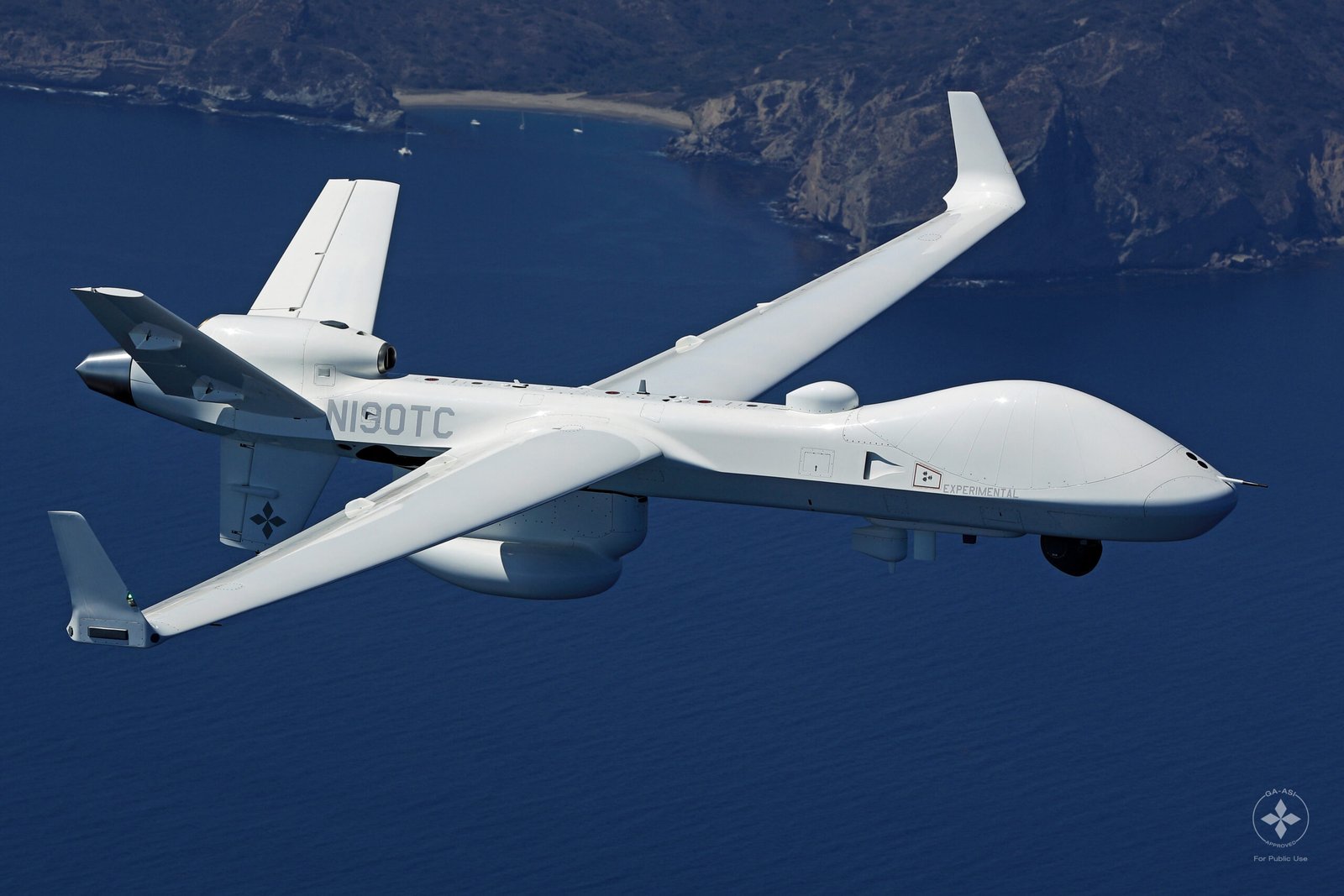
MQ-9B SkyGuardian® and SeaGuardian® aircraft, designed and built by General Atomics Aeronautical Systems, Inc. (GA-ASI), are the latest additions to the MQ-9 family of systems. Its operational pedigree is unmatched: No large uncrewed aerial system (UAS) has demonstrated its effectiveness in more roles and in more theaters than the MQ-9.
It is a proven asset in both permissive environments and highly contested wartime conditions.
MQ-9B goes beyond traditional data collection associated with intelligence, surveillance, and reconnaissance (ISR) UAS – it delivers effects across all domains. And recent upgrades have made the aircraft even more relevant to the Indo-Pacific theater.
In 2026, GA-ASI is rolling out an Airborne Early Warning and Control (AEW&C) mission package, adding an Advanced Precision Kill Weapon System (APKWS) to the MQ-9B’s arsenal, and integrating long-range weapons to increase the aircraft’s standoff strike capability.
Advancing Airborne Early Warning in the Indo-Pacific

GA-ASI’s MQ-9B AEW&C mission package has been developed in partnership with Saab and is poised to transform how nations in the Indo-Pacific monitor and respond to aerial threats. It enables users to detect, classify, and counter threats before they reach their targets.
This innovative capability both complements and extends the reach of traditional crewed systems. For instance, the MQ-9B AEW&C might be used to penetrate airspace deemed too dangerous to risk a large, exquisite system, not to mention the irreplaceable lives of the crew.
The mission package can also be used as an organic AEW capability if crewed platforms are not available, providing persistent, lower-cost early warning coverage over vast maritime and land domains. When needed, MQ-9B will provide long-endurance surveillance of critical infrastructure, maritime chokepoints, and contested airspace.
This capability is particularly relevant in a region where the need for robust surveillance is paramount, given the increasing prevalence of stealthy cruise missiles, high-speed aircraft, and coordinated drone swarms.
A Long-Endurance Solution to the Drone Swarm Threat
The rise of drone swarms as a tactic in modern warfare has highlighted the importance of long-endurance platforms capable of sustained operations. The MQ-9B, with its industry-leading endurance, is uniquely suited to counter this emerging threat.

Recent demonstrations of the APKWS on the MQ-9 underscore its ability to engage multiple targets with precision and efficiency.
MQ-9B’s ability to remain airborne for extended periods ensures that it can provide persistent coverage, ready to take decisive action against a drone swarm attack whenever it strikes.
This staying power, combined with the precision of the APKWS, offers a critical advantage in defending against saturation attacks.
By integrating this capability, the MQ-9B positions itself as a vital asset for Indo-Pacific nations seeking to bolster their defence against unconventional threats.
Extending Reach With Long-Range Weapons Integration
While having the means to shoot down threats in flight is necessary, an even better solution is to strike a target before it can fire salvos.
That’s why in addition to its AEW&C and APKWS capabilities, GA-ASI has announced it is integrating MQ-9B with long-range weapons, such as Kongsberg’s Joint Strike Missile and Lockheed Martin’s Long Range Anti-Ship Missile.
This upgrade enables the MQ-9B to deliver precision strikes over greater distances, providing a strategic advantage in the vast expanse of the Indo-Pacific region.
Whether addressing threats in contested maritime zones or supporting ground operations, the MQ-9B’s ability to operate at extended ranges ensures that it remains a versatile and reliable asset.
The integration of long-range weapons also enhances the MQ-9B’s deterrence capabilities, allowing Indo-Pacific nations to project power and protect their interests effectively.
A Trusted Partner for Indo-Pacific Nations
MQ-9B delivers long-range, persistent ISR that goes beyond collection alone, delivering effects wherever and whenever they are needed across all domains.
With its interoperability with U.S. and allied forces, the MQ-9B is well-suited to support joint operations and strengthen regional security partnerships. Nations as far spread as Japan and Canada, India and Germany, the United Kingdom and Qatar have all kicked off acquisition programs, highlighting its broad utility in a wide range of operational environments.
MQ-9B’s adaptability to diverse mission sets, from ISR to precision strike and maritime domain awareness, ensures that it can meet the unique needs of each nation.
Moreover, the aircraft’s cost-effectiveness and scalability make it an attractive option for nations looking to maximize their defence budgets without compromising on capability.
By investing in MQ-9B, Indo-Pacific nations can enhance their security posture while contributing to a more stable and secure region.
