

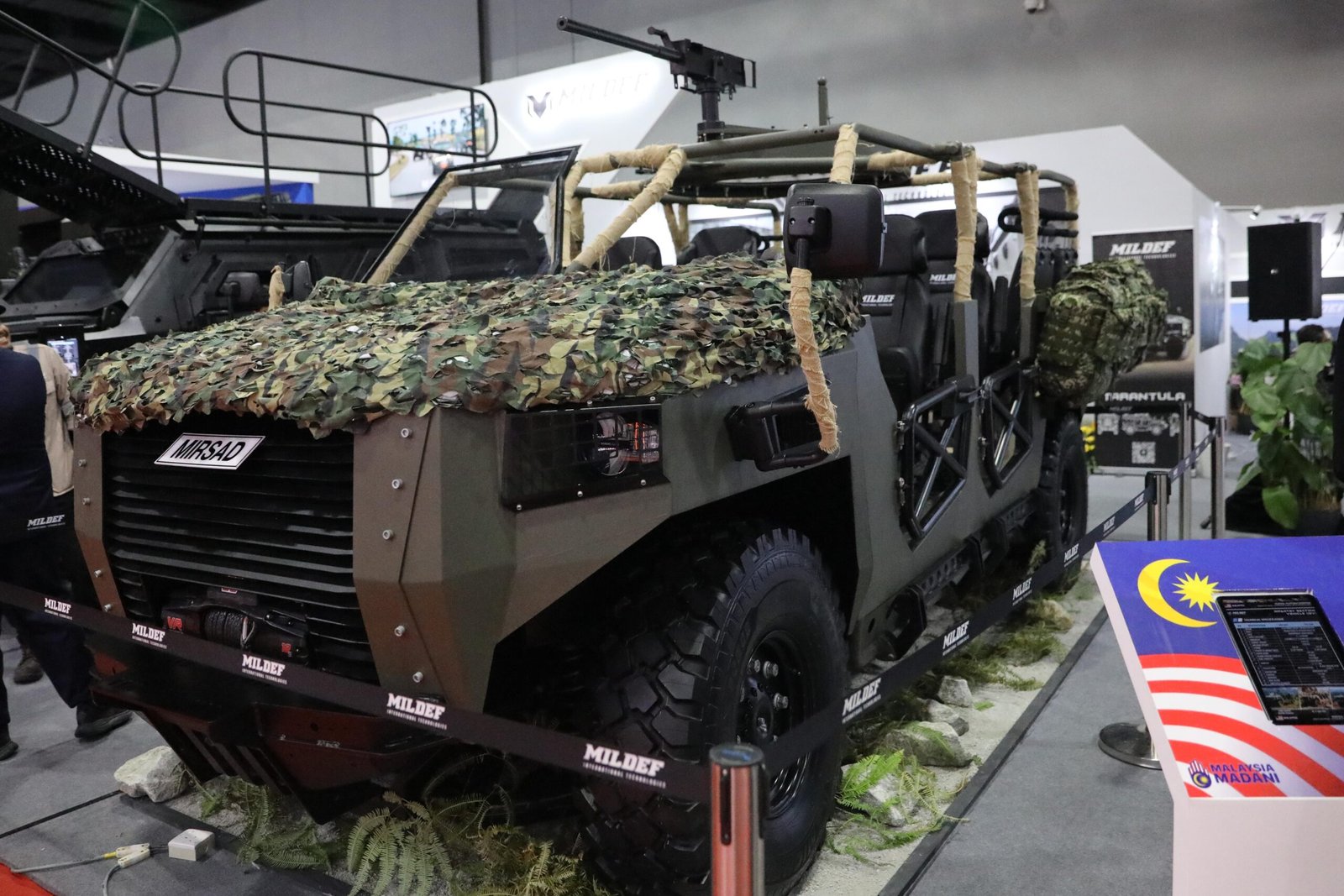
During the DSA 2026 exhibition in Kuala Lumpur, held from 20-23 April, three Malaysian companies displayed 4×4 light tactical vehicles to meet potential Malaysian military and security requirements.
Cendana Auto and Mildef hope to provide infantry section vehicles (ISV) to the Malaysian Army, whilst Weststar is targeting potential requirements for vehicles to conduct border patrols.
Two years ago, at DSA 2024, Cendana unveiled its Vextor 4×4, a four-person tactical vehicle to meet the requirements for both Malaysian Army reconnaissance and infantry section transport. The Malaysian Army indicated it was looking for a single 4×4 type to serve both roles in standard infantry battalions, with two vehicles assigned to each eight-man section.
Malaysian infantry battalions currently do not have tactical vehicles assigned to their infantry sections, leading to a disconnect in mobility between them and the rest of the battalion, which includes mortar and support weapon elements that have their own dedicated vehicles. Instead, infantry only have trucks from the battalion’s transport section, and these are not suited for tactical movement.
However, the Malaysian Army, according to industry sources, revised the concept due to an assessment that while two vehicles assigned to a section would provide tactical flexibility, the section size in turn would be reduced when dismounted. This is because each driver would have to remain with the vehicle, plus the number of such vehicles per battalion would amount to 70+ once rifle platoon and company command elements are factored in.
Furthermore, maintenance and logistics requirements would increase substantially, along with overall costs to the Malaysian Army to equip its infantry battalions.
The army has since moved the reconnaissance vehicle requirement to a separate programme that was tendered in 2024, calling for 100 vehicles to be supplied. That tender was won by Malaysian company High Point Worldwide, which was awarded a letter of acceptance in late 2025.
No details have been released as to what the vehicle type is. Nonetheless, it is an imported vehicle, since High Point Worldwide does not manufacture a vehicle of its own.
The ISV is now a single vehicle able to carry a section, although the ISV requirement has not been formalised into a procurement tender.
At DSA 2026, both Cendana Auto and Mildef displayed their entries to meet the ISV requirement when it materialises into a formal programme.

Cendana’s offering is its Vex-9 multirole operation vehicle with a capacity of nine personnel, a 1-tonne payload capacity, integral smoke grenade launchers and a top-mounted general-purpose machine gun that can be replaced with other weapons if required.
The nine-personnel capacity allows the addition of a dedicated driver and a full eight-man section to operate dismounted from the vehicle.
Cendana officials told Asian Military Review that, as of 2025, the company had supplied 382 vehicles of various types to the Malaysian Army, and it is set to deliver 18 mortar carriers and four Starstreak missile carriers this year.
Additionally, 16 Light Support Vehicles (LSV), based on Cendana’s Artac weapons carrier, are to be delivered to Brunei this year. This represents the company’s first export order. Cendana is seeking to add to this after it signed a letter of agreement with Nafisa Enterprise from Bangladesh at DSA 2026. The agreement covers collaboration in the development of LSV production in Bangladesh.
Cendana is also supplying the vehicle to Malaysian company AMP Corp for its prototype Mobile Surveillance Unit Mk 3, which is intended for the Malaysian Maritime Enforcement Agency. The company’s production rate is a maximum of 15-20 vehicles a month, subject to orders and supply chain availability of components.
Meanwhile, Mildef’s entry for the ISV requirement is a modified version of its Ribat high-mobility light tactical vehicle. The Ribat was originally targeted at the Malaysian Battalion assigned to UNIFIL, with a tender for 50 vehicles issued in April 2025.
However, the UN’s decision in August 2025 to end UNIFIL in December 2026 resulted in that tender being cancelled. Nonetheless, Mildef was awarded a contract in 2026, following a letter of intent in 2025, for the supply of 136 Tarantula high-mobility armoured vehicles, with deliveries to begin next year.
Mildef’s ISV carries a maximum of eight personnel and comes in two variants: the unarmoured ISV 200, and the ISV 250 that is armoured to blast protection Level 1, and which correspondingly carries a higher-horsepower engine to compensate for the weight of the armour.
Mildef officials told AMR that the vehicle, based on the Ribat, can be modified further according to any Malaysian Army requirements that may emerge, such as additional armour protection. Mildef is also supplying 16 identical vehicles to Brunei, and is targeting the Philippines and Bangladesh as future export customers too, according to company officials.

Finally, Weststar is targeting the border security sector with its GK-M2 Rapid Border Patrol Vehicle. This 4×4 vehicle can accommodate four personnel, and it has a weapons mount on its roof able to support a variety of crew-served weapons, including antitank guided weapons, should it be used for missions other than border patrols.
Its payload is the standard 1-tonne capacity that the Malaysian Army sets for 4×4 platforms. While Weststar has been supplying the Malaysian Army with fitted-for-radio variants of the GK-M2, the army has selected different vehicles for its tactical fleet. This is despite the army operating Weststar’s earlier GK-M1 tactical vehicle.
As such, while still offering the GK-M2 to the Malaysian Army for border patrol and urban operations, Weststar is also looking at the Royal Malaysian Police and Malaysia’s various enforcement agencies as potential buyers of the GK-M2.
by Dhirzan Mahadzir
