

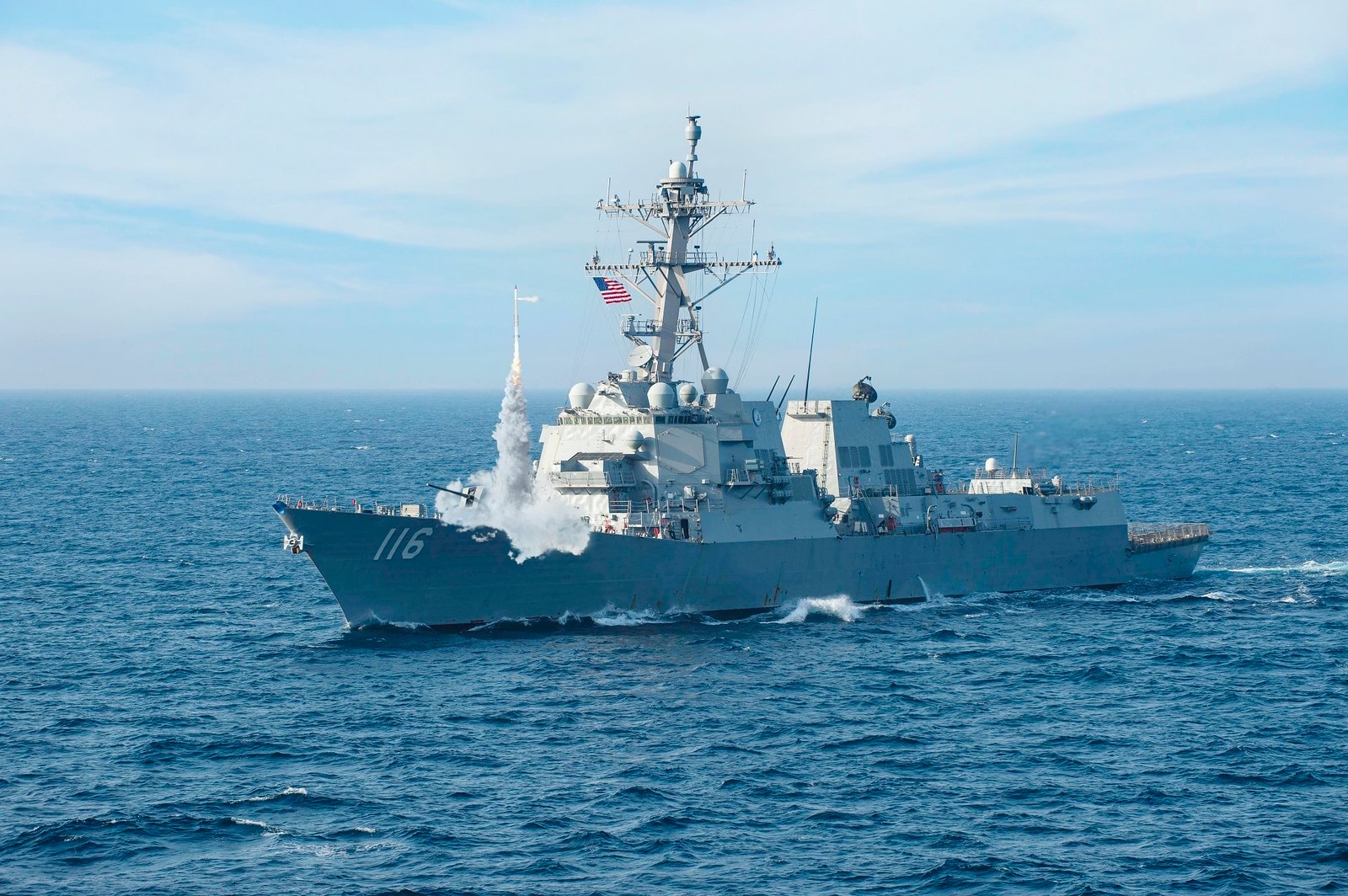
NATIONAL HARBOR, MD — The U.S. Navy is moving forward with PAC-3 MSE integration on the service’s surface fleet in a move to rapidly expand interceptor inventories, pushing forward a capability that Lockheed Martin has been developing for nearly a decade, according to its top missile defense executives. The deal was announced on April 21, 2026.
Jason Reynolds, Vice President and General Manager at Lockheed Martin Missiles and Fire Control, IAMD, and Chandra Marshall, Vice President and General Manager at Lockheed Martin Rotary and Mission Systems and Multi-Domain Combat Solutions briefed reporters on the new contract award at the Sea Air Space 2026 Symposium in National Harbor, Maryland.
“We’ve been working on this for nearly a decade at Lockheed Martin,” Reynolds told reporters during the briefing. “Investing our own [internal research and development funds] to bring this capability into reality. And what we’re gonna do is show you that these battle-tested capabilities are going to be working better together.”
Naval News has covered Lockheed Martin’s work on a navalized PAC-3 MSE capability for several years as the company has matured its canister and launcher modifications to meet the needs of maritime launch. Various executives have outlined the requirements, with the final hurdle often cited as a contract award from the U.S. Navy to begin work. Lockheed Martin has already tested PAC-3 MSE in a ground-based Mk 70 Mod 1 containerized launcher, a road-mobile adaptation of the surface fleet’s Mk 41 VLS.

The $200 million award is crossing the final hurdle, setting up an opportunity for the U.S. Navy to purchase hundreds of interceptors from a production line that is already in the process of expanding threefold to meet demand signals. The U.S. Navy has already been earmarked 405 PAC-3 MSE interceptors in the U.S. President’s FY2027 budget.
PAC-3 MSE has already proven itself across multiple theaters—EUCOM and CENTCOM—as a high-end interceptor capable of engaging hypersonic threats. “We’ve been battle proven in Ukraine to go against hypersonic threats,” Reynolds said during the briefing. PAC-3 MSE has also been used in combat to defend Gulf states across the Middle East with extremely high kill rates. That combat effectiveness has led to an unprecedented surge in demand and interest.
“PAC-3 MSE is the most capable air defense weapon on the planet, going in with Aegis, the most capable combat system on the planet.”
Jason Reynolds, Vice President and General Manager at Lockheed Martin Missiles and Fire Control, IAMD
Integrating the missile with Aegis requires changes to the missile’s command guidance radio frequencies and changes to missile canisters for Mk 41 VLS compatibility. Additional software changes to the Aegis platform and the missile itself are also required, but Lockheed Martin anticipates a first land-based test in early 2027. Initial operational capability (IOC) is scheduled for 2028 when the first ship is scheduled to deploy with navalized PAC-3 MSEs.
“We’ll be looking to introduce this capability as soon as possible. We’ll be doing a land-based test this time next year. We’ll take it to sea in 2028 and that will be IOC.”
Jason Reynolds, Vice President and General Manager at Lockheed Martin Missiles and Fire Control, IAMD
Lockheed Martin hopes the U.S. Navy will capitalize on their large industrial base and wide range of suppliers for PAC-3 MSE—a driving force behind the growth of the missile’s production rate that will build year after year through 2030. At the same time, PAC-3 MSE will offer the fleet a high-end interceptor known to have shot down both air-breathing hypersonic missiles and maneuvering aero-ballistic missiles in combat.
