

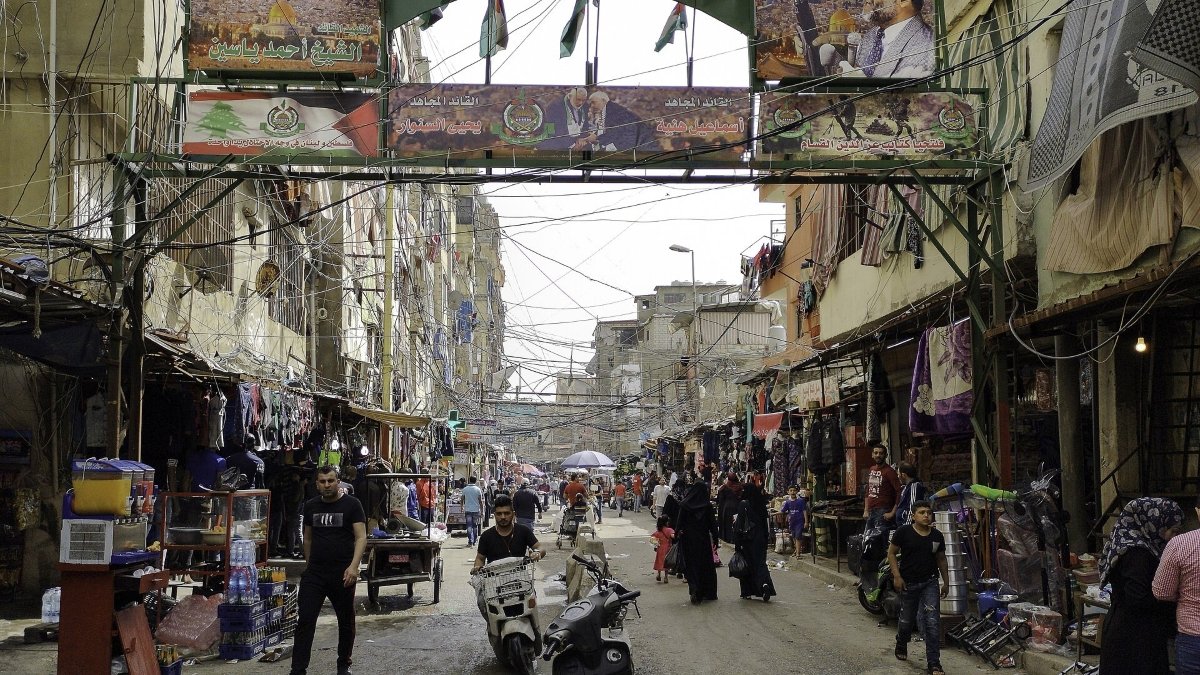
Inside Lebanon, the conditions for the next extremist uprising are quietly taking root.
In the summer of 2007, the Lebanese Armed Forces fought Fatah al-Islam for three months inside Nahr al-Bared, a Palestinian refugee camp in northern Lebanon. Fatah al-Islam was a Salafi-jihadist group that exploited the camp’s power vacuum to establish a strong recruitment base, drawing recruits from Palestinian, Syrian, and broader Arab networks. Once the dust settled, more than 400 people were dead, and the 30,000 residents of Nahr-Bared were displaced for a second time. The very same conditions that led to the Nahr al-Bared clash are reassembling now, across a broader geography, with fewer safeguards in place.
Lebanon’s Palestinian and Syrian displacement zones have merged on the ground. The two institutions that historically kept radicalization in check, the U.N. Relief and Works Agency for Palestinian Refugees in the Near East and Hizballah, have both collapsed as functional buffers. Further, a stateless second generation is coming of age with no legal anchor to any state and the policy response from Beirut, Western donors, and Washington continues to treat an emerging security problem as a humanitarian file that someone else will manage. That approach is accelerating the crisis rather than containing it.
The challenge is significant but not unmanageable and several steps would materially alter the trajectory without requiring new mandates or significant additional resources. Western donors should redirect existing humanitarian budgets to replace the service functions the agency can no longer perform, the Lebanese government’s disarmament process should be paired with verifiable commitments on Palestinian civil rights if it is to reach the armed groups that matter, and Washington should begin treating Syrian and Palestinian displacement zones as a single integrated security environment rather than two separate humanitarian crises. What fills the vacuum left by collapsed institutions will define Lebanon’s security environment for the next decade.
A Refugee Convergence
Lebanon currently hosts roughly 222,000 Palestinian refugees and more than one million Syrian refugees, the highest refugee density per capita of any country in the world. For decades, these populations existed side by side — geographically close but institutionally separate, each with its own aid networks and political relations with Beirut. But now the separation is gone. Palestinian camps in southern Lebanon and Beirut’s southern neighborhoods — notably Ain al-Hilweh, Shatila, and Burj al-Barajneh — now sit alongside or within dense Syrian displaced population zones. Lebanon’s “no-camp policy” for Syrian refugees has forced them into informal settlements in the Bekaa Valley and into the margins of existing Palestinian camps, further crowding communities already under extreme pressure.
The Israeli ground invasion that began on March 2, 2026, triggered by Hizballah’s decision to enter the Iran-Israel conflict, has dramatically accelerated this convergence. Israeli evacuation orders have directly targeted Palestinian refugee camps in the south — including Rashidieh, Burj al-Shemali, and el-Buss near Tyre — and Israeli strikes have hit Shatila and Burj al-Barajneh in Beirut’s southern suburbs. More than one million people have been displaced since March 2, with Syrian and Lebanese displaced families now flooding into Palestinian camps in the north, reversing the pre-war dynamic and creating new layers of overlapping displacement inside the same physical area.
Despite this geographic convergence, Palestinian and Syrian refugee populations continue to be managed as entirely separate humanitarian issues. The U.N. Relief and Works Agency for Palestinian Refugees in the Near East carries the Palestinian mandate, while the U.N. High Commissioner for Refugees carries the Syrian one. Each has different funding streams, different service networks, and different political relations with Beirut. This institutional separation, which reflected a practical logic when the populations were physically separated, no longer maps neatly onto reality on the ground, and it produces a systemic blind spot in how both donors and policymakers assess the security environment inside Lebanon’s displacement zones.
The Collapse of the U.N. Relief and Works Agency for Palestinian Refugees in the Near East
For Palestinian refugees in Lebanon, the U.N. Relief and Works Agency for Palestinian Refugees in the Near East was not a supplementary aid agency, it functioned as a government. Palestinians in Lebanon are barred from the public sector, prohibited from owning property, and excluded from dozens of licensed professions. Therefore, the agency’s schools, clinics, and social services served as the entire institutional scaffolding around which daily life in the camps was organized. As the agency’s Lebanon director, Dorothee Klaus, previously told U.N. News, “There is no other actor that has the resources and is capable to step in.”
That scaffolding is now collapsing. Following U.S. withdrawal of funding under the Trump administration and a broader donor retreat triggered by Israeli allegations against the agency staff, the agency’s Beirut office projects a shortfall of approximately $220 million in 2026. The Israeli ground invasion has transformed this funding crisis into an acute operational emergency. The agency suspended services across its camps in the Tyre area within days of the offensive beginning, while Israeli strikes damaged clinics in Burj al-Barajneh and forced the suspension of health and education services across southern Lebanon. The agency that was already struggling to maintain basic service delivery is now simultaneously running an emergency displacement response with resources it doesn’t have. This funding shortage has led to tangible consequences, including the closure of five schools in Ain al-Hilweh, the dismissal of nursing staff, the decrease in clinic operating days, and the cutting of medical referral budgets — the mechanism by which residents access care outside the camp. Eighty percent of Palestinian refugees in Lebanon already live below the national poverty line, a figure the agency estimates stood at 93 percent before its cash assistance programs were introduced in Lebanon.
Schools are not only for education — they are structured time, adult supervision, and a tangible investment in the future. When they close, young Palestinians are left unsupervised in environments where recruiters from violent extremist organizations can provide money, identity, and community. Ain al-Hilweh has long served as a base for Salafi-jihadist groups including Asbat al-Ansar, Jund al-Sham, and Kataib Abdullah Azzam, and their appeal expands in direct proportion to the institutional vacuum around them.
The Degradation of Hizballah’s Policing Function
Hizballah’s relationship with Palestinian refugee camps was never charitable; it was strategic. Groups hostile to Hizballah — including Salafi-jihadist networks that used Ain al-Hilweh as a base for suicide bombings against Hizballah targets — gave the group a direct organizational stake in the security environment inside the camps. Hizballah maintained this stake not through direct presence inside the camps, which Lebanese law prohibits, but through factional relationships with Palestinian groups that depended on its patronage. Those relationships created informal monitoring networks that made it considerably harder for outside Salafi recruiters to operate freely in territory Hizballah treated as part of its own strategic buffer. The suppression of radicalization was a byproduct of competition, not solidarity, but its effect on recruitment was real.
Israeli strikes in 2023 and 2024 decimated Hizballah’s leadership and significantly degraded its organizational capacity. Under the Nov. 2024 ceasefire agreement between Israel and Lebanon, Hizballah withdrew from positions south of the Litani River, and its informal intelligence networks that had once monitored the camp populations across southern Lebanon and the Bekaa Valley grew thinner. The Israeli 2026 ground invasion has compounded this degradation further. Israeli forces have expanded their operations south of the Litani River with the stated aim of establishing a permanent buffer zone — a posture that, if sustained, would entrench the security vacuum in precisely the geographic areas where Palestinian and Syrian displacement is most concentrated. Therefore, the deterrent effect on outside recruiters operating in Ain al-Hilweh, Shatila, and adjacent Syrian displacement zones has been diminished.
The Lebanese government has moved to fill this gap through formal Palestinian disarmament, with initial weapons transfers from Burj al-Barajneh and several southern camps beginning in Aug. 2025, but the process is partial by design. Hamas and Palestinian Islamic Jihad publicly declared the transfers an internal Fatah matter and declined to participate, while smaller Salafi groups including Usbat al-Ansar and Jundallah were not party to any disarmament discussions at all. The groups most likely to exploit an internal security vacuum are precisely the ones that have opted out of the process meant to manage it.
The Second Generation Problem
Both crises have a generational dimension that Lebanese authorities, Western donors, and U.S. policymakers have not adequately addressed. Syrian children who arrived in Lebanon as children or were born there are now entering adolescence. According to U.N. High Commissioner for Refugees, only half of Syrian refugee children in Lebanon are enrolled in primary school, with secondary enrollment collapsing to just 15 percent, with tens of thousands more blocked from formal enrollment because they lack valid proof of legal residency in Lebanon, documentation most Syrian refugee families cannot obtain. Many hold no legal status recognized by any state, no realistic path to return to their home country, and no right to Lebanese residency or formal employment. They are stateless in practice, aging into a labor market from which they are structurally excluded.
This is an especially salient point as the radicalization literature identifies a convergence of material grievance, identity crisis, and institutional abandonment as the enabling conditions for radicalization and recruitment. Stateless adolescence — no documentation, no legal employment, no institutional anchoring — checks all three. Lebanon’s displacement zones now present those conditions simultaneously across two populations whose specific grievances differ but whose daily circumstances have converged.
The Wrong Response
Washington’s response to Lebanon’s displacement crisis has been to largely delegate it. U.S. policy since the Nov. 2024 ceasefire has concentrated almost entirely on Hizballah disarmament and Israeli withdrawal sequencing, leaving the collapsing international humanitarian system to manage the displacement environment. Further, the Lebanese government’s response has moved in the wrong direction. As Beirut tightened Syrian residency enforcement, accelerated repatriation pressure, and reduced formal engagement with Palestinian and Syrian camp communities, Western donor governments defunded the agency without creating an alternative service delivery mechanism. Further, the Lebanese government tends to view Salafi militancy primarily through a security lens — mass detention, surveillance, and suppression — which risks producing in Lebanese prisons the very radicalization it is attempting to prevent.
The practical effect of securitization without service provision is not a reduction in Lebanon’s displacement burden; it is a reduction in the visibility and manageability of that burden. Populations pushed further from institutional contact are harder to monitor, more economically desperate, and more accessible to organized recruitment networks. Moreover, while this crisis boils under the surface, Washington has largely been absent from this dimension of Lebanon’s crisis. The radicalization environment developing inside Lebanon’s displacement zones is not a humanitarian problem that can be separated from the security agenda. It is the security agenda, operating on a slower timeline than missile trajectories but with consequences that will outlast the current ceasefire.
What Responsible Policy Would Look Like
Three adjustments would meaningfully reduce the radicalization risk without requiring significant new resources.
First, the United States and its European partners — the United Kingdom, Germany, France, and the European Union represent the agency’s largest historical donor base — should reframe their approach to the agency. Cutting funding to the agency on political grounds is a choice with security consequences, not just humanitarian ones. If donors are unwilling to restore the agency funding, they cannot simply walk away from the service structure that the agency built. Practically, this means redirecting existing humanitarian budgets toward direct service delivery in the camps. Those budgets — currently flowing through the U.N. International Children’s Emergency Fund, the European Union’s humanitarian arm the Directorate-General for European Civil Protection and Humanitarian Aid Operations, and bilateral donors including Germany, France, and the United Kingdom — could fund Lebanese non-governmental organizations, sustain the agency’s existing clinic and school infrastructure under alternative management, or expand the U.N. High Commissioner for Refugees programming to explicitly cover Palestinian as well as Syrian populations.
Second, Lebanon’s disarmament process in Palestinian camps should be paired with concrete, verifiable commitments on Palestinian civil rights if it is to reach the armed groups that actually pose a recruitment risk. Specifically, this means lifting the ban on Palestinians working in the licensed professions currently closed to them, extending residency documentation to Palestinian refugees from Syria whose permits have been frozen since May 2024, and granting Palestinians access to the National Social Security Fund on equal terms with Lebanese workers. These are not abstract demands — non-participating factions have explicitly conditioned their cooperation on concrete improvements to Palestinian rights and security guarantees, and addressing them is the only realistic path to a disarmament process that reaches beyond Fatah.
Third, U.S. policymakers engaging Lebanon should begin treating Syrian and Palestinian displacement zones as a single integrated security environment, not two separate humanitarian files. The institutional boundary between them is already gone on the ground and policy that ignores that convergence will consistently misread what is happening inside it.
The ongoing Israeli ground invasion also reframes the urgency of what is unfolding. Institutional collapse, a security vacuum, and a stateless generation are no longer distant concerns. They are present, and they are being intensified in real time. The U.S. brokered ceasefire that began on April 16, 2026, has since been extended by three weeks, but Israel continues to strike southern Lebanon and Hizballah dismisses the truce as meaningless. Even if the fragile ceasefire holds, the displacement environment it leaves behind remains ungoverned, underfunded, and unaddressed. The structural conditions will outlast any pause in hostilities, and policy that waits for the guns to fall silent before addressing the displacement environment will find that the window for intervention has already closed. Lebanon has managed its displacement burden for over seven decades by containing its worst consequences rather than resolving them, but the institutions that enabled that containment are now gone.
The 2007 Nahr al-Bared conflict was possible because a camp’s institutional collapse went unmanaged until it was too late. Currently, the conditions for something worse are being assembled in more camps, with fewer safeguards. The question is not whether Washington will eventually pay attention. It is whether it will pay attention before or after the next inflection point forces the issue.
Jack Schwartz, Ph.D. is a national security professional and regional expert specializing in Middle East security, counterterrorism, and political dynamics across the Arab World. He holds a Ph.D. in political science and writes on Middle East security and conflict at Insurgency Report on Substack.
Image: Wikimedia Commons
