

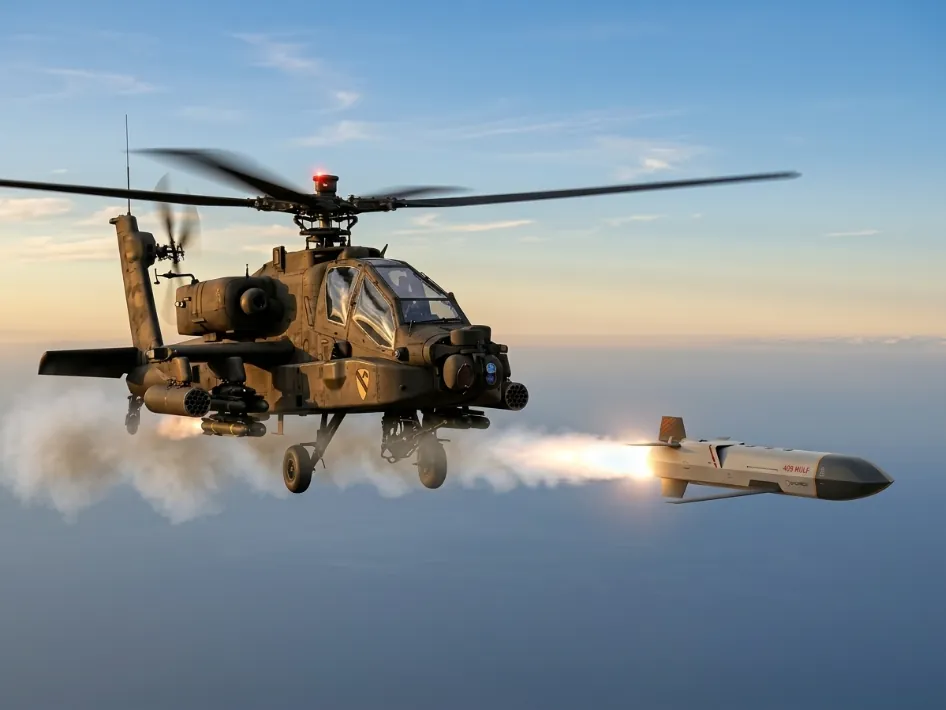
Defense Feeds, Nashville – The U.S. Army faces a stark reality in the Pacific: current Apache and Black Hawk helicopters lack the range to engage modern threats effectively. L3Harris is pitching a solution that fundamentally reshapes rotary-wing aviation.
The company’s Wolf Pack cruise missiles Apache integration extends strike capability from single-digit kilometers to hundreds of kilometers, transforming platforms built for close-range support into multi-domain strike systems.
At the Army Aviation Association summit this week, L3Harris’s strategy director, explained the core problem. Modern helicopters operate in contested airspace filled with advanced air defenses and distributed threats. Traditional weapons systems like the Hellfire missile offer engagement ranges of just 7 km. Against peer adversaries with sophisticated air defense networks, that distance is a death sentence.
L3Harris Wolf Pack Cruise Missiles Transform Apache Helicopter Capability with modular launched effects vehicles designed for affordable mass procurement. Red Wolf handles kinetic strikes. Green Wolf provides electronic warfare and air defense suppression. Together, they work as coordinated packs performing missions that individual aircraft cannot accomplish alone.
Modularity Meets Operational Flexibility
The genius of Wolf Pack cruise missiles Apache design lies in payload interchangeability. A single helicopter can carry multiple variants on one mission. Pilots launch Green Wolf first to scout the electromagnetic environment and identify threats. That data feeds DISCO, L3Harris’s AI-driven targeting software, which maps threat locations across ground and air domains in real time.
Once the picture becomes clear, pilots have tactical choices. Avoid identified threats, suppress them with electronic attack, or engage them kinetically with Red Wolf variants. The missiles coordinate autonomously, communicating with each other and deconflicting search patterns across large areas. When multiple Red Wolves launch together, they work collaboratively toward shared objectives.
That collaborative behavior inspired the Wolf Pack name. These are networked systems operating as coordinated units under pilot command. They search collaboratively, identify targets together, and execute missions with synchronized precision. It’s a revolution in how unmanned effects support manned platforms.
The modularity extends to production. Both Red Wolf and Green Wolf variants share common platforms, turbine engines, navigation systems, and structural components. L3Harris designed production using WOSA—Weapon Open Systems Architecture—to allow rapid payload swaps and streamlined manufacturing. The company has already built scalable production plans capable of ramping toward one thousand missiles annually.

Cost Advantage and Scalable Production
L3Harris prices Wolf Pack cruise missiles Apache at approximately five times cheaper than legacy weapons systems currently fielded. The company targets a cost point of $300,000 to $500,000 per round, hitting the sweet spot for affordable mass procurement. That price advantage is critical because Pentagon strategy for Pacific conflict hinges on one reality: quantity matters.
The Air Force and Army need capability they can buy in volume without breaking budgets. Exquisite, expensive weapons won’t solve problems of distance and distributed targets. Wolf Pack delivers capability in scale without astronomical costs.
The modular design also reduces supply chain complexity. Common components across variants mean simpler logistics, faster maintenance, and reduced inventory management. If demand spikes beyond current projections, L3Harris has designed production capacity to surge significantly above one thousand per year.

Strategic Transformation and Multi-Domain Capability
Wolf Pack cruise missiles Apache integration represents more than capability enhancement. It’s a strategic transformation of Army aviation’s role in joint operations. Current helicopters excel at supporting ground troops within visual range. Wolf Pack enables helicopters to strike maritime targets, suppress air defenses, and support ground operations from standoff distances.
An Apache equipped with Red Wolf can engage enemy naval vessels at ranges previously impossible for rotary-wing platforms. A Black Hawk transport can provide sustained fire support across hundreds of kilometers while remaining outside air defense engagement zones. This shifts Army aviation from close-range support into a true peer contributor to multi-domain operations.
Secretary of Defense Pete Hegseth’s April 2024 memo on launched effects specifically called for urgent fielding of these systems. The Pentagon recognizes that future conflict depends on speed, distributed operations, and overwhelming strike volume. Wolf Pack directly supports that vision.
For Army aviators, Wolf Pack integration means extended combat relevance, dramatically increased lethality, and improved survivability through extended-range engagement. For Army Aviation as a service branch, it means transformation from supporting arm into a true contributor alongside tactical aviation in joint warfare.
Brad Reeves articulated the urgency plainly: “If I were young enough to be flying in that fight, I would want more capability. The U.S. Army needs this, and I believe they want it. It’s a game-changer.”
That assessment reflects Pentagon thinking. Wolf Pack cruise missiles Apache integration isn’t incremental improvement. It’s transformational capability that reshapes how American forces operate in contested environments, moving from close-range concentration to distributed, extended-range strike networks.
