

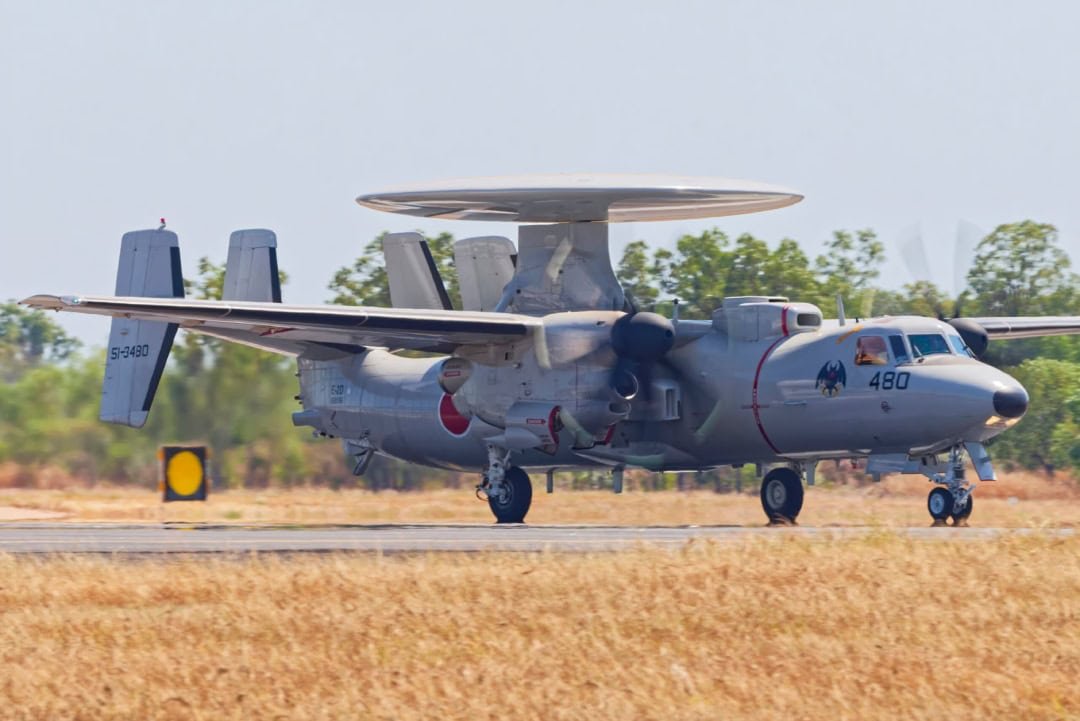
Japan deployed two Northrop Grumman E-2D Advanced Hawkeye airborne early warning and control (AEW&C) aircraft to the multinational Exercise Pitch Black 2026 in Australia’s Northern Territory.
Running from 20 July till 7 August, the exercise series is Australia’s premier air combat training event, with this year’s iteration featuring over 100 aircraft and 2,500 personnel from 20 nations.
The pair of Japan Air Self-Defense Force (JASDF) E-2Ds formed part of Japan’s contribution to the exercise, alongside six Lockheed Martin F-35A fighters.
Both the E-2Ds and F-35As deployed from Misawa Air Base, with the former operated by the Airborne Warning & Control Wing’s 601st Squadron, and the latter drawn from the 3rd Air Wing.
Speaking to journalists at the exercise, including Asian Military Review, E-2D crewmember Lieutenant Shogo Wakahara said, “Exercises like Pitch Black provide opportunities to train alongside partners such as Australia, helping to enhance our interoperability and mutual understanding.”
Wakahara continued, “This is my first time taking part in a large-scale exercise involving so many countries. The biggest takeaway is the importance of training with a wide range of partners and learning how to work together.”
Together with other AEW&C platforms participating in Pitch Black – Australia’s E-7A Wedgetail and Singapore’s G550 AEW – the E-2Ds served as force multipliers providing airborne command and control, force marshalling and battlespace management.
The AEW&C platforms could be assigned to either the friendly or adversary force.
The E-2Ds relied on Link 16, the most commonly employed tactical data link during the exercise, to network with other participants. They are also equipped with the Cooperative Engagement Capability (CEC) system, enabling them to network with maritime assets, though this ability was not used during the exercise.
Wakahara indicated that Australia’s vast airspace enabled training on a scale and complexity that is not possible in Japan’s congested airspace.
He added that the exercise was also conducted predominantly over land, unlike the maritime environment in which JASDF E-2s typically operate.

The E-2D detachment, comprising about 50 personnel, arrived in Australia two weeks ahead of Pitch Black to take part in Exercise Southern Cross alongside the F-35As.
This new trilateral Australia-Japan-US high-end air combat exercise, also conducted over the Northern Territory, aims to enhance interoperability among F-35A operators from all three nations.
Wakahara noted that, while Pitch Black provides large-force employment scenarios, Exercise Southern Cross delivered higher-end training focused on the employment of fifth-generation fighters.
Japan continues to receive the 18 E-2Ds it ordered in three tranches over the past decade, replacing E-2Cs that have served since the late 1980s. Initially assigned to the 601st Squadron at Misawa, the type has also begun entering service with the 603rd Squadron at Naha.
Unlike US Navy E-2Ds, JASDF Advanced Hawkeyes incorporate a “wet wing” design with integral fuel tanks, extending their endurance to up to eight hours.
Alongside the JASDF’s four E-767s, Japanese E-2s are heavily tasked with monitoring frequent Chinese and Russian military aircraft flights operating around Japan.
by Roy Choo
