

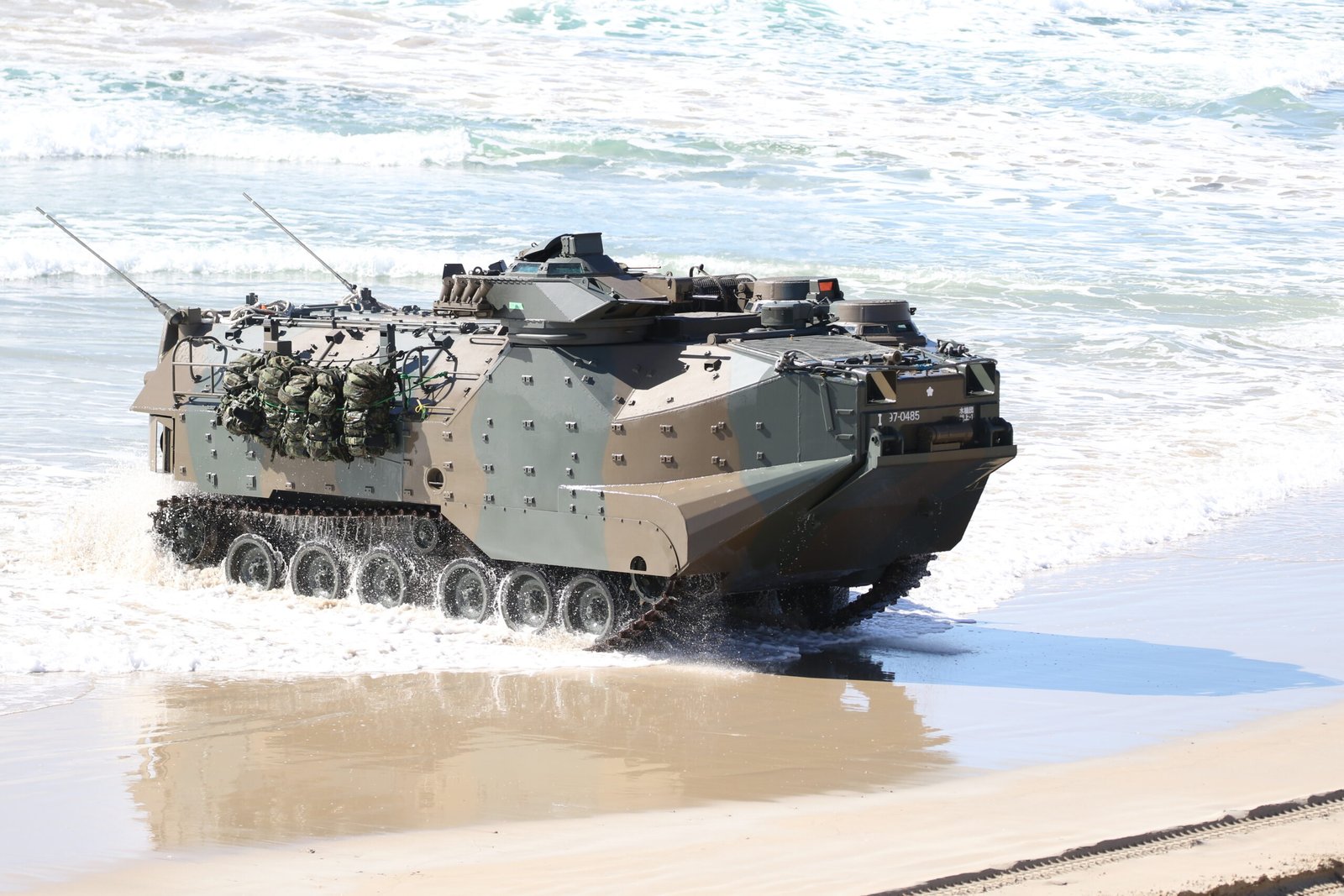
Japan’s Acquisition, Technology & Logistics Agency (ATLA) is developing a new amphibious assault vehicle to support future operations of the Japan Ground Self-Defense Force (JGSDF).
The initiative, being conducted by Japanese firm Mitsubishi Heavy Industries (MHI), is developing a follow-on to the current AAV7A1 RAM/RS amphibious assault vehicle acquired from BAE Systems.
Prototyping and initial research is now moving to producing four vehicle testbeds, including at least one unmanned vehicle, an effort that will continue through till 2027.
The ATLA project, according to public presentations, includes development of both a crewed amphibious vehicle and an unmanned vehicle. The approach will allow remote control from another vehicle with autonomous manoeuvring.
This manned-unmanned teaming operational concept envisions employing an initial assault wave of unmanned vehicles that would suppress defences and secure the beach for successive manned waves.
The current programme draws from the ATLA Future Amphibious Technology Research (FAT-R) project that was revealed at the International Armoured Vehicles (IAV) 2023 conference. At that time, ATLA representatives indicated that, following several years of computer-assisted design and subscale prototyping, a full-sized technology testbed had been built.
Testing of this testbed validated its ability to overcome coral reefs, for example.
The next-generation amphibious vehicle (which MHI also referred to earlier as the MAV, standing for Mitsubishi Amphibious Vehicle) is anticipated to have a combat weight of around 40 tonnes, and it may draw from other associated ATLA development projects.
These include “Tera Ninja” hydropneumatic suspension, improved waterjets, advanced power-assist technology to overcome offshore reefs, and a V8 12MB engine producing 3,000hp. Its exceptional power-to-weight ratio suggests high water speeds using a planing hull approach.

The vehicle is projected to carry up to ten embarked troops plus its crew, and to be equipped with a remote weapon station on the roof.
Japan’s FY2024 defence budget allocated JPY21.1 billion (US$143.5 million) to the unmanned vehicle. Mitsubishi had shown a scale model of its MAV concept at the MAST Asia 2019 exhibition.
The JGSDF anticipates a total requirement of 97 vehicles for its Amphibious Rapid Deployment Brigade (ARDB). The ARDB, formed in 2018, is intended to support the defence of Japan’s southernmost archipelago, including Okinawa.
The AAV7, fielded in its original form by the US Marines Corps in 1971, although updated several times, has limitations in meeting current and future operational requirements.
Japan’s development objectives are therefore to field a next-generation vehicle that has a significantly higher water speed than the current AAV7’s 6.5kt, as well as improved sea stability that is greater than the current Sea State 3 performance, and up-gunning to a 30mm autocannon.
by Stephen W,. Miller
