

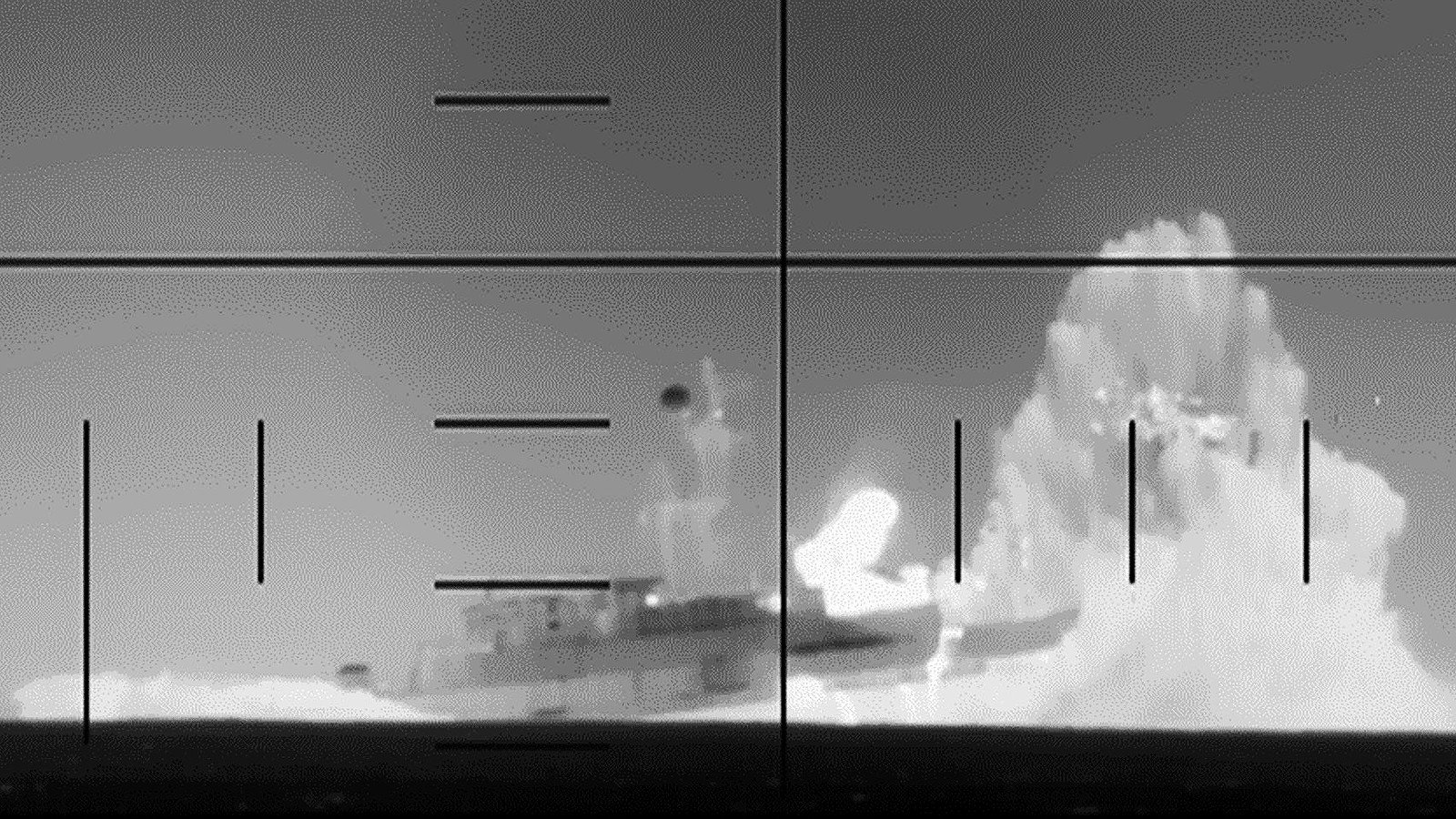
For the first time since the end of World War II, a US Navy submarine has torpedoed and sunk an enemy combatant, in this case IRIS Dena of the Islamic Republic of Iran Navy (IRIN). The action occurred on 4 March, amidst an intensive Israeli and US attack against Iran.
The Iranian Moudge-class frigate was sunk by a Mk 48 torpedo fired by a US nuclear-powered submarine, with some media reporting it was the Los Angeles-class attack submarine USS Charlotte. The attack occurred in the Indian Ocean off the southern coast of Sri Lanka. Reports vary as to how far away the Iranian warship was exactly, but India stated it was 20nm from the Sri Lankan port city of Galle.
The sinking was confirmed by US Defense Secretary Pete Hegseth, who also released video imagery of the attack. “Yesterday in the Indian Ocean…an American submarine sunk an Iranian warship that thought it was safe in international waters.”
However, his claim that it was “the first sinking of an enemy ship by a torpedo since World War II” is erroneous.
The Pakistan submarine PNS Hangor sank the Indian frigate INS Khukri during the Indo-Pakistan War of 1971, while the Royal Navy submarine HMS Conqueror sank the Argentinian battleship General Belgrano during the 1982 Falklands War. A North Korean mini-submarine also sank the South Korean corvette ROKS Cheonan in 2010.
Sri Lanka responded to a distress call from the 1,500-tonne IRIS Dena, rescuing 32 crew and recovering 87 bodies to date. The frigate had a complement of 130, according to Iran.
The frigate had been commissioned into the IRIN in June 2021, and had been attending an international fleet review in India, as well as the Indian-led Exercise Milan, in February. Dena carried two triple 324mm torpedo launchers, so it did possess an anti-submarine warfare (ASW) capability.
Dr. Collin Koh, Senior Fellow at the S. Rajaratnam School of International Studies in Singapore, tweeted, “IRIS Dena is equipped for ASW. The crew might not have maintained proper alert posture, or that it did man battle stations but was outmanoeuvred and outshot by the submarine. We’ll never know. If it had no chance to even fire a shot, it’s normal to expect in this type of game.”

Iranian Foreign Minister Abbas Araghchi said the USA had “perpetrated an atrocity at sea, 2,000 miles away from Iran’s shores”. Further, Dr. Mohammad Fathali, Iran’s Ambassador to India, claimed, “This ship was unarmed and in a regular manoeuvre at sea.”
However, asked in an ABC interview whether the US submarine had acted illegally, Australian National University Professor Don Rothwell responded: “The USA did have a right as a combatant to be able to target the Iranian warship even though it was in international waters, in the Indian Ocean, off the Sri Lankan coast. There’s no real issue there in terms of international humanitarian law and the legitimacy of US targeting of this vessel.”
The USA has destroyed more than 30 Iranian naval vessels in the war so far, with one objective being to defang the Iranian navy.
A second Iranian ship, the 3,300-tonne tanker IRIS Bushehr, later sought refuge in Sri Lanka. It entered the country’s exclusive economic zone, and Colombo confirmed on 5 March that it had interred the ship after an agreement was reached with the captain and Iranian officials.
Sri Lanka’s navy started transferring the 208 crew to Welisara Naval Base on the outskirts of Colombo, while the vessel will be transferred to the eastern port of Trincomalee.
A third Iranian vessel had also requested permission to dock in Sri Lanka, but its current whereabouts is unknown.
President Anura Kumara Dissanayake insisted that Sri Lanka was maintaining its neutrality. “We are not biased towards any state, nor are we subordinate to any state. We act as a free and sovereign nation.”
by Gordon Arthur
